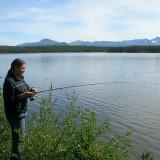
Editor’s Note: In the wake of two major developments regarding the highly controversial proposed Prosperity Mine – the Harper Government’s decision to provide Taseko Mines a new environmental review for an alternate version of the project and the BC government’s issuing of road building and exploration permits to the company, over First Nations opposition – David Williams of Friends of Nemaiah Valley provides a candid summary of the enormous environmental and cultural implications of the proposed mine. This is the first story from our new op-ed blog, Your Voice.
———————————————————————————
Earlier this week, we at Friends of the Nemaiah Valley (FONV) heard that the Canadian Environmental Assessment Agency (CEAA) has agreed to conduct an environmental assessment of Taseko Mines Ltd. (TML) proposed “New Prosperity” mine application in Tsilhqot’in territory.
This unfortunate decision is misguided for many reasons. This is the third try by TML to develop this mine, one of the largest gold/copper deposits in British Columbia. It was turned down twice in the recent past because the environmental consequences would be too great. Even by Taseko’s own admission during hearings last year, this “tweaked” proposal, then known as Option II, would have even worse environmental consequences than the one rejected by the federal government.
While there are environmental reasons to reject this mine – it is in prime grizzly habitat, will destroy a large rainbow trout population, and threatens large salmon runs that are part of the Fraser River fishery – it is the impact it will have on the local Xeni Gwet’in community in the Nemaiah Valley that I want to focus on.
Picture a “camp” of up to 600 miners placed into a remote First Nations Community that is still largely dependent upon the land for sustenance and identity. This camp will be in place for up to 35 years. 250 Xeni Gwet’in, the People of the Rivers, live in the Nemaiah Valley alongside a small settler community of about fifty people. The latter operate small ranches, run wilderness lodges, fish, hunt and trap, and just like the way of life that prevails here.
Xeni Gwet’in, like indigenous people everywhere, identify with their land. They see themselves as part of it and view any action that destroys any part of it as an assault upon their very being. These days Tsihqot’in culture is recovering from the onslaughts of the colonial era; displacement from places they have relied upon for survival for virtually forever, the reserve system, and residential schools that were designed to destroy their language and culture. That recovery is well advanced in the Nemaiah Valley. Fully 50% of the food consumed comes directly from the land and includes salmon and trout from Nabas.
Consequently they have the lowest diabetes rate in British Columbia. The Tsihlqot’in language, almost lost a few years ago, is now taught in the local school. Peter Brand, Director of the brilliant First Voices programme, says that of all the places he visits across the province the Nemaiah Valley Xeni Gwet’in live closest to their traditional way of life.
An ethic of caring for their land lies deep within the culture.
Chief Marilyn is one of three Xeni Gwet’in co-authors interviewed by Jonaki Bhattacharyya, doctoral candidate at the University of Waterloo. (It’s Who We Are: Locating Cultural Strength in Relationship with the Land, a chapter in a forthcoming book published by UBC Press).
“You need to teach about the importance of caring for water and resources as early as you can! And that’s how the language is learned.
The Tsilhqot’in language is where the deepest strength of who we are and how we’re tied to the land really is.”
Speaking of the panel hearings into Prosperity Mine specifically specifically Marilyn says:
“Our community here, Xeni Gwet’in…we went into the CEAA Panel hearings thinking that we weren’t going to have enough speakers. That was always the fear in all the communities. Because that is a very threatening, intimidating process! Even to us, as leaders! But…our people did just tremendously. It would blow your socks off! Our Elders, our people…just being there, filling the room all those days, and being here those long hours. You couldn’t chase them away if you wanted to. They’d probably chase you away! [laughs] And our youth, the school, all of the kids… The senior class decided to do some submissions. They did a beautiful job. And the intermediate class, they did a play. That was so amazing! They did such a tremendous job. The strength and the voices of everybody in the Tsilhqot’in communities…”
From the same chapter by Bhattacharyya, Xeni Gwet’in Wild Horse Ranger David Setah:
“I think in order to give, to find that strength…your kids should also know their past, your past histories… all that about being caretakers, Chilcotin War, all the legends. All that will lead them to who they are. And all that will strengthen them, because they know that they are actually Tsilhqot’ins, and they know their history. And they can go out there being proud because they know they’re connected to that area.
That’s one of my biggest goals is that we’re being caretakers. We’ve done it in the past, and with European contact and things like that, we can still do it. We must still keep in mind that we need to protect our rights. If we keep on in that fashion we’re just building ourselves a stronger nation, and it would be pretty hard for something to come in to affect us. The land is… to remain as a nation and to be recognized as a nation you need the land. We need to take care of the land. That’s what we did a long time ago. And that’s why we’re situated in the areas that we are: to take care of the land.”
Culture matters. These voices bring an important message. Indigenous cultures and languages are vital repositories of knowledge and custom that show a thousand ways to be human. Indigenous cultures, and a way of life still strong in the Nemaiah Valley, can teach us all how better to live in this land. Until we learn to show respect for the land, and for them, we will continue an ethic of endless growth that is having cumulative environmental impacts that threaten the very ecosystems that make life on this planet possible.
The people of Xeni are not unsophisticated. They and their settler neighbours and friends were opposed to Prosperity Mine last year. The new model is no better or even worse. They know what 600 miners running loose in their community will do to their way of life, to their land, and to their children. Drugs, alcohol and abuse will be an inevitable component. Mechanized recreation on a vast scale will destroy budding attempts by the community to build a local economy centred around wilderness and cultural tourism. There is plenty of precedent for similar disasters throughout Canada and in third world countries.
It is time to put an end to this colonialist venture if Canada is to maintain even the pretence of being a just nation.
David Williams is the President of Friends of the Nemaiah Valley

 Impress everybody with your literary taste. ISBN 978-1552854013.
 Make a fashion statement.