Read this story from The Province on today’s watershed press conference held by First Nations from around the province to deliver a unified, unwavering message of opposition to the proposed Enbridge pipeline to Kitimat.
“B.C. First Nation communities have formed a united front against
pipeline expansion and oil tanker traffic, as Enbridge Inc. pushes ahead
with its plan to build a pipeline from Alberta to Kitimat. Several
new First Nations signed on to the Save the Fraser Declaration Thursday
in Vancouver, bringing the total number of bands supporting a ban on
pipeline and tanker expansion to 130. Collectively, the signatories represent an ‘unbroken wall of opposition’ from the U.S. border to the Arctic Ocean.” (Dec. 1, 2011)
Watch this 2 min Global TV news story on the significant proposed increase in Tar Sands tanker traffic out of KinderMorgan’s terminal in Burnaby’s Burrard Inlet. (Nov. 21, 2011)
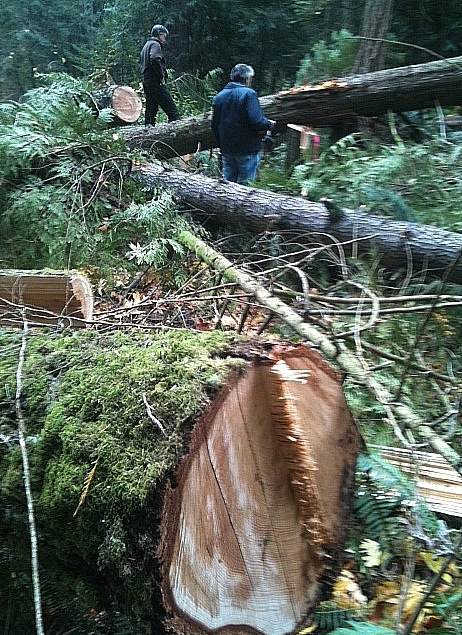
Early logging of DL33 before it was halted by protestors several weeks ago
One of the last remaining intact old-growth Douglas Fir groves on Vancouver Island is slated to be logged today, following an injunction last week against protestors who halted an earlier attempt to commence work. The forest, near Nanoose Bay, is known in logging parlance as DL33 and is home to red-listed Coastal Douglas Fir.
The issue is pitting environmentalists against the local First Nation, as the company doing the logging, Snaw-Naw-As Forest Services Ltd, is aboriginal-owned. But conservationists were shocked to learn at the BC Supreme Court this past Friday that the First Nation has already got a buyer lined up to purchase the logs – namely Timberwest.
A spokesperson for the Mid-Island Chapter of the Wilderness Committee slammed Timberwest’s involvement in a recent press release. “Timberwest is certified by the Sustainable Forestry Initiative (SFI) – which says on its website that: SFI labels are recognized globally and provide a visual cue to help customers source responsibly managed forest products,” said the Wilderness Committee’s Annette Tanner.
“And we also note that Timberwest’s website states that: ‘Protection of biodiversity is a key element of sustainable forest management and TimberWest continually strives to improve efforts to sustain key habitat for plants and wildlife. This endeavor is not only part of delivering on our social and environmental license to operate, it meets the increasing market demand for products from timberlands that have been independently certified as having high standards of environmental management,'” said Tanner.
Having successfully obtained an injunction against the protestors who interrupted early work at DL33 several weeks ago, it is expected the logging will commence today.
The Wilderness Committee and its supporters are focusing their attention on the would-be buyer of these old-growth Douglas Fir logs in a last-ditch effort to save this rare forest. An offer from Timberwest to purchase the logs, obtained by the Wilderness Committee, was dated October 24, suggesting the purchase agreement was likely the catalyst for this logging to commence.
It remains to be seen whether this negative publicity for Timberwest has any effect on the planned work or whether cancelling their contract with the First Nation would prompt its logging company to reconsider the project.
This, dear friends, is a plea for help. Let me illustrate that with an anecdote.
The great American attorney, Clarence Darrow once had a client praise him asking, “How can I help?” to which he replied, “Madam, since the Phoenicians invented money there’s only been one answer to that question.”
The Common Sense Canadian needs your help, which is especially so when you see what we and other organizations are doing up against corporations and governments which have an endless amount of money. For example, in the struggle to keep our power in BC’s hands we are up against General Electric and both the federal and provincial governments. With fish farms we’re fighting both senior governments and an industry which is immense.
The same applies with pipelines and tanker traffic – the enemy is both governments and endless corporation lucre.
Our need is magnified many times over by the corporatization of the major media.
We at the Common Sense Canadian also back, wherever we can, those fighting to save agricultural land and prime wildlife preserves. There are many valiant people and organizations with which we ally ourselves and they with us.
The leadership provided by Alexandra Morton, for one example, has had an extraordinary impact; as has the leadership of Donna Passmore, Rex Weyler, Jennifer Lash and Independent MLA Vicki Huntington. In naming these names I must say that there are many more, like the tireless Joe Foy and Gwen Barlee of the Wildlife Committee and indeed valiant fighters all around this province.
Now let me make this clear – we are not overwhelmed by the forces of environmental evil. Indeed we relish the fight; we’d prefer not to have a fight but if that’s what the bastards want, that’s what they’ll get. Most of us have been up against these forces for years and we know there will be many scars to come.
We at the Common Sense Canadian see ourselves as an outlet for others which is why we make space available for people to express their views. I would urge you to look at the quantity and quality of regular contributors. I assure you that you’ll be impressed by those who regularly contribute – for free on a regular basis. We also encourage others to pitch a blog through our pages.
In the absence of a mainstream media we try to take their place.
The task we face is bigger than groups like us, and you who help us, have ever faced. The governments and large corporations are coming at us on a massive mission that will scar our wonderful province for all time.
Every time we blink another army appears – recently it’s been the “frackers” who, going deep in the ground, with a massive use of water which they pollute beyond repair in the process, to capture huge quantities of gas not available through traditional drilling methods. This hasn’t been presented to us the citizens who need to know the answers to many questions; where do you get the water? Is that water that could and should be going to farmers and hydro electric facilities? What happens to that water after its been blasted with great force during the “fracking” process? Does it get into the water table and become unsafe to drink?
These questions are wrapped up in the issue of Site “C”. Quite apart from the normal and serious environmental concerns, is this power going to be delivered to fracking operations, coal mines and the Tar Sands so that we use an environmental nightmare to assist the biggest polluters on the planet?
These and many other questions should be determined by our elected officials after thorough consultation with all citizens and after a thorough airing in the House of Commons and the BC Legislature.
The environmental processes in place are a terrible disgrace. I’ve said this before but I’d almost prefer a root canal without anaesthetic than go to another. They are stacked. with all awkward questions being “out of order”, complete with a corporation-government cosiness that makes you want to vomit.
We can and do contribute to the common cause – just look at the great work my colleague Damien Gillis does with his camera and his insightful articles he does while I use my lungs and computer to try to get the message out. (To paraphrase the great Robert Benchley “it took me 15 years to learn that I couldn’t write but by that time I was too famous to quit.”)
As mentioned earlier, we the citizens face a force of environmental degradation, to the immense profit of outsiders who thus are unconcerned about environmental and, yes spiritual, matters with only the people as our soldiers. That won’t deter any of us but you can keep us in the fight with financial help.
Please join us, if you can, at my roast on Thursday at the Wise Hall 1882 Adanac Street where for $35 ($40 at the door) you can expect some very well known people give me the mickey as I enter my 9th decade.
Also, watch this coming Monday for the start of our Common Sense Canadian membership drive for– as we unveil our hip new t-shirt that promises to the must-have fashion item of 2012!
The following is a press release from hereditary leaders of the Wet’suwet’en and Unist’hot’en Nations of Northwest BC:
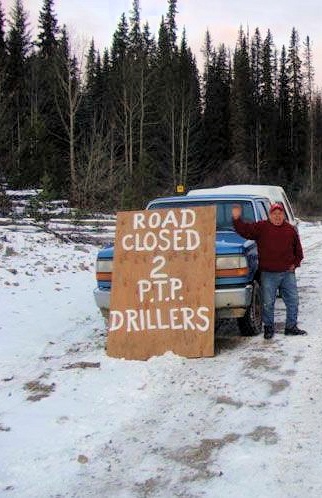
November 15, 2011 – Setting up a road blockade with signs “Road
Closed to Pacific Trails Pipeline Drillers”, an alliance of the
Unist’ot’en and the Likhts’amisyu of the Wet’suwet’en Nation have
evicted and escorted out Pacific Trails Pipeline drillers and their
equipment.
According to Wet’suwet’en hereditary chief Toghestiy, “We evicted
Pacific Trails Pipeline drillers from our territory this weekend. The
drillers in one vehicle actually cheered for our blockade and one
driller told us ‘Nobody wants to see any pipelines in the North –
especially one that operates as dirty as this one. Have a good day guys
and good luck.’”
“Pacific Trails Pipeline had moved in equipment to do directional
drilling around Gosnell River where our salmon spawn. Their exploratory
drilling and whole pipeline proposal will spell certain disaster in the
Peace River area. We have to protect our sensitive aquifers from the
destruction of pipelines – from the Alberta Tar Sands to our side of the
Rocky Mountains. You cannot make compromises with the life-sustaining
force of water” continues Toghestiy.
Kloum Khun, a Likhts’amisyu hereditary Chief who also participated in
the blockade, said: “We had a sign that said ‘No Pipelines’ and pointed
it out to the drillers. We told them to take out all their equipment
from our territory.”
The Pacific Trails Pipeline, official known as the Kitimat Summit
Lake (KSL) gas pipeline, is a proposed natural gas pipeline that will
move upto 1 million cubic feet per day of natural gas from Summit Lake
near Prince George to Kitimat using an underground 36 inch diameter
pipeline with an 18-metre right of way on each side. Much of this
natural gas is acquired through the environmentally destructive process
of hydraulic fracturing, known as fracking. After processing, the
natural gas would be shipped in supertankers from ports in Kitamat to
the international market. In February 2011, Pacific Northern Gas sold
its stake in the project to the Apache Corporation and EOG Resources
(formerly Enron).
The Pacific Trails Pipeline has a similar proposed right-of-way as
Enbridge Pipeline in Wet’suwet’en territory. According to Toghestiy:
“Enbridge is using the fact that Pacific Trails is proposing the same
right of way as Enbridge to mitigate their own ecological footprint on
our territory.” During a May 2011 interview with Fox News, Enbridge CEO
Pat Daniel discussed Enbridge’s move into the natural gas market and the
possibility of “synergies” between the Enbridge’s Gateway Project and
the Pacific Trails Pipeline.
The $5.5-billion proposed Enbridge Northern Gateway Pipeline would
carry 700,000 barrels of crude oil a day from Alberta to Kitimat. In
August 2010, representatives of Enbridge in Smithers, Michelle Perret
and Kevin Brown, received formal notice from Wet’suweten hereditary
chiefs Hagwilakw and Toghestiy that Enbridge did not have permission to
build a pipeline on their lands and was trespassing on unceded
Wet’suwet’en lands.
Freda Huson, a spokesperson for the Unist’ot’en Clan of the
Wet’suwet’en, says her community was not consulted about these proposed
pipelines: “The corporations never informed us or consulted us about
their plans. Pacific Trail Pipeline’s proposed route is through two main
salmon spawning channels which provide our staple food supply. We have
made the message clear to Enbridge and Pacific Trails and all of
industry: We cannot and will not permit any pipelines through our
territory.”
The Unist’ot’en Clan of the Wet’suwet’en participated in the First
and Second Indigenous Assembly Against Mining and Pipelines in BC. Says
Mel Bazil: “The plans of Christy Clark and the BC government to push
mining and pipeline developments into our territories will fail. We
reject the short-term interests of profit that motivates those mining
and pipeline developments that are trespassing on our unceded Indigenous
lands.
– 30 –
MEDIA CONTACTS:
Freda Huson: spokesperson for Unist’hot’en: (778)210-1100 or (250) 847-8897
Toghestiy: (250) 847- 8897
Kloum Khun’s: (250) 847-9673
Mel Bazil: 250-877-2805
A version of this article first appeared on the website of Strategic Culture Foundation, a Russian online paper.
Let me explain the title to this article. Canada’s overriding mission, according to its constitution. is “Peace, Order and Good Government”, yet I see violence ahead and It’s all about the Tar Sands in Alberta, the worst polluting project in the world, and proposed pipelines from them to the British Columbia ports of Kitimat and Vancouver.
As an inseparable companion is the Keystone XL pipeline from the Tar Sands to Houston, Texas.
Sniffing anxiously around is China which has $75 BILLION invested in the oil pit.
It must be noted that in the middle of the mess that’s a-brewing are First Nations, who, in contradistinction to many aboriginals elsewhere, carry a lot of legal weapons arising out of Supreme Court of Canada decisions and their rights to unceded territories in BC, and it may be within that power that they can stop pipelines – and their stated goal is to do just that.
The proposed pipelines to Kitimat through BC will be sited through one of the last real wilderness areas in the world. There are two pipelines – one to carry the Tar Sands gunk, officially called bitumen, and the other to take back to Alberta the condensate which is mixed with the Bitumen to allow it to flow through the pipeline. Enbridge, the pipeline company, has an appalling record on spills and time taken to respond.
Of huge importance is the shipping of this gunk down the coast of BC, arguably the prettiest and most treacherous coast in the world.
First Nations, plural, have unceded land where they have traditionally fished and hunted for centuries. All along the pipelines and down the coast the various nations have said, “no way”. And as to the tanker traffic, the huge Exxon Valdez spill in 1989 remains burned in their memories.
Meanwhile, on the south coast of BC, another pipeline battle is mounting around KinderMorgan’s plans to turn Vancouver into a major shipping port for the Tar Sands. The company wants to boost the existing Trans-Mountain Pipeline, designed to supply the Lower Mainland with oil for local uses, from 300,000 barrels to 700,000 barrels a day, with hundreds of Suezmax tankers shipping toxic bitumen through the Salish Sea en route to Asia and the United States.
The stakes of this issue were ratcheted up a notch when the First Nation in whose traditional territory the pipeline terminates and the tankers depart from – the Tsleil-Waututh (“People of the Inlet”) – took a strong stance against the expansion of this pipeline and tanker traffic through their waters.
Up until recently, KinderMorgan may have figured it was going to slide its pipeline under the radar, while protests raged against Enbridge and TransCanada (the company behind the Keystone XL). But it looks very much now as though they won’t be so lucky.
Hanging over these proposals is the uncomfortable truth that spills from the pipelines and tankers are not a threat but a reality waiting to happen. On the tanker issue, for example, Environment Canada, scarcely full of Greenies, says that there will be a spill of 1,000 barrels every four years and a 10,000 BBL spill in 9.
Here’s the chilling fact: not only are the spills a certainty, no matter what size the spill the damage will be horrific. The Enbridge pipeline passes through Caribou feeding grounds and over and through a great many fish bearing rivers and streams including three major salmon spawning rivers.
I would suggest readers go to this site to see the Enbridge spill into the Kalamazo River in Michigan and note that Enbridge’s record on this spill is typical and it hasn’t been cleaned up 15 months later (and never will be). Remember, this spill happened in a populated area, not the wilds of British Columbia.
Let’s take a look at the Keystone XL pipeline to Houston. Readers have no doubt read about the rallies including movie stars in front of the White House. President Obama has postponed the decision until 2013.
Here’s the crunch – this postponement means that huge pressure now will be mounted against by the government of Canada and within hours of the President’s announcement the Canadian Minister of Finance, Jim Flaherty said, “it may mean we have to move quickly to ensure that we can export oil to Asia through British Columbia”. (Cynics like me note that the formal environmental hearings of Mr Flaherty’s government have scarcely begun, confirming what we always knew – these hearings are a farce.)
That is a declaration of war.
I am a peaceful man who hates violence so much he turned off the first Harry Potter movie. I have lived in, and loved my province for a lifetime of nearly 80 years and I can tell you that there’s going to be violence and that I will be lying in front of the first bulldozer. The largest of the First Nations along the proposed pipeline has contemptuously turned down a 10% piece of the action. Unless that’s just part of a dickering process –I don’t think so – First Nations will pose a huge actual and political problem for the Federal Government.
Moreover, it’s not just the pipelines that will be resisted – I don’t believe that coastal First Nations can be bought off and the pipelines are useless without the tanker traffic.
What President Obama and Finance Minister Flaherty have done is to all but ensure violence. Obama’s postponement until 2013 really means more like 2014 since the Keystone XL people know that they must, as a minimum, come up with an alternative to avoid the environmental concerns with their present plans. Trans-Canada is already trying to push the project forward with a few minor tweaks, but that may be wishful thinking as the have to get by the growing numbers of environmentally sensitive people who will have been emboldened by Obama’s action. In the meantime the pressure on BC will substantially increase.
This brings in China. It’s not just the money, although even to China, $75 billion is a hell of a lot of dough; what’s also at stake is China’s need for oil. What will China do? It sure as hell isn’t going to just turn around and find another pen to play in. Ironically, the BC premier has just been in China trying to sell them BC lumber and BC coal!
Let’s pause and catch our breath. Are we not supposed to be weaning our way off the use of fossil fuels? Are we not supposed to be finding alternative sources for our power and fuel needs? Yet here we have the Premier of British Columbia flogging coal, for God’s sake! And we have the national finance minister unable to wait to destroy our province in order to jack up production and sales of the worst fossil fuel of the lot!
It would be folly and unhelpful for me to predict how China will deal with the US but clearly British Columbia can be and will be hit hard.
Doesn’t that mean that Canadians will buckle under pressure?
That’s what Mr. Flaherty hope, but I believe he’s whistling past the graveyard. He doesn’t know or understand British Columbians.
Back in 1992 the federal government held a national referendum on proposed changes to the Constitution which we were told would solve all our problems with Quebec. One of then-Prime Minister Mulroney’s senior aides told me and my radio audience that if the referendum failed, the country would immediately collapse. In the face of extreme forces such as 100% of business and 100% of labour, plus both the federal and provincial governments, British Columbians turned it down by just under 70%! Every single constituency (the votes were counted according to provincial election boundaries) turned this deal down and it was fascinating to see that every ethnic area voted just as the rest of British Columbians did. In short, British Columbia is very different than other provinces – it doesn’t accept threats.
There is always the danger that the forces for expanding the Tar Sands to Asia will abandon the highly controversial Enbridge pipeline for the lesser known expansion of the KinderMorgan line to a tanker terminal in Burnaby, next to Vancouver.
If that’s the plan, the war simply shifts battlefields. And the First Nations and their supporters have already signaled their intention to fight back.
Take it from me, as they sing in The Music Man, “There’s Trouble in River City” – a heap of trouble.
Read this report from the New York Times on the invasion of prime hunting lands in Pennsylvania by the natural gas fracking industry.
“Some of this state’s most prized game lands lie atop the Marcellus Shale, a vast reserve of natural gas.
And now more and more drills are piercing the hunting grounds. Nine
wells have cropped up on this one game land of roughly 7,000 wooded
acres in Potter County, and permits have been issued for 19 more.
An old dirt road that meanders up a ridge here has been widened and
fortified. Acres of aspen, maple and cherry trees have been cut. In
their place is an industrial encampment of rigs, pipes and water-storage
ponds, all to support the extraction of natural gas through hydraulic
fracturing, a process known as fracking.
‘Who wants to go into their deer stand in the predawn darkness and
listen to a compressor station?’ lamented Bob Volkmar, 63, an
environmental scientist who went grouse hunting the other day through
these noisy autumnal woods. ‘It kind of ruins the experience.’”(Nov. 12, 2011)
Editor’s Note: We are pleased to welcome Ottawa-based environmental journalist and educator Mark Brooks to our team of Common Sense contributors. A former analyst for the Government of Canada and an author whose work has appeared in The Globe and Mail and Ottawa Citizen, Mark brings a national perspective to The Common Sense Canadian.
————————————————————————
Strolling around Washington, D.C. last weekend, I came upon an impressive memorial to the famous wartime president Franklin Roosevelt. Upon the gray granite walls were inscribed many of FDR’s most memorable quotations. “Men and nature must work hand in hand,” he wrote in a 1935 message to Congress. “The throwing out of balance of the resources of nature throws out of balance also the lives of men.”
Having traveled to the U.S. capital to cover the latest protest of the Keystone XL project, I wondered what FDR might say about TransCanada’s controversial pipeline proposal. A pipeline that would transport tar sands crude from northern Alberta to the Gulf of Mexico, Keystone has been described as a 2700 km “fuse to the biggest carbon bomb on the planet” in the words of author and activist Bill McKibben. Protest organizers had hoped to encircle the White House with at least 4000 people in what McKibben called both an “O-shaped hug” and “house arrest.” Instead, at least 10,000 protesters showed up, young and old, from all over North America, ringing President Obama’s residence three-deep.
This action was the latest in a growing campaign to try to choke off supply routes to the tar sands. The company behind the pipeline, TransCanada, responded in an entirely predictable manner, betraying an almost total lack of understanding of some very legitimate concerns. “What these millionaire actors and professional activists don’t seem to understand is that saying no to Keystone means saying yes to more conflict oil from the Middle East and Venezuela filling American gas tanks,” TransCanada spokesman James Millar said. “After the Washington protesters fly back home, they will forget about the millions of Americans who can’t find work.”
Only a few months ago, approval of the proposed Keystone XL pipeline was considered a fait accompli by many of the project’s supporters. Prime Minister Stephen Harper called the approval a “no brainer” and TransCanada was so sure it would get the go-ahead from U.S. regulators, they had already bought the pipe and was stockpiling it in North Dakota. The company claims to have already spent $1.9 billion to secure land and equipment for the project and it fully expected to begin construction early in 2012. This has all changed dramatically now that President Obama has ordered the U.S. State Department to conduct a thorough re-review of the project, effectively delaying approval of Keystone until after next year’s U.S. elections.
While another version of Keystone XL may yet be approved, the delay represents a substantial victory for those groups opposing the pipeline. It is also another significant setback for the beleaguered tar sands industry coming as it does on the heels of a European Commission move to classify oil from the tar sands as carbon intensive and highly polluting.
Truth be told, Keystone approval has been plagued by problems for some time now. The U.S. State Department came under heavy criticism this summer for releasing a hasty environmental assessment that found the project would pose no significant environmental risks. It was later revealed that the Department not only allowed TransCanada to select the contractor that conducted the review, the company chosen, Cardno Entrix, turned out to have business ties with TransCanada and would likely stand to benefit from the project’s approval. Environmental groups also released emails that showed a friendly relationship between officials at State and representatives of TransCanada.
The Nebraska legislature then began considering legislation that would have forced TransCanada to reroute the pipeline away from the Ogallala aquifer, a major source of drinking water for the region. Comments by President Barack Obama further fuelled speculation that the writing was on the wall when he took personal responsibility for approval of the pipeline and said that “folks in Nebraska, like all across the country, aren’t going to say to themselves, ‘we’ll take a few thousand jobs’ if it means that our kids are potentially drinking water that would damage their health or if … rich land that is so important to agriculture in Nebraska ends up being adversely affected.”
The decision to delay was nonetheless remarkable given the current dismal economic climate in the U.S. and the well-financed campaigns being waged by TransCanada and the governments of Canada and Alberta promising jobs and economic growth should Keystone be approved. In the end, a hodge-podge collection of environmental and labour groups, Nebraskan residents, a few politicians and a handful of U.S. celebrities have managed to, temporarily at least, derail the $7 billion project. As Naomi Klein tweeted after the decision was announced, when the campaign against Keystone XL began, “most Americans hadn’t heard of the tar sands, let alone Keystone. This is what 3 months of amazing campaigning can do.”
The governments of Canada and Alberta both expressed disappointment with the decision but remain optimistic that the project will eventually be given the green light. But rather than addressing the very legitimate concerns of the many disparate groups who have come together to oppose Keystone XL, Federal Natural Resources Minister Joe Oliver said recently that “if they don’t want our oil…it is obvious we are going to export it elsewhere.” TransCanada immediately warned that the delay could kill the pipeline but vowed to work with the State Department to find a new route. The company’s Chief Executive Russ Girling has suggested a legal battle could ensue if the pipeline is delayed.
What backers of the pipeline have not yet been able to fully grasp is that, for the growing movement opposing the project, this campaign goes far beyond Keystone. At its core, this is a struggle over the kind of energy future we want to build for ourselves. When I spoke with Naomi Klein in Washington, she put it this way. “This is not just about Keystone, it’s about all the pipelines. Whether it’s in Nebraska or British Columbia, whether we’re talking about Northern Gateway or Kinder Morgan, people have made it clear they’re willing to take actions in line with the urgency of this crisis. Even if they approve this pipeline or any other, they have to know there will be people in front of every bulldozer.” Sure enough, in the hours following the State Department decision, the Twitter-verse was buzzing with individuals committing to take non-violent action should the Keystone project ever be approved.
Also speaking in D.C., NASA scientist James Hansen, one of the world’s leading climatologists, captured what many in the crowd and a growing number around the world are coming to realize, that we are at a critical juncture. “There is a limit to how much carbon we can pour into the atmosphere. Tar sands are the turning point in our fossil fuel addiction. Either we begin on the road to breaking our addiction or we turn to even dirtier fossil fuels.” If Keystone XL or the proposed Enbridge Northern Gateway pipeline to the west coast of B.C. is built, it will ensure increased tar sands production and a commensurate rise in greenhouse gas emissions.
For climate justice activists, labour groups and citizens assembled in Washington, this scenario is no longer acceptable. The decision to delay Keystone XL is no doubt reason for optimism, but it likely represents only the beginning for a movement that now appears to be at last finding its stride. What these folks are demanding is not simply that the tar sands pipelines be re-routed to safer terrain or that adequate measures are put in place to prevent oil spills, they want a long-term plan to gradually wean ourselves off fossil fuels and towards a clean energy future that could create millions of green jobs, something the governments of Canada and the U.S. have thus far refused to consider. Until they do, it will mean that “the arteries that are carrying this dirty oil all over the world” must be blocked, Maude Barlow of the Council of Canadians told me. “If we can stop Keystone, we can stop Enbridge going west. It’s the beginning of a real movement with Americans and people around the world to say this is the wrong model.”
Mark Brooks’ Video of Naomi Klein speaking in Washington, D.C. on November 5
Read this op-ed in the Vancouver Sun by SFU assistant professor John Axsen on the carbon emissions implications of the Clark Government’s support for three new major LNG plants.
“Premier Clark plans to construct three massive liquefied natural gas
(LNG) plants in Northern B.C. This won’t only create jobs. Extracting
shale gas and operating these plants will release enough global warming
gases to undo B.C.’s other efforts to cut emissions. Clark claims these
plants are in the best interest of B.C.’s families.
However, the
effects of climate change will deliver hardship to B.C. families in
coming decades. The National Round Table on the Environment and the
Economy concludes that climate change will inflict billions of dollars
in economic losses on B.C. residents each year.” (
Read this editorial from Rafe Mair in The Tyee on the increased pressure to build oil pipelines from the Tar Sands through BC in the wake of Obama’s decision to send the proposed Keystone XL pipeline to Texas back to the drawing board.
“Now that the Obama administration has delayed its decision
on whether to approve the Keystone XL pipeline from Alberta’s oil sands
to refineries in Texas, we had better gear up for quite a fight here in
British Columbia. The pressure just rose to push through two dangerous
oil sands pipeline projects running through our own province.” (Nov. 14, 2011)


 November 15, 2011 – Setting up a road blockade with signs “Road