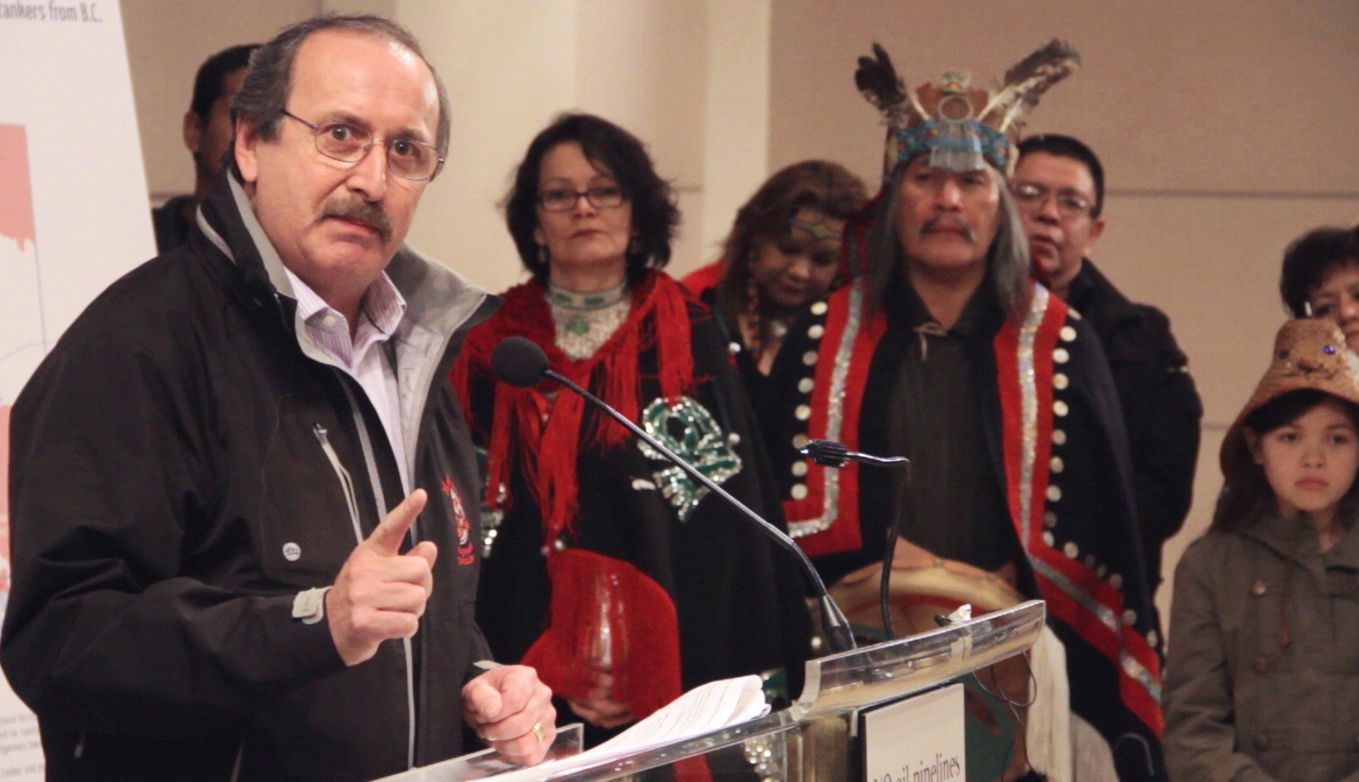
While news emerges that a court order may have been obtained to remove Gitxsan leaders and community members who took over the Treaty office in Hazelton earlier this week – in response to a deal made with Enbridge by treaty negotiator Elmer Derrick without the knowledge or approval of the community – a new video demonstrates how the Gitxsan are banding together in this moment of crisis. The situation is summed up eloquently by one of the community matriarchs shown in the video, produced by Ardea Films:
“Today is a new beginning. Today is the day the healing will begin. Our hearts have been broken, our families have been divided. Today, we’ll begin to talk, we’ll begin to love; we’ll begin to share and honour one another once again. So I put this out to all of us as Gitxsan people: We must stay strong, as the whole country – particularly our aboriginal neighbours – are disappointed with us …But we must stay strong. We must stay proud.”
Read this story from APTN on the escalating tensions over the crisis at Attawapiskat, culminating yesterday in calls from aboriginal leaders for an oil pipeline blockade to get the Harper Government’s attention.
“OTTAWA–Some Manitoba chiefs called for “action”
against existing oil pipelines on a day of heated words at a special
chiefs assembly in Ottawa that heard from embattled Attawapiskat Chief
Theresa Spence and saw an impromptu march to the doors of Parliament
Hill that ended with police intervention.
Terry Nelson, who is no longer officially chief of Roseau River, told
the assembled chiefs that the only way to escape from Attawapiskat-like
situations was to seize a portion of the resource wealth flowing from
their lands.
Nelson, who was given the microphone by Waywayseecappo First Nation
Chief Murray Clearsky, said there were plans to launch actions against
existing oil pipelines in Manitoba, Saskatchewan and Alberta, along with
several U.S. states.
He said the only way First Nations can deal with the nagging funding
problems plaguing their communities was to seize a share of the
resources flowing from their territories.
“The chiefs in Manitoba have been listening and they hear very
clearly we have to take action,” said Nelson. “In June, we are going to
have continuous, ongoing demonstration action on the pipelines, from
Alberta, Saskatchewan, Manitoba, northern Minnesota, Wisconsin, North
and South Dakota, to sit on those pipelines until this government comes
to their goddamn senses.” (Dec. 6, 2011)
Read this breaking story from The Vancouver Sun reporting that according to the National Energy Board Joint Review Panel, the decision on the proposed Enbridge Northern Gateway Pipeline will now be delayed until late-2013.
“CALGARY — The joint review panel hearing submissions on the
controversial Northern Gateway oil pipeline to the B.C. coast will take a
year longer than expected to deliver its final report. In a
projected schedule released late Tuesday, the three-member panel said it ‘would anticipate releasing the environmental assessment report in the
fall of 2013 and its final decision on the project around the end of
2013.’ That’s a year later than expected, confirmed Annie Roy, panel spokeswoman.”
Watch this video from Global TV today on the ongoing controversy over the now-disputed Gitxsan First Nation deal with Enbridge. Note how Enbridge carefully videotaped the whole process, then provided it to media – complete with b-roll footage of pipeline construction jobs. The majority of the footage in this Global segment derives from a corporate press kit from Enbridge. (Dec. 6, 2011)
Listen to this 23 min radio program hosted by The Current’s Anna-Maria Tremonti, debating the notion of “ethical oil.” In in “Ethical Oil” spokesperson Kathryn Marshall squares off against Nobel Laureate Jody Williams, Chair of the Nobel Women’s Initiative – who recently signed a letter with Archbishop Desmond Tutu and six other Nobel Laureates calling for the Obama Administration to reject the proposed Keystone XL pipeline from the Alberta Tar Sands to the US Gulf Coast – and a business ethics professor from York University. (Dec. 6, 2011)
Read this story from The Globe and Mail on the swift and strong reaction by Gitxsan hereditary chiefs following Friday’s unauthorized deal with Enbridge, signed by the nation’s lead treaty negotiator, Elmer Derrick.
“Gitxsan hereditary chiefs on Monday called for the resignations of negotiators involved in a controversial pact with Enbridge. After
emergency meetings over the weekend, a group of hereditary chiefs
marched on the offices of the Gitxsan Treaty Society on Monday to demand
the immediate resignation of three of the society’s employees. Those
employees include Elmer Derrick, a Gitxsan Treaty Society negotiator and
a hereditary chief who on Friday announced a deal with Enbridge to
support the Northern Gateway project.
‘We put on our regalia and walked to the Gitxsan Treaty Society and
informed them that their services were no longer needed,’ Norman
Stephens, who is part of a group of hereditary chiefs speaking out
against the Enbridge agreement, said Monday in a telephone interview. The
employees refused to leave, saying that the society’s board of
directors – not the hereditary chiefs – governed the society, according
to Mr. Stephens. That resulted in a subsequent resolution by the
chiefs that the society directors could no longer sign or act on behalf
of the Gitxsan clans, Mr. Stephens said.
A call to the Gitxsan Treaty Office was not immediately returned.” (December 5, 2011)
The heated debate playing out in the BC media over the past few days regarding the now-disputed deal announced this past Friday between Enbridge and the Gitxsan First Nation warrants a closer examination of the lone Gitxsan man behind the deal. Just who is Elmer Derrick – besides a hereditary chief and lead treaty negotiator for the Gitxsan? It turns out Mr. Derrick also has a decade-long history as a key political appointee of the BC Liberal Party.
Mr. Derrick was among the first political appointees of Gordon Campbell (see Order in Council 847) when the former premier replaced most of the BC Hydro Board of Directors with his own appointees soon after coming to power in 2001. Derrick was among that first batch of board appointments and retained his position at least until March 2008, the last time he is listed as a director in the annual report of the crown corporation.
Mr. Derrick began his foray into politics under the NDP’s tenure, when he was appointed in 1995 to the board of the Nicola Valley Institute of Technology (O.I.C. 1331). Six years later he was becoming a go-to appointee for Campbell. In 2002, Derrick was appointed to the First Peoples’ Advisory Committee (O.I.C. 385) to the Campbell Government as well. In his biography on the Northwest Tribal Treaties Association’s website, Derrick is also listed as a board member of Powerex – BC’s electricity trading crown corporation – and “a volunteer community member of the National Committee on Sustainable Development, Indian and Northern Affairs Canada for three successive reports to the Parliament of Canada.”
Mr. Derrick involved himself in the recent BC Liberal leadership debate earlier this year – throwing his support behind losing candidate George Abbott, according to a Black Press story which is no longer posted on the company’s websites but was re-posted on a Vancouver Island realtor’s blog, where it remains at the time of publication of this story. The story notes, “Also joining Abbott at the announcement were Klahoose First Nation Chief Ken Brown, Gitsxan Chief Elmer Derrick…” (emphasis added).
Mr. Derrick has also acted as co-chair of the Northwest Power Line Coalition, an industry-driven group designed to support the building of the Northwest Transmission Corridor – an initiative championed by both the provincial Liberal and federal Conservative governments – to open up mining and hydro projects in Northwest BC. Among a group of over 50 mining and industrial equipment companies, engineering firms and trade organizations are two First Nations entities, listed as, “Gitxsan Hereditary Chiefs and Tahltan Development Corporation.” A Marketwire story form January 2010 quotes Mr. Derrick: “‘We look forward to working with and supporting [BC Transmission Corporation] in this process,’ added Coalition Co-Chair Elmer Derrick, Hereditary Gitxsan Chief. ‘We are confident that the needs, concerns and questions of those impacted by this power line will be met through the environmental assessment.'”
Mr. Derrick has come under fire by members of his own Gitxsan nation for brokering a deal with Enbridge in support of the company’s proposed Northern Gateway Pipeline. Several hereditary chiefs from the community claimed in a press release this past Friday that Mr. Derrick had no authority to sign an economic benefit agreement with Enbridge and are now seeking to reverse that move.
The protest against the 2,763 km Keystone XL pipeline from Alberta’s tar sands to America’s Gulf States’ oil refineries are driven by a deeper concern than risk to Nebraska’s Sand Hills region and its underlying Ogallala aquifer. The same applies to The worldwide Occupy movement, too, is motivated by a deeper concern than unregulated banking practices and the growing disparity between rich and poor.
This deeper concern could be interpreted as criticism of the industrial and financial institutions that comprise the economic engines of our modern age. But even this is not deep enough. Both protests, it seems, have their deepest common cause in a loss of confidence in the system itself, a foreboding created by repeated warnings of profound environmental transformations that could traumatize our present civilization.
Granted, not everyone articulates this foreboding. But decades of multiple environmental warnings have been eroding confidence in a system that seems more interested in its own success than the ecological havoc it is causing. The cumulative effect of these warnings is a growing sense of anxiety and pessimism. Some people respond by entrenching their faith in the system and doing what they have always done; others are challenging the system by demanding change.
One of the forces behind the Keystone XL pipeline protests, for example, is an organization called 350.org. It contends that the continual burning of oil – especially the “dirty” oil of the Alberta tar sands – is environmental folly. Developing the tar sands simply entrenches an indefinite commitment to oil and prevents the necessary shift toward clean, renewable energies. 350.org believes that our reliance on fossil fuels is untenable so it is “defusing the carbon bomb” – 44 percent of greenhouse gas emissions come from coal, 36 percent from oil and 20 percent from natural gas. Atmospheric carbon dioxide has now reached 393 parts per million from a historical level of 280 ppm, climate stability can only be assured at 350 ppm, and emissions are on a course for 450 ppm, a concentration that could reach the feared “tipping point” beyond which our planet’s ecology would shift into uncontrollable warming.
Science supports this prediction. The International Energy Agency (IEA) reports that by 2015, given our present global emission rates, we will have lost 90 percent of our safety margin for avoiding this tipping point. By 2017, without radical reductions in greenhouse gases, we will have reached this point. So, for 350.org, stopping the Keystone XL pipeline is literally a life-or-death issue. The next struggle will be to stop the Northern Gateway pipeline, a project by transnational corporations that intends to export Alberta’s tar sands oil from BC’s West Coast to Asia.
The Occupy movement is responding differently to the same foreboding. It implicates transnational corporations in a wide range of social, financial and environmental wrongs. While these corporations have generated considerable global wealth, they have done so by exploiting the disadvantaged at the expense of everyone else – the earnings of the world’s middle class have remained almost unchanged since the 1970s. Meanwhile, income of the wealthiest 1 percent has increased manyfold – the average 2009 income for each CEO of the 500 largest corporations was $8 million.
The Occupy movement also blames financial corporations for the Great Recession of 2008, the consequences of which are still echoing around the planet. The trillions of dollars borrowed by countries to shore up their banks and avert a financial collapse became an excessive burden on precarious economies already stressed by debt.
The other wrong that motivates the Occupy movement is the undue political and economic influence held by transnational corporations. Indeed, this influence is deemed so powerful that most nations equate economic health with corporate health. Meanwhile, these corporations show no allegiance to any particular nation – they invest where the constraints are lowest and the profits are highest. An analysis by the Swiss Federal Institute of Technology of the interlocking relationships of the world’s 43,000 transnational corporations revealed that a core of 1,318 controlled 80 percent of the world’s operating revenue. Within this core, 147 controlled 40 percent of all wealth (New Scientist, www.bit.ly/onkFR2). So these corporations own at least this share of the record 30.6 billion tonnes of greenhouse gases emitted in 2010.
Meanwhile, transnational corporate investments continue in oil, gas and coal, helped by global government subsidies in 2010 of $470 billion. To the many billions already invested in the Alberta tar sands, an estimated $253 billion will be spent over the next 25 years. The $7 billion to build the Keystone XL pipeline is an extension of this investment. So, too, is the $5.5 billion for the 1,172 km Northern Gateway proposal. Then add the multiple LNG plants proposed for coastal BC. The Sacred Headwaters of the Skeena, Nass and Stikine Rivers in central BC, described by the renowned ethnobiologist Wade Davis as a world wilderness treasure, will be trashed by the planned gas, oil and mining industrial development there. Corporate salmon farms operate with the same intrusive aggression. Indeed, few places on Earth can escape corporate capital and its hunger to exploit resources and feed its market.
A growing number of critics now recognize this trend as pathological and dangerous – and others are beginning to recognize their complicity. This is the awareness that is motivating the Keystone XL protesters. The global Occupy movement is motivated by a similar awareness. Its action was inspired by a single question posed in Vancouver’s Adbusters magazine: “What is our one demand?” Both protest groups would probably agree that a complicated answer is coalescing into a few simple words: “Give us back our countries, our democracies and our planet.”
Read this follow-up correction story from The Vancouver Sun, setting the record straight after their erroneous Friday front-page story reporting that the Gitxsan First Nation had struck a deal with Enbridge regarding the company’s highly controversial proposed Northern Gateway Pipeline. As The Sun now reports, the only deal with Enbridgre was made by a lone rogue bureaucrat from the band’s treaty negotiation office and had no official support from the hereditary or elected leadership of the nation. The story reports leaders of the nation are considering firing the perpetrator of the illegitimate deal, one Elmer Derrick.
VANCOUVER — Two chiefs of the Gitxsan First Nation in northern B.C.
said they are “in shock and embarrassed” after Enbridge announced Friday
that the aboriginal community had become an equity partner in its
embattled Northern Gateway pipeline proposal.
Norman Stephens and
Marjorie McRae said they have the support of most of the other 63 chiefs
and the rest of the First Nation in denouncing Friday’s agreement
announced by Enbridge and Hereditary Chief Elmer Derrick. Friday’s deal
was projected to bring at least $7 million to the community.
“The
majority of the hereditary chiefs didn’t know that this nonsense was
coming — we didn’t even know he was negotiating with them,” said
Stephens, also a hereditary chief who goes by the traditional name
Guuhadawk. “The hereditary chiefs did not know about it and are opposed
to it.
“The claimed $7-million benefit shouldn’t even be a part of
it because it goes nowhere to compensate the Gitxsan for any damage to
our fishing stocks if there was a spill.” (Dec. 4, 2011)
Art Sterritt of the Coastal First Nations sets the record straight at a recent press conference
Editor’s Note: Since the publication of this editorial, The Vancouver Sun has published a form of a correction story on its front page Monday – though no mention of the mistakes it made with its Saturday headline story.
There is a reason – a big reason – chiefs of all First Nations in line to be adversely affected by oil pipelines and tanker traffic are so stubborn. You see, they understand that the consequences can be summed up by the words “certain catastrophe”. These little words sum up why Prime Minister Harper and Premier “photo-op” Clark are getting no traction with bribes in exchange for pipelines and tankers.
My colleague, Damien Gillis and I attended a press conference last Thursday called by First Nations who would be impacted by scheduled pipelines and tankers to outline their “Save the Fraser Declaration” – a document that leaves no doubt about their unified opposition to these proposals. In all, 131 nations have now signed on.
Moreover, this declaration almost certainly will be signed in the near future by the Tsleil-Waututh First Nation, who face the proposed expansion of KinderMorgan’s pipeline from the Alberta Tar Sands to the their traditional territory on the Burrard Inlet. The Tsleil-Waututh first came out against the company’s plans – which could see up to 300 supertankers loaded with Alberta bitumen plying the waters of Vancouver – in a press release last month.
On this point, the Tsleil-Waututh’s Community Development Director, Rueben George (grandson of Canadian hero Chief Dan George) strongly intimated that his group will soon endorse the Fraser Declaration, once they’ve completed due process within their community. I have no doubt that the federal approval of KinderMorgan’s ability to export more oil from the line, arrogantly coming along side Thursday’s press conference, will guarantee the expected response from First Nations in and around the Burrard Inlet.
When the Tsleil-Waututh do sign on to the Fraser Declaration, that will formally unite the battles against both proposed pipeline projects in BC, drawing together an unprecedented alliance of First Nations and non-indigenous supporters around the province.
A couple of weeks ago there was an article in the business section of The Globe and Mail, where Art Sterritt, Executive Director of the Coastal First Nations, was quoted in a manner that suggested that perhaps the First Nations might bend on the pipelines if the environmental studies warranted it: “’If we could have a fresh start and were able to build a good relationship, the Coastal First Nations might be willing to take another look at the project,’ Art Sterritt, the group’s executive director, said in an interview. ‘That wouldn’t mean we would necessarily come out and agree with it, but we would certainly take a closer look at it.’”
At Thursday’s press conference, Damien gave Mr. Sterritt an opportunity to address that article and the way his words and Coastal First Nations’ position were presented within. The chief responded that he had been quoted out if context and the nations he represents were unequivocally opposed to the pipelines. Without diminishing the comments of others, Chief Sterritt’s uncompromising words were among the strongest of the day and left no doubt that no pipelines or tanker traffic will pass through lands and waters claimed by First Nations. “Tanker traffic is banned from the Great Bear Rainforest, from the Great Bear Sea. It will never happen,” Sterritt declared to the assembled press gallery.
Chief Sterritt’s words should be paid careful attention; since you can have all the pipelines in the world but if the oil can’t be taken by tanker to its destination, or if permitted to do so, can’t ship it out, there’s no point building pipelines. It’s a football game with one goal post and end zone missing – there can be no “game”.
As a bit of a cynic I had wondered if what we were seeing were negotiations and Enbridge was considering a counter-offer that First Nations would accept. After this press conference, my cynicism left and I’m convinced that it’s not a matter of negotiation but a clear statement that the issue is not negotiable, no matter what the final bribe might be offered.
This point cannot be over-emphasized, given the poverty in many bands. Unlike what we see in other segments of Canadian society, many First Nations are putting culture and the future of their children ahead of bribes – no matter what the amount is.
There’s been concern expressed – by me as well as others – that at the end of the day the northern pipelines and tanker traffic might not happen because the KinderMorgan line, which already brings unrefined oil to Vancouver Harbour, will be expanded so as to allow it to take more Tar Sands bitumen, thus making the northern lines unnecessary. Rueben George of the Tsleil-Waututh, while he is still canvassing his members, stated firmly that there would be no Tar Sands gunk passing in or through First Nations land.
I have a couple of personal observations – just why the Campbell/Clark government would grant Taseko Mines the right to start construction on its Prosperity Mine before it had been approved by the federal authorities is utterly beyond me. Talk about throwing gasoline onto the fire! This displays – as if any further proof were necessary – the insensitivity and arrogance of a government that has badly lost its way. That insensitivity and arrogance came out in the aboriginal writ hearing for an injunction against Taseko drilling and road construction – which the First Nation thankfully won this past Friday.
Leaving aside First Nations, why on earth would any government want to inflict huge environmental catastrophes on British Columbia? Is the answer to that they simply don’t give a damn about it? Is it as the late mayor of Vancouver Gerry McGeer said, “It’s only 2500 miles from Vancouver to Ottawa but it’s 25,000 miles from Ottawa to Vancouver.”?
Finally, a warning to both senior governments and the corporations involved – unpleasantness unto violence can clearly be seen ahead if these propositions are not quickly buried. Given the insensitivity and arrogance that has marked this issue, rising hostility from First Nations can be expected. I simply don’t see any common ground – it’s a dispute incapable of any “middle” ground settlement. And probably it always was.
Don’t get me wrong – I haven’t heard anything, not a soupcon of suggestion, of violence from First Nations, I simply raise the question: Given this solidarity by First Nations every inch of the way from the Tar Sands to and down the coast of BC, what other outcome can anyone with a modicum of intelligence expect if the companies, blessed by our political leaders, try to push ahead?
Postscript
Since penning the above, we get absolute proof of the bias of the Vancouver media, especially the Sun.
Friday’s paper contained a lone article, buried in the BC Business section, on the historic declaration by over 130 First Nations opposing the Enbridge pipelines from the Tar Sands to Kitimat down our perilous and beautiful coast destined for China. Saturday’s paper, by contrast, bore a full front-page story, with a whole series of related features, trumpeting, “Gitxsan Supports Enbridge Pipeline – First Nation to Generate $7 Million as Equity Partner.”
The Vancouver Sun gave its front page to ONE First Nation that had allegedly signed with Enbridge. But within hours of the story breaking on Friday, the hereditary and band chiefs of the Gitxsan had come out blasting the story and setting the record straight. Turns out it wasn’t the First Nation partnering with Enbridge, but rather a single man – one Elmer Derrick – who is not even a chief but a representative of the Nation’s treaty negotiation office! [Ed. correction: Mr. Derrick is one among some 60 hereditary chiefs of the Gitxsan, in addition to his role as a treaty negotiator]
“The Gitxsan people are outraged with the Enbridge Northern Gateway Pipeline Agreement”
Contrary
to the announcement of Elmer Derrick of today’s date, the representatives of the Plaintiffs to the British Columbia Supreme Court Action No. 15150, cited as Spookw v. Gitxsan Treaty Society, oppose the Agreement. The Gitxsan plaintiffs include Hereditary Chiefs and four Gitxsan bands with a population of over 6,000 Gitxsan people; the majority of whom are House members in the Gitxsan traditional system represented by Hereditary Chief, Spookw, in the court action.
The representatives do not support Enbridge Northern Gateway Pipeline agreement entered into by Elmer Derrick and state “Elmer Derrick and the Gitxsan Treaty Society/Gitxsan Economic Development Corp. does not speak for all Gitxsan. The Gitxsan people had no knowledge of the proposed Agreement nor were they consulted.”
Oh, and one other tiny little detail: The proposed pipeline doesn’t even run through Gitxsan territory!
So 131 First Nation chiefs sign an agreement to oppose the Enbridge pipeline and tanker traffic and no front page story – yet one renegade bureaucrat supports Enbridge and is the main headline and story on the front page.
Though it hardly needs proving, here The Vancouver Sun, in the clearest of evidence, demonstrates its bias with the subtlety of a logging truck coming down a logging road.
This is a gross breach of journalistic ethics which does have a clear message – if you want a fair newspaper account of anything that fights big business, look elsewhere. The Sun is a paper that manages, by shabby news reporting, tepid columnists, and establishment-friendly use of the op-ed page, to make it clear that no matter what the subject, if corporate predators are involved, they must be looked after.
We are seriously considering cancelling The Sun and the only thing that holds us back is that we would miss Rex Morgan MD in the comic strips.