Category Archives: Oil&Gas

Climate Justice meets Civil Rights in DC over Keystone XL pipeline

Share

Read this story from the Tyee’s Geoff Dembicki on the historic civil uprising brewing in Washington, DC over opposition to the proposed Keystone XL Pipeline and other climate flashpoints, like the Tim DeChristopher issue.

“The end-goal of this mass act of civil disobedience, hyped as the largest in American climate movement history, is to kibosh TransCanada Corp.’s proposed Keystone XL pipeline. For organizers, this proposal is about much
more than a US$7 billion steel artery pumping crude from Alberta’s oil
sands to Texas Gulf Coast refineries — it’s a referendum on the fate of the climate.” (Aug 19, 2011)

http://thetyee.ca/News/2011/08/19/Climate-Justice-Movement/

Share

Norway’s Statoil in More Legal Trouble Over Tar Sands Environmental Violations

Share

Read this report from a Norwegian news site of legal woes for the Norwegian oil giant in the Alberta Tar Sands.

“Statoil has been charged with several violations of water usage at the
site south of Fort McMurray in Alberta, and was called back into court
this week for another hearing. News bureau NTB reported that it remained
unclear whether the case would go to trial or whether Statoil, which
faces millions of Canadian dollars in fines, would agree to pay a
settlement.” (August 17, 2011)

Share
Enbridge Chairman Pat Daniel

Rumours of Pipeline’s Demise Grow as Speculation Surrounds Enbridge

Share

It’s impossible to divine anything concrete from the flurry of interesting chatter surrounding Enbridge’s embattled 1,100 km Northern Gateway Pipeline proposal. Alternate routes, Asian energy experts laughing at our stupidity, Enbridge as a straw man to help push through another pipeline to the US…Much of it coming via rumours, hypotheses, and veiled political innuendo.

But one thing it does indicate is a sudden shift in the once-predictable narrative connected to Enbridge’s project.

Up until recently, the story was all about a stand-off between the world’s biggest pipeline builder and stubborn First Nations and environmentalists in BC opposed to the project. The company and its political boosters maintained it was good for the economies of Western Canada, would provide oodles of person-years of employment and a bituminous shot to our GDP.

If they could just get us skeptical citizens and First Nations to get that through our thick skulls – and stop worrying about the threat of spills, in spite of the company’s dismal track record.

As the storm has brewed over the past year and a half, the company has focused its efforts on shoring up political support and wooing First Nations with increased economic incentives. Postmedia’s resident corporate/oil industry apologist, Barbara Yaffe, was issuing free lectures to aboriginal leaders as recently as a couple weeks ago, advising them to suck it up, get with the times, and get onside this oil pipeline project, as well as a highly contentious mine proposal at Fish Lake in the Chilcotin region.

The political strategy seemed to be working – with the exception of the Clark Government’s coy avoidance of outright support for the pipeline of late (even they can read polls and see how unpopular the concept is in BC – better to sit on the sidelines than say something printable in support). The issue figured prominently at recent meetings between the country’s provincial energy ministers and premiers – and Alberta’s energy minister Ron Liepert has been an enthusiastic torch bearer for the project.

With a fresh Harper majority in Ottawa, it would seem the political conditions are right for Enbridge.

But on every other front, the company is, well, getting its butt handed to it. Their image woes now extend to major international press, including National Geographic, ABC News and the New York Times.

And so it is that rumours and hypotheses implying the pipeline is in real trouble (or should be) begin to spread.

All of a sudden, we have 3 – count ’em – relatively new proposals for getting Alberta Tar Sands crude to tankers on the north Pacific Coast. One by rail to Prince Rupert, one a spur off a proposed KinderMorgan pipeline expansion, and the other floated just this week in a Sun column by Barbara Yaffe.

Ms. Yaffe’s now signing a different tune – suggesting that all the controversy from the Enbridge line could be avoided by shifting to a new scheme from a little-known Vancouver consulting company called G Seven Generations, Ltd. The company is apparently involved in a plan to move bitumen by train from Alberta to Valdez, Alaska (yes, the same Valdez of Exxon infamy) – one would presume through the Yukon, though that detail is omitted in Yaffe’s column.

Yes, perhaps this $20 Billion pipeline on rails (almost 4 times the projected cost of the Enbridge line) is the answer. Ms. Yaffe certainly seems to think it should be a breeze. Just as, I’m sure, Enbridge thought about its pipeline only a few short years ago.

Or maybe KinderMorgan – the company stealthily trying to slip by the public with a massive expansion (potentially totalling over 800,000 barrels/day of new Tar Sands capacity) will build a spur off its Trans-Mountain Pipeline east of Prince George and follow a very similar corridor as Enbridge to a new tanker terminal in Kitimat (how they think this proposal will be music to people’s ears following a defeated Enbridge line with essentially the same flow of oil through the same path is a mystery). The company floated the spur on its website earlier this year.

Or could the bitumen be carried on CN rail lines to the Port of Prince Rupert?…

Then, just this week we read in a column in the Tyee by Dr. Michael Byers an account of a candid conversation he claims to have had at a recent international conference in Hawaii, shedding yet new light on the subject.

Byers says he overhead a number of high-level Asian energy players mocking us silly Canadians for building a pipeline to our Pacific Coast, ostensibly to carry bitumen to Asian countries that have no use for it – owing to a severe lack of refinery capacity to deal with the problematic black sludge. The man Byers is speaking to is “the chairman of a Singapore-based consulting firm that operates at the highest levels of the global oil and gas industry.”

This energy consultant tells Byers:

“‘The Gulf of Mexico coast is the only place in the world with any significant capacity for handling bitumen. That’s because it has refineries equipped to handle heavy oil from Venezuela. If the Asians buy any bitumen from Canada, they’ll insist on a very steep discount, because they’ll have to ship it to the Gulf of Mexico, too.’

He chuckles. ‘But we don’t tell the Canadians this straight-out. We write a report for them.'”

Byers relates more of their conversation, as he asks the consultant:

“‘But what about the Northern Gateway?…Enbridge is a major player. Surely they would realize that there’s no market in Asia?’

‘Enbridge is a pipeline company, not an oil company,’ he replies, taking an even closer look at me. ‘They’ve promised to find a market, and nothing more. They don’t care if it’s at a discount.’

‘So you’re saying that Northern Gateway doesn’t make economic sense,’ I studiously repeat.

He nods emphatically. ‘If the Canadians were smart, they’d build the capacity to refine all their bitumen at source, so as to ship a much more valuable product to Asia and elsewhere. But there are only a handful of upgraders in Alberta — and their capacity is actually going down.'”

So the Asian market will take Canadian bitumen, but only at a “steep” discount – which completely contradicts one of Enbridge’s main justifications for the project: that it will enable Canadian oil companies to fetch a higher dollar for Tar Sands crude on the international market (which typically pays a little more than the West Texas-based crude exchange for North American oil).

The upshot, according to Byers’ consultant, is that the Enbridge Northern Gateway is primarily functioning as added pressure on US regulators to approve the proposed 3,200 km Keystone XL pipeline from the Tar Sands to refineries on the US Gulf Coast. In the wake of two serious spills in the States from the pipeline’s existing sister line, the Keystone Pipeline, this latest proposal form TransCanada Pipelines is meeting unexpected opposition from environmentalists and political forces in Washington as the Sate Department deliberates the project’s future.

The idea is that the possibility of a competing export route to Asia will heighten pressure for our southern neighbours to pass the Keystone XL.

Does all this second-hand speculation portend the end of Enbridge’s pipe dream, or are these rumours of its death – as Mark Twain once said – greatly exaggerated?

The coming months, in the lead-up to the public hearings for the project at the National Energy Board, should provide some interesting new chapters to this saga.


Share

Enbridge Northern Gateway Simply an Uneconomic Ruse to Push Keystone XL, Says Asian Energy Expert

Share

According to what a leading Asian energy consultant let slip at a recent conference to UBC’s Dr. Michael Byers, China doesn’t have the refining capacity to handle Alberta bitumen – therefore they would only buy Tar Sands crude transported by the Enbridge Northern Gateway Pipeline at a steep discount. This consultant further implies Enbridge’s line is a ruse – an uneconomic straw man designed to put more pressure on the US State Department to approve the contentious Keystone XL line to the Gulf of Mexico, where the only significant bitumen refining capacity lies.

Read Dr. Byers’ article here (August 17, 2011).

Share

Enbridge alternative: Rail to Valdez Alaska? So says Barbara Yaffe

Share

Read this article by the Vancouver Sun’s chief Enbridge apologist, Barbara Yaffe – now touting a rail route connecting the Alberta Tar Sands to Valdez, Alaska as a more palatable alternative to the Enbridge Northern Gateway Pipeline.

“This plan has a huge and unmistakable advantage: Aboriginal chiefs like
it. And the company is confident environmentalists and the broader B.C.
public will like it too. Under the scheme, oilsands product would be
unloaded from rail cars at Delta Junction in Alaska, then fed into an
existing pipeline that snakes southward to Valdez.” (August 16, 2011)

Share

Rafe & Damien on EVOTV (Part 1)

Share

Rafe Mair and Damien Gillis discuss The Common Sense Canadian and their coverage of key environmental and public policy issues in BC and Canada on Shaw’s EVOTV, with host Irma Arkus. The three cover a wide range of issues in the half hour program – from private river power and the state of BC Hydro to oil pipelines and supertankers on our coast, natural gas fracking, coal mines, salmon farms and the Cohen Commission into disappearing Fraser River sockeye. (Aug 8, 2011)

Share
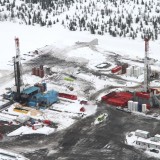
Drills for fracking operations near Hudson's Hope, BC

What “Fracking” is About

Share

Until a couple of months ago I had never heard of “fracking”.
I now understand why. And I should have known.

Governments, by long standing habit, don’t like smarty pants
environmentalists to learn what the hell is going on and thus be able
to alert the masses, for those masses can mess up the process. The BC
government’s policy was neatly summed up by Finance Minister Kevin
Falcon when he was Transport Minister. Frustrated by boo-birds who
were always asking questions, going to public meetings and
demonstrating, said the Chinese “don’t have the labour or
environmental restrictions we do. It’s not like they have to do
community consultations. They just say ‘we’re building a bridge’ and
they move everyone out of there and get going within two weeks. Could
you imagine if we could build like that?”

Here is as good a definition I could find for “fracking”:

Horizontal hydrofracking is a means of tapping shale deposits
containing natural gas that were previously inaccessible by
conventional drilling. Vertical hydrofracking is used to extend the
life of an existing well once its productivity starts to run out,
sort of a last resort. Horizontal fracking differs in that it uses a
mixture of 596 chemicals, many of them proprietary, and millions of
gallons of water per frack. This water then becomes contaminated and
must be cleaned and disposed of.

What happens is that the drilling is not done vertically but
horizontally which allows the company to recover huge quantities of
natural gas unobtainable by vertical drilling and they do it by
forcing huge quantities of water laced with the chemicals mentioned.

Knowing that, what sorts of questions are running through your
mind?

  • Does this process weaken the ground so that it might
    collapse?

  • Where do they get all that water from?

  • What happens to the river or lake from which all that water
    was taken?

  • What happens if it comes from a reservoir for a dam, does its
    loss reduce the capacity of that dam?

  • Does it go into the water table? Assuming that it has to go
    somewhere, how clean is it?

  • Does the process have any greenhouse gas emissions?

  • What about people who live and/or work in the area – does
    this process affect them adversely?

This isn’t something that came down the river on a piece of bark
but is a major undertaking throughout North America. The Atlantic
Provinces are involved and Quebec has suspended fracking until there
has been a detailed environmental review.

What about the BC government? Surely they have done studies,
issued a white paper and encouraged public involvement!

Not a chance. The Minister responsible – the Minister of Forests,
Lands and Natural Resource Operations, Steve Thomson – simply refuses
to comment. You will note that the Minister of Environment is not
involved in this huge environmental question mark.

Here we go again, folks! This is the Campbell/Clark Energy plan
all over again. Bring in a policy with huge implications for the
environment and just refuse to answer obvious questions and, for God’s
sake, don’t have any public hearings! The entire environmental policy
of this, the worst government since the Coalition of the 40s and
probably beyond, is to simply ram things through and the public can go to
hell.

We must assume that companies will lie through their teeth which
is quite understandable when you remember that their sole objective
of existing is to make money for shareholders. I don’t say that with
a sneer – it’s simply that their raison d’etre does not permit
them to utter a discouraging word about anything they do.

“Good corporate citizen” is an oxymoron. Whatever they
do from sponsoring a Little League Team to building a new wing to a
hospital has a profitable pay-back. They don’t make gifts
anonymously.

They hire the most expensive liars of earth, the Public Relations
industry, to distract the public with literature and film that would
make Josef Goebbels blush with pride. That, armed with some crap from
the Fraser Institute and a rigidly right wing government is all
that’s needed.

It’s all rather like the aphorism, “If a husband sends his
wife flowers for no reason, there’s a reason.” If the government
doesn’t want you to know, there is a reason – and the reason with this government is invariably that they and industry are about to
do it to you again. Lie, obfuscate and clam up is the way the game is
played.

The underlying philosophy of this government is as Kevin Falcon
stated – the public is a nuisance. Don’t level with them for it might
worry the little dears.

Share

First Nations Leaders Respond to Barabara Yaffe’s Provocative Column on BC Resource Projects

Share

Read this scathing response to a recent column by the Vancouver Sun’s Barbara Yaffe, titled “First Nations Need to Embrace Resource Projects” – from the Vice Tribal Chief of the Carrier Sekani Tribal Council and the Tribal Chief of the Tsilhqot’in National Government. (Aug 2, 2011)


Share