
Read this report from the Omaha World-Herald on debate commencing in the US House of Representatives over TransCanada Pipelines’ controversial proposed Keystone XL pipeline. (July 26, 2011)
Read this report from the Omaha World-Herald on debate commencing in the US House of Representatives over TransCanada Pipelines’ controversial proposed Keystone XL pipeline. (July 26, 2011)
Read this article from the Province on the forthcoming National Geographic cover story on the Great Bear Rainforest and battle over the proposed Enbridge pipeline to BC’s coast. (July 21, 2011)
Read this report from the Vancouver Sun on this week’s meetings between Canada’s provincial energy ministers and a new plan to see Canada transformed into a global energy superpower. (July 20, 2011)
Read this report from CBC.ca about the shocking announcement by Shell of its intention to pull out of the $16 Billion Mackenzie gas pipeline project, delivering a major blow to the future of the project that would bring gas from the Beaufort Sea to Alberta. (July 15, 2011)
Read this article from the Globe and Mail on the growing momentum for a national energy strategy, a concept the Harper Conservatives are now mulling out loud, in contrast to their traditional opposition to the idea. (July 10, 2011)
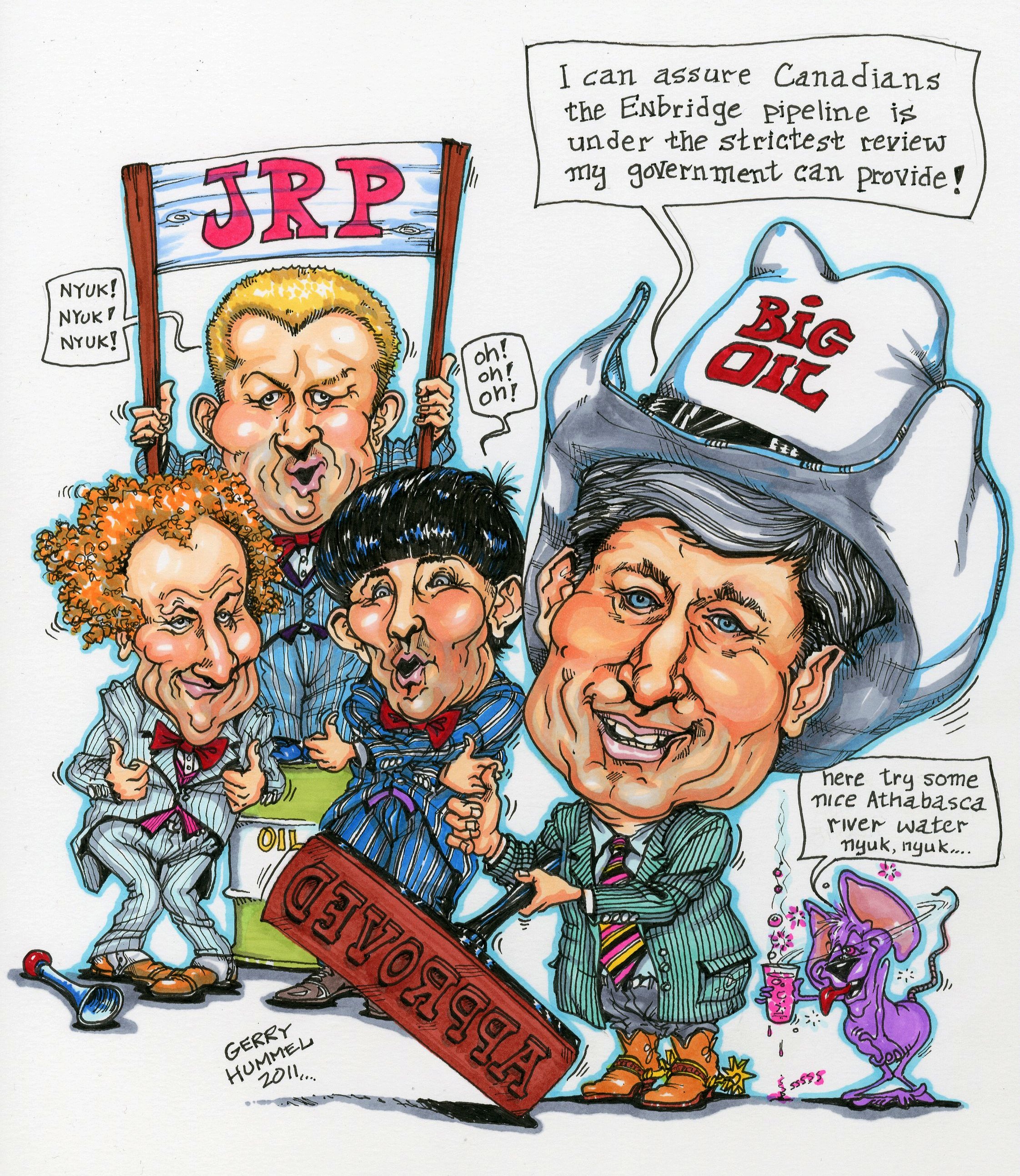
The latest cartoon from Gerry Hummel – referencing the Joint Panel Review for the hugely controversial proposed Enbridge Northern Gateway Pipeline. Rules defining public participation were recently announced by the Canadian Environmental Assessment Agency and National Energy Board. Despite assurances of multiple avenues for public comment, many First Nations, citizens and conservation groups from the region are expressing their doubts – remaining in steadfast opposition to the project.
Watch this 3 min video news story from international agency AFP on the proposed Enbridge Northern Gateway Pipeline and the Tar Sands – featuring images by Damien Gillis and Ian McAllister. (July 5, 2011)
Read this important story from the Vancouver Sun on new details of staggering number of oil pipeline accidents and incidents logged by the Transportation Safety Board of Canada – three quarters of them stemming from Enbridge or TransCanada Pipelines. (July 5)
Read this article from the Washington Post on yet another pipeline leak disaster unfolding in Montana – July 4, 2011
Last week a global oil emergency was declared and the response rolled out, but almost nobody noticed. The International Energy Agency (IEA) started tapping into member state’s emergency oil reserves, something that has only happened twice before. While the crisis in Libya has removed only a tiny percentage of world oil supply from the market, about 1.5 million barrels a day, IEA member countries agreed to release 2 million barrels of oil per day from their emergency stocks over the next 30 days.
So what was the emergency? According to the IEA media release, “the ongoing disruption of oil supplies from Libya . . . threatens to undermine the fragile global economic recovery.”
The “economic recovery” the IEA talks about implies the return to ever-increasing greenhouse gas emissions, which was only briefly interrupted in 2009 by the global economic disruption following the 2007-2008 oil price spike. What they want to recover is the economic growth that has pushed greenhouse gas emissions to record levels in 2010, setting our planet on track for two real emergencies – run away global warming and economic chaos when the next major oil supply disruption happens.
According to a recent IEA report, energy-related carbon emissions in 2010 were 5 percent higher than the previous record set in 2008. Fatih Birol, IEA chief economist, was widely quoted ringing the alarm bells about how this means we are on the brink of exceeding 2 degrees Celsius above preindustrial levels – the point at which many scientists believe global warming would spiral out of our control to absolutely catastrophic levels. “Our latest estimates are another wake-up call,” said Birol. “The world has edged incredibly close to the level of emissions that should not be reached until 2020 if the 2ºC target is to be attained.”
We need to learn to burn much less oil sooner or later, so why not take ‘bold and decisive’ action this summer? If the IEA, which represents the wealthiest countries including Canada, was serious about reducing greenhouse gas emissions and vulnerability to oil price spikes they have a number of options. The most obvious is to blow the dust of their 2005 report Saving Oil in a Hurry which asserts that “In the case of a moderate reduction in oil supplies, a reduction in IEA transport fuel demand of even a few percent could have a substantial dampening effect on surging world oil prices.”
The transport sector accounts for over half of oil use in IEA countries and is expected to account for nearly all future increases in oil use. Increases in oil consumption now must come from destructive unconventional sources such as the Canadian tar sands.
More and more countries are admitting that major changes in transportation policy are needed to meet greenhouse gas reduction targets. More and more experts are also warning that the peaking of conventional oil supplies will likely lead to a destructive roller coaster of price spikes and economic downturns. Saving Oil in a Hurry lays out measures to rapidly reduce oil demand in ways that could translate into a long-term positive response to both of these daunting challenges.
Some of the changes suggested are what was recently tested during the 2010 Winter Olympics in Vancouver. For example, rush hour bus-only lanes were converted to 24 hour operation on many main streets including Broadway. Lower or free transit fares are also suggested in Saving Oil in a Hurry; during the Olympics many buses operated without fare boxes – offering free transit on a random basis. Increased transit service is also part of Saving Oil in a Hurry the report advocates increasing off-peak transit service including weekends and evenings to capture recreational travel and keeping older buses in service longer to increase peak service as new buses come into service – as was done during the Olympics. All of these measures have been reversed since the Olympics but transit ridership is still significantly higher than before.
Other measures suggested in Saving Oil in a Hurry include lowering highway speed limits to 90 km/h, introducing aggressive driving efficiency education campaigns, and converting existing general purpose lanes to high occupancy vehicle lanes.
All of these measures could lead into the larger changes needed over the medium and long term. But our governments and international agencies seem determined to waste this perfectly good emergency and make us more vulnerable to the next oil price spike – which could be a big one if Saudi Arabian oil extraction is disrupted.
What is really needed to deal with the twin crises of peak oil and global warming is a major transformation of transportation and economic policy. Ensuring that more and more oil and other resources are consumed every year is no longer a sane policy. Either one of these challenges justifies action on the scale of the mobilization for World War II, which saw civilian automobile manufacturing plants converted to military production almost overnight.
Transportation Transformation: Building complete communities and a zero-emission transportation system in BC, a recent report I co-authored, proposes taking many of the measures in Saving Oil in a Hurry much further. We envision transit lanes painted on almost every major arterial in BC, lower transit fares, and electricity replacing oil as the fuel for public transit. We also propose rapidly creating more complete communities with much better cycling and pedestrian facilities to reduce the need to travel by car or transit for everyday tasks such as grocery shopping. Longer distance freight and passenger service would be provided by electric trains.
We need a declaration of emergency to mobilize the resources needed for the transformation. One opportunity has been squandered, but the next and likely more dramatic oil price shock could be right around the corner. Our governments and institutions seem set to squander the next opportunity for change as well, unless they feel real pressure to face up to reality. You can get involved in creating the Transportation Transformation we need, start by signing up for action updates at www.StopThePave.org.