
All posts by Common Sense Canadian

Exxon Chief Acknowledges Global Warming From Fossils Fuels, Insists Humans Will Adapt

Share

Read this Canadian Press story, via TheTyee.ca, on Exxon CEO Rex Tillerson’s recent statement covering global warming, fracking, and other controversial aspects of his company’s business. (June 28, 2012)

ExxonMobil CEO Rex Tillerson says fears about climate change, drilling, and energy dependence are overblown.

In a speech Wednesday, Tillerson acknowledged that burning of fossil fuels is warming the planet, but said society will be able to adapt.

The risks of oil and gas drilling are well understood and can be mitigated, he said. And dependence on other nations for oil is not a concern as long as access to supply is certain, he said.

Tillerson blamed a public that is “illiterate” in science and math, a “lazy” press, and advocacy groups that “manufacture fear” for energy misconceptions in a speech at the Council on Foreign Relations.

He highlighted that huge discoveries of oil and gas in North America have reversed a 20-year decline in U.S. oil production in recent years. He also trumpeted the global oil industry’s ability to deliver fuels during a two-year period of dramatic uncertainty in the Middle East, the world’s most important oil and gas-producing region.

“No one, anywhere, any place in the world has not been able to get crude oil to fuel their economies,” he said.

In his speech and during a question-and-answer session after, he addressed three major energy issues: Climate change, oil and gas drilling pollution, and energy dependence.

Tillerson, in a break with predecessor Lee Raymond, has acknowledged that global temperatures are rising. “Clearly there is going to be an impact,” he said Wednesday.

But he questioned the ability of climate models to predict the magnitude of the impact. He said that people would be able to adapt to rising sea levels and changing climates that may force agricultural production to shift.

“We have spent our entire existence adapting. We’ll adapt,” he said. “It’s an engineering problem and there will be an engineering solution.”

Andrew Weaver, chairman of climate modeling and analysis at the University of Victoria in Canada, disagreed with Tillerson’s characterization of climate modeling. He said modeling can give a very good sense of the type of climate changes that are likely. And he said adapting to those changes will be much more difficult and disruptive than Tillerson seems to be acknowledging.

Steve Coll, author of the recent book “Private Empire: ExxonMobil and American Power,” said he was surprised Exxon would already be talking about ways society could adapt to climate change when there is still time to try to avoid its worst effects. Also, he said, research suggests that adapting to climate change could be far more expensive than reducing emissions now. “Moving entire cities would be very expensive,” he said.

Read more: http://thetyee.ca/Blogs/TheHook/Environment/2012/06/28/exxon-fossil-fuel-adapt-climate/
Share

Norwegian Salmon Farming Industry in Dire Financial Straits

Share

Read this blog from Alexandra Morton, summarizing the dire financial situation for the world’s biggest salmon farming operators, all headquartered in Norway. (June 25, 2012)

In 2009, I met with the previous CEO of Marine Harvest in Norway. She asked me, “what do you want?” When I said, “you have to move your industry out of the narrow Fraser sockeye migration route off Campbell River,” she said it could not be done, because their share price must rise every quarter. However, today Marine Harvest is moving farms from exactly that area trying escape a parasite that liquifies salmon flesh (Kudoa). People don’t want to consume their salmon through a straw.

Screen Shot 2012-06-26 at 11.31.29 PMKudoa, the white balls in this picture, releases an enzyme that liquifies the flesh after death. Salmon farms are almost certainly enhancing this parasite similar to how they enhance sea lice, viruses and bacteria

Kudoa is a typical customer claim. At 4Q11, Marine Harvest continued to report Kudoa challenges linked to the Campbell River area…. The company will concentrate production at the best sites, while other sites will be closed down in order to improve biological performance.” Download MHG4Q11update080212 copy.pdf (884.4K)

For Marine Harvest Canada, the 2011 profit was affected by exceptional customer
claims and discards at harvesting totalling NOK 67.7 million due to the parasite Kudoa thyrsites. A restructuring plan for Canadian operations led to restructuring costs of NOK 23.4 million

Operating revenues for Marine Harvest Canada were NOK 1 182 million in 2011 (NOK 1 371 million). The average price achieved in CAD was 11% lower than in 2010 due to high presence of Kudoa combined with a general reduction in the market price. Total costs related to discards and claims as a result of soft flesh (Kudoa), amounted to NOK 68 million/NOK 2.00 per kilo harvested in 2011 (NOK 24 million/0.72 per kilo harvested).”Download MH_AnnualReport_2011_Web copy 2.pdf (6264.7K)

Read more: http://alexandramorton.typepad.com/alexandra_morton/2012/06/how-viable-is-salmon-farming-.html

Share

NDP Pushes Past Conservatives in Federal Polling

Share

Read this story from The Vancouver Sun, reporting on a national survey by Global TV and Postmedia that gives the NDP a 3-point advantage over their Conservative counterparts. Is Stephen Harper paying a price for his controversial omnibus budget bill, which guts environmental laws and rolls back Old Age Security, among other dramatic non-budgetary policy changes? (June 22, 2012)

OTTAWA — The federal New Democratic Party has become the leading choice among Canadian voters — especially those in Ontario and Quebec — as the most favoured party to govern the country, a major new poll has found.

The national survey commissioned by Postmedia News and Global TV also reveals that Prime Minister Stephen Harper’s Tories are slipping in popularity and the once-powerful Liberals are continuing to wane.

Ultimately, the poll conducted this week by Ipsos Reid reveals a historic shift in political allegiances, as a growing consensus forms around the NDP among those Canadians who would like to see Harper’s Tories removed from office.

According to the poll, which asked Canadians who they would vote for if an election occurred today, the NDP under Thomas Mulcair would receive 38 per cent of the popular vote, up three points since last month. (That’s also well up from the 2011 election, when the NDP finished second with 31 per cent of the vote.)

The governing Tories would receive 35 per cent of the vote, down two points since last month (and also down from the 40 per cent they attained to win a majority government last year.)

Support for the Liberal party, now heading into an unpredictable leadership race that won’t include its current leader Bob Rae, is also shaky. The party would get 18 per cent of the vote, down one point from its showing in the 2011 election.

The Green party would receive about four per cent of the vote. And the Bloc Quebecois, once powerful in its province, is now running second to the NDP there.

Ipsos Reid president Darrell Bricker said in an interview Friday that the findings are part of a significant trend which shows Canadians are becoming more polarized around key issues such as the economy, the role of government, and taxes.

He said left-wing, “progressive” voters are now coalescing around the political voice that offers the strongest opposition to Harper’s government.

“That’s what’s happening now for the NDP,” said Bricker.

“We’re seeing that there is an opposition emerging. People who are against Harper figure that they have the best chance of defeating them, and that’s where they are going.”

Read more: http://www.vancouversun.com/business/ahead+Tories+Canada+wide+poll+Liberals+struggle/6827125/story.html

Share

Government Pushes Raven Coal Mine to Next Stage, Comox Valley Residents Remain Defiant

Share

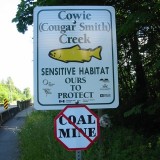
The recently released Application Information Requirements/Environmental Impact Statement (AIR/EIS) Guidelines Document on the Raven Underground Coal Mine Project signals the end of the Pre-application Stage of the Environmental Assessment (EA) process and sets the table for the next stage, which is the Application Stage. This AIR/EIS document is partly the culmination of several years of public consultation, which included 3 public meetings and 3 public comment periods, resulting in a near record 5,000 written comments submitted. Over 95% of the written comments expressed concern or opposition to the project.

In theory, the purpose of the public consultation was to produce an AIR/EIS that would adequately address the public concerns about the massive coal mine’s negative impacts on the region’s water aquifers, the Baynes Sound shellfish industry, air and noise pollution, and socio-economic issues, just to name a few. Not surprisingly, the early reviews of the AIR/EIS show a document that is largely deficient, and the AIR/EIS has not adequately addressed the public’s concerns. Since the proponent’s application will be based on the AIR/EIS document, it’s clear that the application will be flawed and not address the public’s numerous and legitimate concerns, and moreover the future EA process on this project will not be rigorous or comprehensive.

Despite widespread public concern and opposition, and the lack of a social license being granted by the residents of the Comox Valley and Port Alberni, the EA process continues to move forward. However, the huge public outcry over the coal mine proposal is growing louder every day and the communities impacted by the Raven Mine are united more than ever in their opposition to this insane proposal.

In the coming months we’ll continue to strengthen our message of concern and opposition to the Raven Mine, and make it clear to our local, provincial, and federal elected officials that this project is unacceptable. With the provincial election just around the bend, you never know, some of them might actually listen.

A lot of twists and turns left to go in this saga, and as Yogi Berra once said, “It ain’t over ‘til it’s over.” Stay tuned.

John Snyder is a resident of Fanny Bay, BC, and the president of CoalWatch Comox Valley

Share

BC NDP Confirm Support for Fracking, LNG

Share

Read this story from the Vancouver Sun, reporting on the BC NDP’s support for natural gas and LNG development in BC integral to BC’s future, dismissing the mounting environmental concerns about fracking and LNG in the process. (June 14, 2012)

Opposition energy critic John Horgan sounded almost as happy as the B.C. Liberals recently when Shell Canada announced that it was moving forward on a $4-billion pipeline to transport natural gas from northeastern B.C. to a proposed liquefaction plant at Kitimat.

“Very good news,” Horgan said. “I’m pretty excited about it. Shell’s a big deal. They’ve got gas that they want to get out of the ground, and they want to get it to a market where they can get a better return than they do in North America.”

Natural gas, not oil, be it noted. Still his enthusiasm for LNG development stands in marked contrast to the national NDP’s recent doomsaying about resource exports, hydrocarbons, pipelines and tanker traffic.

When Horgan was reaffirmed as energy critic by new leader Adrian Dix last year – a position that is likely to translate into a term as energy minister if the New Democrats form government in 2013 – he made it clear that the party’s green proclivities on oil would have limited application to development of the provincial natural gas resource.

“A natural-gas proposal makes sense,” Horgan said, “because it’s a product from British Columbia, so the royalties would stay here, the jobs would be created here. And gas vents; it doesn’t stick.”

His made-in-B.C. stance even extends to the most controversial aspect of natural gas development, namely the means of extracting it.

Fracking, to use the unflattering short-hand term for the process of hydraulically fracturing shale rock to release the gas trapped within, has generated concerns about excessive water use, subsurface pollution, and seismic activity.

But would Horgan “call for a moratorium on hydraulic fracturing until British Columbians know more?” The question was put to the would-be energy minister by would-be NDP candidate George Heyman of the Sierra Club during Horgan’s recent appearance on Voice of B.C. on Shaw TV.

“No,” was the clear implication of his more lengthy reply.

“People within the NDP predisposed to green, environmental concerns were troubled that you heard from other jurisdictions where people were lighting their taps on fire because the gas had seeped into aquifers and into the water tables.

“That’s not the case in B.C. Our deposits are three and four kilometres under the ground. In Pennsylvania, the Marcellus play, which is providing gas now to much of Eastern Canada – that’s very shallow, relative to our deposits.”

He’s impressed with the B.C. industry’s experience and expertise. “We’ve been fracking in B.C. for decades and we do it fairly well. I’ve been to a number of frack sites, and I’m comfortable with the technology.”

As for water use, he maintains the provincial party has already addressed those concerns. “We’ve put in place what we consider to be a scientific panel that would review and ensure that water is disposed of appropriately, and that we reduce the amount of fresh water that’s involved in fracking.”

Seismic activity? “Not significant issues when you’re that deep in the ground. You wouldn’t want to necessarily be fracking along the Juan de Fuca fault, but in the Peace country it’s relatively safe – at least, that’s what I’m advised, and I’ve not heard of any seismic activity in the Peace.”

So green New Democrats like Hey-man should relax. But even as Horgan and his colleagues support fracking, pipelines, terminals and the tanker traffic necessary to transport the product overseas, there’s another big challenge to LNG development.

Read more: http://www.vancouversun.com/technology/Horgan+deems+greener+future/6780093/story.html

Share

Pipeline spills are not the exception in Alberta, they are an oily reality

Share

Read this article by Stephen Hume in the Vancouver Sun. “Something is exceptional when it happens so infrequently that when it does occur, it’s a surprise.

“But I know from my reporting career, which was ushered in by a series of massive pipeline spills in Alberta more than 40 years ago, that these events occur with depressing regularity.

“The pipeline industry has had almost half a century to work on the problem, yet oil spills, explosions, fires and toxic pollution as a consequence of ruptures are anything but exceptional. They still happen on an almost daily basis.”

Read more: Pipeline spills are not the exception in Alberta, they are an oily reality

Share

Humpback’s Carcass Towed Off Beach

Share

Read this story from the Calgary Herald on the juvenile humpback whale found dead early this morning on White Rock beach, likely due to starvation stemming from a fishing net that ensnared the whale. (June 13, 2012)

METRO VANCOUVER – The carcass of a beached humpback whale was towed off White Rock beach late last night with the help of a high tide.

The emaciated remains are now anchored off the beach while marine biologists decide what to do with the young whale, that died yesterday after beaching itself while wrapped in fishing line.

Efforts are now underway to identify the gear, in hopes of determining where and when the roughly three-year-old whale became entangled.

Vancouver Aquarium staff have also taken various samples from the remains to check for other causes of death, but say the whale’s condition suggests it starved after being tangled for some time.

The steady return of humpback whales to local waters took a graphic twist Tuesday morning when the juvenile wrapped in line washed ashore and died just east of the White Rock pier.

Hundreds of onlookers swarmed the scene, experiencing a mixture of sadness and awe at the presence of such a large marine mammal at their feet.

Some brought flowers for the whale. Members of the Semiahmoo First Nation danced and drummed in its honour. Both RCMP and federal fisheries officers stood in soaking boots and pants to maintain crowd control in the sea water.

In classic west coast fashion, one man on a standup paddleboard cruised by for a closer look before authorities shooed him away.

While grey whales are known to wash ashore in Metro Vancouver from time to time, this is the first such event in recent memory involving a humpback whale and is further evidence of the species’ gradual return to local waters.

“We know they used to inhabit the Strait of Georgia 100 years ago,” said Lance Barrett-Lennard, a marine mammal specialist with the Vancouver Aquarium.

“We see it as a good sign they are using these waters again, but they’re still not an everyday sight.”

RCMP Sgt. Paul Vadik said police were first notified of the beached whale at 5:15 a.m. It was still breathing but died about an hour later.

The whale measured 8.5 metres from the head to the base of its fluke, or tail fin, and is thought to be about three years old.

The creature had become entangled with heavy nylon line in its mouth, baleen and fluke, and could have suffered for months before dying.

Read more: http://www.calgaryherald.com/travel/Humpback+whale+carcass+towed+beach/6777710/story.html

Share

Plains Midstream Spill Impacts May be Permanent

Share

Read this story from the Globe and Mail on the likely lingering effects of the ongoing Plains Midstream pipeline spill in Alberta. (June 12, 2012)

A sunny break from heavy wind and rain allowed crews to come out in force to battle an oil spill that has stained one of Alberta’s most important rivers – one that, environment officials warn, is likely to never be completely cleaned up.

Rough weekend weather and a flooded Red Deer River had impeded efforts to clean up a spill of 160,000 to 480,000 litres from a Plains Midstream Canada pipeline. But on Tuesday, a response team of nearly 200 workers set to work skimming, vacuuming and absorbing the spill.

It was difficult work, made worse by the high water that is hampering access to the 25 pools of oil that Plains crews have identified in back eddies along the 30 kilometres of river that stretch between the ruptured pipe and Lake Gleniffer, a reservoir whose dam has helped contain the spill.

“It’s been very, very difficult to access a lot of these areas because of the high flows, the very rapid current,” said Martin Bundred, the lead man on the spill for Alberta Environment and Sustainable Resources Development. “We have to use airboats to get in [and there are] lots of sandbars lots of obstacles – whole trees coming down the river. It’s not a nice place to be.”

In fact, the challenges of cleaning an oil-stained river are so great that it’s unlikely that all of the oil will be cleaned up. Some will deliberately be left alone to degrade naturally, an unwelcome prospect for those whose backyards and pasture lands along the Red Deer have been blackened from the leak.

“There are situations where it does make sense to leave things in place,” said Mr. Bundred. In this case, “with a very light crude, you’re going to get degradation very quickly.”

Read more: http://www.theglobeandmail.com/news/national/ruptured-pipeline-to-be-vacuumed-out-to-prevent-more-oil-from-spilling/article4253832/

Share

A Canada Day message for the Harper Government

Share

I listen to the radio and TV news and see our country being devastated by the Conservative Government. We have lost the worlds confidence, in our governments thinking, actions and leadership. The government has disgraced the Canadian people on the world stage, the United Nations, the Peace process, and almost every normal way of dealing with the world. Instead of leading the world in the cleanup of pollution, the government wants to lead the world in polluting it and calling anyone, who doesn’t agree with them, radicals, terrorists, etc. etc.

The Harper government also loves to give away our money to rich and profitable corporations. When first elected, $19 billion in back taxes of corporations, foreign and domestic, gone. The $15 billion surplus the Liberals left as a cushion. gone. Rolling back the taxes, to 15%, of huge, very profitable foreign and domestic corporations, gone, billion dollars for a one day G8/20 meeting, gone and with the same breath telling the people, that paid out all this money, that they must cut back on all the services that Canadian people rely on and pay for. That is our money! We don’t give you that money to be given away! We give you that yo provide services for us, the people of Canada! You have no right!

I would like the people of Canada that don’t agree with the way our government is running/ruining our country and want to protest that fact peacefully and with no dialogue, only a general disgust with the Harper Government’s wicked ways. Please wear your Canadian flags upside down on Canada Day. By doing this small gesture, we can tell our friends and neighbours, that we care about Canada and we don’t like the direction the Harper government headed and we would like to change direction to a more calm and peaceful way of life. We can feel proud that we don’t stand for Harper’s, down with the people of Canada, attitude and “the Canadian people don’t care about the things we are doing” talk.

Please join me on July 1st and wear, your flag, pin or whatever, that has a Canadian flag on it, upside down as a very peaceful and silent protest.

Thank you.

If you don’t feel this way, HAPPY CANADA DAY!

Share