
Category Archives: Oceans

UNESCO biosphere reserve status has done little if anything to protect Clayoquot Sound

Clayoquot under siege: Ecological gem still threatened by logging, mining, fish farms

Share

“Every normal man must be tempted, at times, to spit upon his hands, hoist the black flag, and begin slitting throats”. (H.L. Mencken)

Those who fought to save the trees at Clayoquot and the tens of thousands of their fellow citizens – indeed environmental defenders from all over the globe – would, if they knew the truth, be appalled and ashamed and fighting mad at what has happened since 1994 when then Premier Mike Harcourt thought he had protected much of the Clayoquot old growth timber.

The battle known as the “War In The Woods” solved little if anything when all’s said and done. In 1993, the war commenced with almost 1000 protesters winding up in jail. The “war” became international with eco-stars like Robert F. Kennedy getting in the trenches. Clayoquot Sound was named a Biosphere Reserve by UNESCO. An independent panel of scientists got into the act as did the NDP government of the day – but once the fine print was read, the various agreements and legislative efforts following 1993 did little to change things. Tragically, as too often is the case, destitute First Nations – aided by newer, smaller outside companies only too eager to help them harvest and sell Clayoquot’s forests – wound up doing the logging. And they were no better able to do it in an environmentally sound way than were the large companies which left because they couldn’t make money if the new rules were enforced. The bottom line is that whether the area was clear-cut, helicopter logged, or a combination of methods, they could no longer turn a profit, so they left. But the First Nations need money and the forest suffers accordingly.
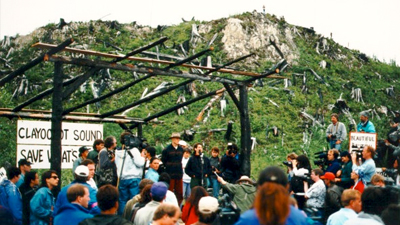
“War in the Woods” protests in Clayoquot Sound two decades ago

In the final analysis, Clayoquot Sound is an international symbol of how environmental fights usually end with the environmental groups winning the battle yet losing the war.

In fact, Clayoquot Sound environmentalists resemble a prize fighter who valiantly gets off the canvass only to be knocked down again, for in addition to the forestry battle they thought they had won, they might now be down for the count with several other environmental catastrophes in the ring wielding knockout punches.

Clayoquot Sound is an unbelievable gem in a coast of gems. Famous for its waves which attract thousands of surfers every year, it is, or was, also famous for its salmon fishing. Perhaps most of all, Clayoquot Sound is a place you want to be – a spectacular rain forest close enough to “civilization” to be reachable, yet seemingly remote.

As if the logging weren’t bad enough, there is a proposed copper mine on Catface Mountain, which, if it is approved and brought to fruition, will literally lop off a third of the mountain – and mine deep into its core. The good news is that the test drilling thus far shows low grade copper, calling into doubt its viability; the bad news is that if world prices of copper are high, this means huge open pit mining because extracting low grade mineral means much more rock must be taken for the undertaking to work. As I write this, 22 further holes are being drilled and results will be known by year’s end.
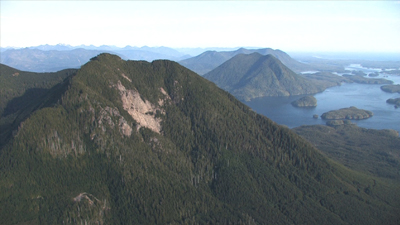
Catface Mountain, where Imperial Metals wants to build a mine

Clayoquot Sound has always been known for spectacular fishing, supporting substantial commercial and sports fisheries. Enter the salmon farmers. Much attention has been paid to the ruinous contact of Broughton Archipelago migrating salmon and the clouds of sea lice from fish farms there. More recently, thanks to the vigorous scientific work by Alexandra Morton, the environmentalist hero of the Broughton tragedy, we now know that sockeye from the Fraser are all but certainly facing the same fish farm-induced perils faced by the pinks and chum in the Broughton Archipelago. While the research into the impacts of salmon farms continues at Clayoquot Sound, every indication is that it’s Broughton Archipelago re-visited, and then some. (See my colleague Damien Gillis’ new film on the salmon farm situation in Clayoquot here).

The Department of Fisheries and Oceans is on the matter, but how comforting is that? Will it be the same DFO we’ve come to have contempt for? Will it again be like lying sick in hospital and the undertaker comes to visit with a tape measure in his hand? Unhappily, that’s not all. Tofino dumps its raw sewage into the ocean, sewage that increases as tourists arrive. The mayor and council know the harm this does but say, simply, that with the tax base they must work with they simply cannot provide the treatment that’s needed.
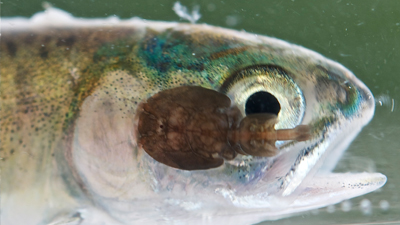
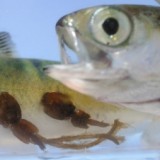
Clayoquot Sound salmon smolt with sea lice from nearby fish farms

The mayor and council have done their damndest to protect their beautiful unique sound, as have environmental groups, but as long as the situation I’ve described continues, it will be one pace forward, two paces back.

History tells us that DFO, who is supposed to protect wild fish, is mandated to support fish farms by a government of ignorant cretins which hasn’t a soupçon of care for the environment. We also know that the provincial government can’t wait to have private companies destroy our rivers for power and the profits destined for out-of-province shareholders of large international corporations – indeed one private power dam (the industry prefers we call them weirs) is under construction in Clayoquot, with several more to follow.

Clayoquot Sound, the place everyone thought had been made safe for nature, sits on the edge of the precipice overlooking utter destruction while industry – and it must be said some First Nations – and the two senior governments are fighting to see who will give it the last and fatal push.

If we are to have any hope of truly protecting this magical place, it’s high time we hoisted up that black flag again.

Share

Triumphant Victoria Finale for Salmon Migration! (and more)

Share

Watch the climactic finish of the “Get Out Migration” for wild salmon – May 8 in Victoria, where 5,000 turned out to the the lawn of the provincial Legislature to tell governments to get open net salmon farms out of BC’s waters. 8 min short documentary featuring powerful speeches from salmon biologist Alexandra Morton – who led the Migration down Vancouver Island – former BC Environment Minister Rafe Mair, Grand Chief Stewart Phillip, Order of Canada recipient Vicky Husband, plus aboriginal drums, music, colourful costumes and thousands of citizens committed to saving wild salmon…Everything the mainstream media didn’t show you about one of the largest and most powerful public demonstrations of its kind in BC history.

More videos about the Wild Salmon Migration:

The Common
Sense Canadian’s video coverage of the historic walk for wild salmon down Vancouver
Island, culminating in Victoria on May 8. Wild salmon advocates take to the streets
and take on big Norwegian corporations to take back their wild salmon.”

A diverse group of wild salmon advocates, part of the “Get Out Migration,” led by
biologist Alexandra Morton, sent a message to the world’s largest salmon farming
corporation in Campbell River – headquarters of the Norwegian company’s Canadian
operations. Marine Harvest owns close to half of all salmon farms on BC’s coast,
linked to the devastation of vital wild salmon runs. The concerned citizens and
First Nations returned a pile of farmed Atlantic salmon to the company, just a few
of the over 40,000 that recently escaped from Marine Harvest’s farm in Port
Elizabeth. Escaped Atlantic salmon, an invasive species on BC’s coast, are just one
of a long list of severe ecological impacts from Norwegian open net salmon farms.

Wild salmon advocates on the historic Get Out Migration called for the resignation
of Geir Isaksen – CEO of Norwegian Government-owned Cermaq, the world’s second
largest salmon farming corporation – at the company’s headquarters in Campbell
River, over his failure to protect BC’s wild salmon from the ecological impacts of
his company’s farms. Salmon conservation groups have been pushing for the clearing
of the the “Wild Salmon Narrows”, a critical migratory pathway for embattled Fraser River
sockeye and other wild salmon. Isaksen recently rejected calls to close just two
Cermaq-owned farms despite having called for such precautionary measures himself in
his 2009 report to shareholders.

Common Sense Canadian video on the launch of the historic Walk
for Wild Salmon down Vancouver
Island:

On the eve of the kick-off of the “Get Out Migration”, Rafe Mair wishes
Alex Morton Godspeed and urges all British Colombians to join her on
her historic trek down Vancouver Island. The march was intended to rally the public and send a message to governments
that it’s time to remove open net salmon farms from BC’s coast and help
save our embattled wild salmon.

Share

Fast for BC’s Wild Salmon

Share

First Nations of BC’s Broughton Archipelago – devastated by the impacts of salmon farms – led a fast for wild salmon during the Olympics. 45 people participated in the 29-hour fast in Vancouver – and around the world via Facebook. 92% of BC’s salmon farms are Norwegian-owned, and, since the Winter Games is a major attraction in Norway, the group took advantage of the opportunity to reach out to Norwegian citizens through the media and Facebook. The event garnered excellent coverage in Norway.

Share
Juvenile Fraser River sockeye infested by sea lice

“Farmed Salmon Exposed” online, plus positive reviews from international media

Share

Damien Gillis’ new documentary, “Farmed Salmon Exposed: The Global Reach of the Norwegian Salmon Farming Industry” is now available online here in its entirety. Click here to view it.

The film has been screened over 40 times in 9 countries around the world since this past November, when it was launched during the Pure Salmon Campaign’s Global Week of Action on salmon farms. One of these screenings, at the recent global Seafood Choices Summit in Paris, caught the attention of ABC TV’s award-winning food critic, Steve Dolinsky (http://tinyurl.com/y8wfyl – scroll down to Day 2) and received this positive review by The Atlantic Monthly’s Barry Estabrook (http://tinyurl.com/y9vlzxj):

“I’ve visited salmon farms, read scientific articles, and interviewed the multi-billion-dollar industry’s advocates and detractors, but never have I encountered anything as graphic as the film Farmed Salmon Exposed by Canadian filmmaker Damien Gillis…The film in its entirety is positively gut-wrenching…Industry representatives said that the movie was one-sided…Farmed Salmon Exposed is one-sided. It’s the side of the industry the multi-national corporations don’t want us to see.” – The Atlantic


The film will also be playing at a number of film festivals around the world this year, including in Vancouver. The trailer to the film was seen over 35,000 times globally and there have been 25,000 hits on the recently released four chapters of the 23-minute film. Now, for the first time, TheCanadian.org presents the full film online.

Share
Over 700 citizens supporters took a stand at this rally for wild salmon in Vancouver - October 2009

The time has come

Share

In this province, those who care for the environment must be their own media.

Tom Paine, the “media” catalyst for the American Revolution, rallied Americans with the stirring words “these are the times that try men’s souls”.

Are these words applicable to British Columbia, its governments and the farmed fish issue?”

I say, clearly yes, with this difference – Paine was rallying for an armed revolution while those who oppose fish farms in BC waters rally for changes within the confines of our democratic system.

Continue reading The time has come

Share
Alexandra Morton addresses 600 citizens in Qualicum Beach, BC - January 2010

What does Alexandra Morton have to do to prove her case against fish farms?

Share

The plain fact is that Alexandra Morton shouldn’t have to prove a damned thing. By international law we’re bound by the Precautionary Principle, meaning that those who would invade the environment must demonstrate beyond a reasonable doubt that they can do so safely. To put it bluntly, industry has done absolutely nothing to meet the onus of the Precautionary Principle.

All the fish farmers have proved is that they’ve contributed to Campbell’s party and all the Campbell government has proved is that they got the message loud and clear. The Campbell government, when it comes to the environment, doesn’t give a damn what it does or says as long as the money’s there.

Since Alex blew the whistle nearly a decade ago every independent fisheries scientist has confirmed that sea lice from fish farms were wiping out migrating wild salmon smolts. Every peer reviewed paper confirms Alex’s findings all of which were also peer reviewed.

Campbell Knew All Along

Campbell, who makes Pinocchio a minor leaguer, has consistently alleged that he has science on his side yet is unable to produce a single independent report to support him.

“Knew all along” – a tough charge?

Not a bit. Because, you see, BC wasn’t the first place to have their wild salmon savagely destroyed by lice from fish farms. When I met with Irish scientists under the eminent Dr. Patrick Gargan a few years ago in Galway, one of them looked at me at said, and these were his words which I won’t mince: “Can’t ye fucking well read out there in Canada? Don’t you know what happened in Norway … Scotland … here in Ireland? Can’t ye fucking read?”

We can, but Gordon Campbell won’t.

The federal government was also warned in 1991. Norwegian MP John Lilletun came to Canada to tell us that Norwegian salmon farmers were coming here to get away from higher environmental standards they faced back home. Clearly, the warning fell on deaf ears.

The Former Norwegian Attorney General Speaks Out

Many of us could read and spoke out again and again based upon this evidence. Now we can hear from Georg Fredrik Rieber-Mohn, a Norwegian judge who, as Attorney-General drew up important environmental protection guidelines for Norwegian fish farms. Here’s what he recently said – and I advise Campbell and his toadies to cover their eyes.

During his remarks he alluded to the pending hockey game between Canada and Norway and said this:

[quote]

In 1999, I was proud to present the so-called “wild salmon plan” which proposed national protection for the 50 best salmon rivers and the 9 most important fjord-systems across Norway – the national laksfjords – where salmon farms would be prohibited. However, intense lobbying from the salmon farming industry watered down the proposals so that by the time they passed the parliament in 2007 the protected fjords had become smaller and gave less protection against the salmon farming industry.

The result has been a heavy defeat for wild salmon and a huge win for sea lice. Scientific research published by the Norwegian Institute of Nature Research indicates that the areas protected from open net cage salmon farms are simply too small to offer adequate protection from sea lice. (emphasis mine)

Scientists in Norway detail growing sea lice resistance to the chemicals designed to kill them. The Norwegian Food and Safety Authority recently reported nearly 100 cases of chemical treatment failures as sea lice are now immune. So serious is the situation that the Directorate of Nature Management – the Norwegian Government’s conservation adviser – has called for drastic reductions in farmed salmon production and slaughter of farm stock to reduce the sea lice burden. (emphasis mine)

Put simply, we had an open goal to save wild salmon but we missed the target. Now we are dealing with the consequences of poor defending. Atlantic salmon in the wild in Norway are now threatened with extinction in many rivers in Norway. There are many causes to this decline, but in vast areas the farming of salmon is the main factor. Escaped farmed salmon is a huge problem added to the problem of uncontrolled growth of sea lice. Scientists foresee remarkable damaging effects in new areas in the future.

[EDITOR’S NOTE – in BC escapees indeed are occupying spawning redds but, thankfully, they do not interbreed with wild salmon].

In Norway we are underdogs to save wild Atlantic salmon – like in today’shockey game – but nature is resilient and wild salmon can make a comeback if given a fair chance. The lessons to be learned from Norway are painfully clear but the solution is an easy one.

If you want to protect wild salmon then you have to move salmon farms away from migration routes. (emphasis mine) Juvenile wild salmon have to run the gauntlet past salmon farms on their way out to sea and scientific reports show that they are decimated by sea lice – with reports of up to 90% mortality in some regions.

Even the owner of Marine Harvest – the world’s largest salmon farming company and #1 in both Norway and in British Columbia – agrees that we must move the farms. When he was fishing on the River Alta – one of Norway’s most majestic wild salmon rivers – in 2007 John Fredriksen made a plea as a passionate angler to relocate open net cages to save wild salmon. (emphasis mine)

Last year, I was honoured to meet with sea lice scientist Alexandra Morton in Oslo. I listened with a sense of deja vu as she outlined how Norwegian companies – who control over 90% of BC’s salmon farms – are spreading sea lice to wild salmon. I watched Canadian filmmaker Damien Gillis’s film “Dear Norway – Help Us Save Wild Salmon” and I was struck by a strong sense of solidarity and eerie familiarity. (my pride in the work done by my colleagues merited my emphasis)

Yet there is still hope for wild salmon in both Norway and Canada. With the world watching there is a growing sense of public awareness globally and a passion to save wild salmon.

[/quote] In the name of God, won’t Campbell and federal fisheries minister Gail Shea not listen now?

Where has the Media Been?

When you look back at the last near decade you see that both governments had the means to know as much then as they do now. Alex Morton, with only a few in support, painstakingly re-invented the wheel so that Gordon Campbell, who then had sole control of the issue, would see the facts, do his duty and get rid of the fish farms. In 2002 I presented to him, at his request, a paper laying out the scientific evidence of the catastrophe visited upon wild migrating salmon by lice from fish farms. I didn’t even get the courtesy of a reply. Many of “the few,” and Alex herself, are finally being recognized by the public but why has it taken so long?

The answer is simple: the media, for that read Canwest, has simply refused to cover this issue. It’s not the fault of the many fine people who write for these poor excuses for newspapers. They understand as we in fairness should too, that there’s no point in writing that which won’t be published. Many of them have slipped little bits of information but this is scarcely “holding the government’s feet to the fire!” No, I of all people make no criticism of the journalists for like them I too have had to grovel before these bastards.

The paltry 3-4 pages in the Globe and Mail‘s BC Section give better coverage of BC matters than the combined rubbish that comes out of the Sun and the Province.

This Mess Ought Never to have Started

This mess ought never have started. While the NDP government first licensed these contaminators they had the sense to re-evaluate their decision and place a moratorium on further expansion. I believe they should have banished them but at least they recognized that the “precautionary principle” ought to have been applied and wasn’t.

When Campbell took office he knew the facts. He also knew who donated to his party; and he couldn’t care less about our wild salmon just as he doesn’t give a damn about our rivers. Corporate donors meant everything; idiots like Alexandra Morton and her supporters mustn’t be permitted to interfere with unbridled capitalism as preached by the ultra right wing Fraser Institute, a former “Fellow” of which is a senior editor at the
Vancouver Sun.

Campbell has been untruthful (I prefer a stronger term but my lawyer doesn’t) about BC Rail and spouts untruths through his teeth about his energy program which has our great power company, BC Hydro forced to pay double what it’s worth to private companies for power it can’t use and must therefore export at a huge loss.

Alexandra Morton is going to win her fight, for which for those who care for our salmon, is our fight too – a battle to save the very soul of our province.

The Media in this province ought to have seen this issue for what it so clearly was from the outset and pursued Campbell with the same vigour they quite properly pursued Glen Clark over the “fast ferries.” Canwest dislikes the NDP so covers for Campbell – as simple as that.

Heroes and Villains

We in BC have an industry, two governments and a media we should be thoroughly ashamed of.

On the other hand, we have a gallant lady who came from California to watch whales and stayed to make the saving of our wild salmon a sacred task and getting nothing but abuse for her efforts from industry, government and media.

Alexandra Morton deserves the undying affection and deepest gratitude of us all.

Share