Category Archives: Energy and Resources

BBC Video & Report: Shale Gas Moratorium Urged in UK

Share

From the BBC.co.uk – Jan 16, 2011

by Roger Harrabin

The UK government should
put a moratorium on shale gas operations until the environmental
implications are fully understood, a report says.

The Tyndall Centre for Climate Change Research report comes amid reports a firm has found reserves in Lancashire.

In the US, officials are investigating claims that shale gas drilling has polluted water supplies.

However, UK ministers have rejected a moratorium, saying that drilling for shale gas does not pose a threat.

“We are aware that there have been reports from US of issues
linked to some shale gas projects,” a spokesman for the Department of
Energy and Climate Change (Decc) told BBC News.

“However, we understand that these are only in a few cases
and that Cuadrilla (the firm testing for shale gas in Lancashire) has
made it clear that there is no likelihood of environmental damage and
that it is applying technical expertise and exercising the utmost care
as it takes drilling and testing forward.”

Watch video and read full article here

Share

Audio: Damien Gillis on CHLY’s ‘Sense of Justice’

Share

Listen to this feature chat on Nanaimo-based CHLY’s Sense of Justice show with host Rae Kornberger. The Common Sense Canadian’s Damien Gillis discusses private river power, oil tankers, and making the environment a key issue in this pivotal year for BC politics.

Click here to listen – choose the “2011/01/12 a discussion of IPP’s” in the top left corner of the audio player. It my take a few seconds to load.

Share

Tar Sands Oil Some of World’s Dirtiest: Report

Share

From TheTyee.ca – Jan 14, 2011

Findings counter studies that put bitumen’s carbon footprint slightly higher than regular crude.

A report
by a major global research group representing the world’s 10 largest
car buying markets has concluded that Canada’s bitumen is one of the
world’s dirtiest oils due to its poor quality, low gravity and the vast
amount of natural gas needed to enrich it.

The study for the International Council on
Clean Transportation (ICCT), which looked at the carbon intensity of oil
from 3,000 fields now supplying European gasoline markets, also concluded that increasing reliance on dirty fuels will raise greenhouse gas emissions by 45 per cent above that of conventional oils.

The findings of the ICCT, a group that does
technical research on the environmental performance of automobiles,
contradicts modeling studies
funded by the Alberta government and the oil sands industry which claim
that bitumen has only a five to 15 per cent higher carbon footprint
than conventional crude.

The study calculated the amount of green
house gas emissions created by extracting, moving and refining different
types of crude oil based on specific characteristics including weight,
viscosity, purity, age of the field, leaks and the flaring of waste
gases. (About 20 per cent of oil’s carbon footprint comes from the
production and refining process: the rest comes from cars burning
gasoline.)

Read full article

Share

Enbridge oil spill could cost Canadians billions: report

Share

From TheTyee.ca – Jan 13, 2011

by Geoff Dembicki

Canadian taxpayers could be on the hook for billions of dollars in
clean-up and compensation costs if an oil tanker crashed on the west
coast, suggests a report released Thursday.

“The funding and compensation scheme that exists under
Canadian law would be remarkably inadequate in the event of a
catastrophic oil spill,” it reads.

The report was written by the University of Victoria’s Environmental Law Centre and prepared for the Living Oceans Society.

It notes that Canadian law currently provides up to about
$1.33 billion to deal with the aftermath of potential oil spills. Yet
remediation costs associated with the Exxon Valdez disaster were at
least US $3.5 billion, the report reads.

And the U.S. government forced BP to set up a US $20 billion compensation fund for its Gulf of Mexico spill.

Thursday’s report is aimed directly at Enbridge’s plans
to build a pipeline from Alberta’s oil sands operations to coastal
Kitimat, then transport crude oil on supertankers to markets in China
and beyond.

In the event a tanker crashed in the notoriously
turbulent waters of the Hecate Strait, Enbridge would have little legal
liability, the report notes.

Read full article

Share

Must-read critique of Risks from Enbridge Pipeline

Share

Read this exceptionally informative rebuttal to an Ebridge defender in the Northern Sentinel!

By Murray Minchin of Kitimat, BC – Jan 12, 2011

Allan Hewitson’s article in the December 22, 2010 Northern Sentinel, Miscellaneous coastal tanker traffic
suggests he must have incredible physical flexibility, which is
admirable, but it appears he’s managed to manoeuvre his head into a
location which affords a very limited angle of view regarding Enbridge’s
Northern Gateway proposal. Perhaps his position doesn’t allow him to
see many of the problems and unanswered questions, so I’ll try to shine
some light on them for him.

First of all, he was confused in thinking there are no
differences between transporting natural gas and bitumen, when they are
as different from each other as wood smoke is to cold molasses. When
natural gas escapes from a pipeline it dissipates into the air, leaving
the surrounding environment unharmed. Bitumen on the other hand will
flow downhill to the nearest waterway, then separate out from the
naphtha used to make it thin enough to flow through the pipeline. The
bitumen, which is heavier than water, will then sink to the river bottom
at a rate dependant on the speed of the current and how large the
globules of bitumen are. Hundreds of miles of river bottom and salmon
spawning gravel would be contaminated, crippling that river system’s
salmon based ecosystem as well as the food and commercial fisheries for
generations. It would also cause lasting damage to tourism throughout
BC.

In shipping the products there are equally dramatic
differences. Natural gas is cooled to -160 degrees celsius until it
becomes a liquid and reduces by 600% in volume. This means ships
carrying the liquified natural gas will call in Kitimat’s port every 60
days, or only 6 times a year as compared to Enbridge’s 225 oil
supertankers per year. Actually, one oil supertanker will be arriving
empty and one leaving full every 36 hours or so, so they’ll be making
450 separate transits through our waters per year.

Read full article

Share

Tar Sands Explosion Injures 4

Share

From CBC.ca – Jan 6, 2011

An explosion has rocked the Horizon oilsands site near Fort McKay in northern Alberta, injuring four employees.

The explosion occurred around 3:30 p.m. MT Thursday. The owner of the
site, Canadian Natural Resources Ltd., said at 7 p.m. MT that the fire
was contained to the coker area. A coker uses heat to convert bitumen
into crude oil.

Three employees were taken to hospital in Fort McMurray. One person
sustained first-degree burns, another suffered second- and third-degree
burns and a third suffered a neck injury.

Read full article here

Share

Maude Barlow on Secretive, Scary Canada-EU Trade Deal

Share

From the Globe & Mail – Jan 6, 2011

by Maude Barlow

What you don’t know about a deal you haven’t heard of

In coming days, Canadian and European officials will intensify
negotiations on a new trade agreement most Canadians have never heard
of. The Canada-European Union Comprehensive Economic and Trade Agreement
is by far the largest free-trade deal this country has ever undertaken.

If
it goes through, CETA will open up the rules, standards and public
spending priorities of provinces and municipalities to direct
competition and challenge from European corporations. Ottawa refuses to
even discuss the environmental implications, but a recent trade
sustainability impact assessment commissioned by the European Commission has sounded alarms in several areas.

The report says the kind of liberalizing trade deal envisioned will lead
to increased European investment in the Alberta tar sands, and thus to increased greenhouse gas emissions. Trade lawyer Steven Shrybman
has sounded a similar warning in a recent legal opinion, noting that
CETA will give corporations the right to ignore or challenge existing or
new rules aimed at reducing the current heavy footprint of the tar
sands. He posits that the Conservative government sees international
trade regimes as an important tool for defeating efforts to address
climate change.

Read full article here

Share
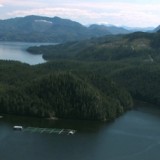
An open net fish farm in BC's Broughton Archipelago

Making the Environment a Key Political Issue in 2011

Share

A new year and I enter the last year of my youth – I just celebrated the 40th anniversary of my 39th birthday. This is the year for my first great grandchild – a daughter will be born to my grandson Ty and his lovely wife Rhea in April. And it has all seemed to happen so fast.

This year will be a very important one for us who love our province and want it to be saved from those who, in Oscar Wilde’s words, “know the price of everything and the value of nothing”.

Why is this such a special year?

Because it’s one that will be chock-a-block with electioneering as the two major parties in BC select new leaders, we see if a third middle party may emerge, and the feds almost certainly will have an election.

We have a critical job to do – and an unusual one.

Let me explain.

Until recent times, the public could rely upon the media to present them not only with issues but points of view surrounding these issues. There was always a debate going on and there was a reasonably informed voting public. Since 2001, when the Campbell government took over, the media have been, for one reason or another, defanged pussy cats. You only have to look back at the great work Vaughn Palmer did on NDP Premier Glen Clark’s “fast ferries” issue to see how a public could be informed very much against the wishes of the government. The NDP government of the day pulled out all the stops and had people like me, in the media, pressed to come and see these magnificent vessels that so clearly were the wrong boats for the waters they were to ply. All to no avail – not just because of Palmer but because the full media coverage made it a large and legitimate issue.

It was scarcely just fast ferries – the media made the government’s life miserable, which is what they did to the government I was in. And they were right to do so.

Of course there were excesses – that’s what democracies are all about. That’s the premium we pay for free speech.

Since 2001, the government has got away with whatever they wished to do and in 2009 we saw what that meant – a 50% turnout at the polls. And what should have been a huge issue – the environment in general and a disgraceful handling of fish farms, highways, and rivers in particular – simply wasn’t because these issues didn’t seem to be real. How could they be real when Tony, Vaughn, Mike, and especially Christy didn’t talk about them? How could they be issues when the opposition who followed the poll numbers instead of making them hadn’t the foggiest idea what was going on and campaigned in slogans, as so long has been their wont? I campaigned around the province for the NDP – not, for God’s sake, because I had become an adherent to that party but because I wanted to see the environment saved and they were the only possible alternative to the Liberals.

Most NDP stalwarts will now agree with me that their campaign, especially on the environmental issues, was appalling. We, the members of the voting public now have the solemn obligation of making sure that this doesn’t happen again.

The “environment” isn’t a non-issue because it isn’t an issue, but because both political parties, for one reason or another, haven’t made it one. In other words, it’s like the tree in the forest – if no one’s there to listen, there’s no noise when it falls.

As many of you know, I’ve been asking people to pass on that which I circulate and other stuff that comes to my attention. While I believe that what I say is right, that scarcely makes me right. What I do say with more confidence is that it is an important part of the debate that ought to be. And this is what we must, in my opinion, concentrate on – namely making the environment not just a real issue but one which will decide the government at election time.

Forgive my repetition on this point but if a government screws up the economy, a new government with time can make it better. What we cannot ever do is get back our rivers, our fish, or our farmland once destroyed.

Please, then, for the sake of those to come, get behind us at The Common Sense Canadian and help us make the environment the #1 issue such that political parties no longer can avoid.

Let me close by telling you one of the reasons we call ourselves “The Common Sense Canadian.”

Both Damien and I, the founders, are huge fans of Thomas Paine, the failed customs official from England who was both catalyst and chronicler of the American Revolution, starting with his blockbuster bestselling pamphlet called Common Sense.

With this and other pamphlets, he circumvented the censorship of the aristocracy and reached the “common man.” Google it and read it yourself – it makes damned good reading today.

With TheCanadian.org, we are trying to follow Tom Paine’s example. For 2011, please resolve to help us do that – by sharing our work with others and getting involved in your own way in these vital issues.

I have full confidence that if the public of BC is fully informed on the issues at hand, we shall see justice and common sense prevail.

Happy New Year!

Share

Harper’s Pipeline Nightmare

Share

What kind of year in politics is 2011 going to be? Very
likely another year (or at least ten months) of gridlock at the federal
level, with no sign of any so-called game changer on the horizon.

A spring election is looking less likely as
the Conservatives try to make a deal with the NDP — swapping its
support for the budget for increased support for seniors and hopefully a
halt to scheduled corporate tax cuts. Harper seems resigned to
remaining a minority government and doesn’t want an election. Canadians
are no more willing to give him a majority today than they were last
year or in the last election. As soon as a Harper majority appears
possible, a whole whack of voters change their minds and the
Conservatives go back to their maximum maintainable level of 36-38 per
cent.

So if there is so little meaningful action
on the parliamentary political front, we should look to
extra-parliamentary politics for action. And here the movement seems to
defy the polls. Because while environmental issues are still taking a
back seat to economic ones, it is on the environmental front that stuff
is actually happening. While the media seem to focus on the lack of
action on climate change, other enviro issues are witnessing intense
activity and campaigning by dozens of groups.

They have demonstrated that Stephen Harper,
a man who doesn’t like to blink, can be defeated when opponents fight
smart and are in for the long haul. The rejection of the B.C. Prosperity
copper-gold mine proposal and the saving of Fish Lake was a good
example. Approving the mine in the face of very effective publicity on
the part of opponents proved just too much for even Stephen Harper to
pull off. Defying many of the pundits’ predictions, the Conservatives
backed off and actually listened to their own environmental review
panel.

Coming down the pipe

While the fight isn’t over yet, Harper
faces another major defeat and it will happen this year. He will
confront another Fish Lake-like decision, except this time it is a much
bigger issue: the so-called Northern Gateway project, Enbridge
Corporation’s plan to construct a 1,200 kilometre pipeline (across 1,000
streams and rivers) that would carry unrefined bitumen from the tar
sands to Kitimat on the West Coast. That would result in some 200
supertankers a year loading the stuff up and taking it to markets in the
U.S. and Asia through the pristine and treacherous waters off the B.C.
coast.

Read full article here

http://thetyee.ca/Opinion/2011/01/03/HarpersNightmare/

Share

Tough Energy and Environmental Questions for 2011

Share

In looking ahead to 2011, I see a very troubled environmental scene. This is because of one thing mainly: with our governments money talks and big time money talks big time. This will reflect itself in several ways and places.

In order to understand this, I think, it must be remembered that corporations don’t give a rat’s ass about the environment. They would pollute all water, destroy wildlife, and desecrate the environment generally. Every tiny bit of environmental restraint has been and always will be imposed by government and it will be resisted and ignored by the corporate world. Many of my generation and others have been brought up to respect government authority and to assume that the world was full of “good corporate citizens.” We, in fact, marveled at the great construction taking place such as Alcan even reversing rivers and creating huge artificial lakes. We developed a public mindset that marveled, uncritically, at development.

There is no question that much of the world will need power; more and more every year. What’s interesting is the lack of an intelligent debate on the subject both at a local and global level.

We have industry and environmentalists fighting but it’s scarcely a fair fight. On the Enbridge proposal to build two pipelines from the Tar Sands to Kitimat and back, industry is out-spending the environmental community 100-1. All the magazines I read carry huge touchy feely ads from huge corporations who tell us in full page ads that they are working just as fast and as hard as environmentalists to make all their creations green.

Much of the problem has been created by an uninformed and ill-informed public which refuses to critically consider anything they’ve been brainwashed into believing or disbelieving. We in the environmental field, me very much included, have decided that certain issues cannot be discussed. These beliefs have become a hardened catechism that brooks no debate.

I have written in the past about nuclear power, for example. This is wrong, we all agree. They explode like atom bombs or melt down. If you live near them or work in them, you’ll be nuked. And there are the calamities at Chernobyl and Three Mile Island.

In the first case there was a disaster, and at Three Mile Island there was a dangerous near-miss. And these and other scares tell us that if you do nuclear power and don’t keep up safety programs it’s only a matter of time before you have very bad news. Nuclear plants are hugely expensive to maintain and no one has found a safe way of dealing with the waste.

Does this mean that nuclear can never be debated again? Do any of us know what research has been done in recent years? In a moment I’ll tell you why this is an important question.

On the other side we’re told that wind power is the way to go because it’s “green” and that’s good. (“Green” is now a weasel word used by polluters to gloss over their destructive policies). The fact that wind power is hugely expensive and invariably set up with taxpayers money, that it is unreliable and environmentally unsound is not dealt with, for this is the reverse of the uranium argument – nuclear is bad and wind power is good, now let’s have no more arguments. While we’re at it, the future is electric cars and that’s that! Never mind asking where the electricity is coming from and how green that source is – this matter has been decided, period!

Right behind nuclear power comes fossil fuel power. This source of power is evil, so no more discussion please.

I would advise one read the lead argument for the use of coal in this month’s Atlantic Monthly. Here is a pretty strong argument which, in a nutshell says “we’re not going to eliminate coal as a source of power for a very long time to come. Isn’t the object to lower carbon emissions, so if we have no alternative for coal we should work harder at reducing the carbon footprint of this and other fossil fuels? Are there not, coming out of China for God’s sake, new techniques which have dramatically reduced the unhappy consequence of burning coal for power?”

My point is that of a British Columbian who wants to save his province’s environment. If I fight on the mantra that fossil fuels and nuclear are bad for the environment so that their use must be eliminated, doesn’t that lead to the conclusion that hydroelectric power is the only way to go? Of course we have wind power, tidal, and solar power but until they can supply the world’s needs for power, what is left?

Do we not see that by saying that other countries must stop all nasty sources of energy we are inviting them to look to us to supply the power from our rivers?

The demand for energy must go somewhere and rudimentary economics tells us the demand will lead to and find a supply – and we’re it! That demand is going to increase so that every piece of water that moves in BC will become a potential source.

This is the great evil of the Campbell Energy Plan (based largely of private river diversion projects), which has been sold on the basis of our own needs – which is plain barnyard droppings. Not only is it going to outside consumers, it is saying “look, neighbour, don’t you worry your pretty little heads about designing your own sources of energy and don’t bother for a moment with conservation because there’s lots more where that came from!”

I will soon be accused of all the usual sins – Rafe Mair favours nuclear, fossil fuel power, etc. – but I am not. What I’m saying is that our energy policy has us financing, out of taxpayers’ pocket, large international corporations who build their plants to produce power for somewhere else.

How are we financing these corporations? This is not hyperbole at all. We buy their power at 2-3 times what we can sell it for and that is money in the bank that otherwise would have to be borrowed or used out of the company’s assets. British Columbians are, therefore, not giving away power to other jurisdictions so that they needn’t make any sacrifices themselves – we’re financing the operation!

We’re saying to American governors: don’t worry about your environment, don’t fret about how you deal with carbon emissions, don’t give more than a passing thought to conservation – BC rivers and streams are yours for the asking!

It’s one thing to be a good neighbour but don’t you think this is a bit too much!

Share