Category Archives: Energy and Resources

New York Times: Fracking Chemicals Were Injected Into Wells, Report Says

Share

From the New York Times – April 16, 2011

by Ian Urbina

WASHINGTON — Oil and gas companies injected hundreds of millions of
gallons of hazardous or carcinogenic chemicals into wells in more than
13 states from 2005 to 2009, according to an investigation by
Congressional Democrats.

 The chemicals were used by companies during a drilling process known as
hydraulic fracturing, or hydrofracking, which involves the high-pressure
injection of a mixture of water, sand and chemical additives into rock
formations deep underground. The process, which is being used to tap
into large reserves of natural gas around the country, opens fissures in the rock to stimulate the release of oil and gas.

Hydrofracking has attracted increased scrutiny from lawmakers and
environmentalists in part because of fears that the chemicals used
during the process can contaminate underground sources of drinking
water.

“Questions about the safety of hydraulic fracturing persist, which are
compounded by the secrecy surrounding the chemicals used in hydraulic
fracturing fluids,” said the report, which was written by
Representatives Henry A. Waxman of California, Edward J. Markey of Massachusetts and Diana DeGette of Colorado.

The report, released late Saturday, also faulted companies for at times
“injecting fluids containing chemicals that they themselves cannot
identify.”

The inquiry over hydrofracking, which was initiated by the House Energy and Commerce Committee
when Mr. Waxman led it last year, also found that 14 of the nation’s
most active hydraulic fracturing companies used 866 million gallons of
hydraulic fracturing products — not including water. More than 650 of
these products contained chemicals that are known or possible human
carcinogens, regulated under the Safe Drinking Water Act, or are listed
as hazardous air pollutants, the report said.

A request for comment from the American Petroleum Institute about the report received no reply.

Matt Armstrong, an energy attorney from Bracewell & Giuliani that
represents several companies involved in natural gas drilling, faulted
the methodology of the congressional report released Saturday and an
earlier report by the same lawmakers.

“This report uses the same sleight of hand deployed in the last report
on diesel use — it compiles overall product volumes, not the volumes of
the hazardous chemicals contained within those products,” he said.
“This generates big numbers but provides no context for the use of these
chemicals over the many thousands of frac jobs that were conducted
within the timeframe of the report.”

Some ingredients mixed into the hydraulic fracturing fluids were common
and generally harmless, like salt and citric acid. Others were
unexpected, like instant coffee and walnut hulls, the report said. Many
ingredients were “extremely toxic,” including benzene, a known human
carcinogen, and lead.

Companies injected large amounts of other hazardous chemicals, including
11.4 million gallons of fluids containing at least one of the toxic or
carcinogenic B.T.E.X. chemicals — benzene, toluene, xylene and
ethylbenzene. The companies used the highest volume of fluids containing
one or more carcinogens in Colorado, Oklahoma and Texas.

The report comes two and a half months after an initial report by the
same three lawmakers that found that 32.2 millions of gallons of fluids
containing diesel, considered an especially hazardous pollutant because
it contains benzene, were injected into the ground during hydrofracking
by a dozen companies from 2005 to 2009, in possible violation of the
drinking water act.

A 2010 report by Environmental Working Group,
a research and advocacy organization, found that benzene levels in
other hydrofracking ingredients were as much as 93 times higher than
those found in diesel.

The use of these chemicals has been a source of concern to regulators
and environmentalists who worry that some of them could find their way
out of a well bore — because of above-ground spills, underground
failures of well casing or migration through layers of rock — and into
nearby sources of drinking water.

These contaminants also remain in the fluid that returns to the surface after a well is hydrofracked. A recent investigation
by The New York Times found high levels of contaminants, including
benzene and radioactive materials, in wastewater that is being sent to
treatment plants not designed to fully treat the waste before it is
discharged into rivers. At one plant in Pennsylvania, documents from the Environmental Protection Agency
revealed levels of benzene roughly 28 times the federal drinking water
standard in wastewater as it was discharged, after treatment, into the
Allegheny River in May 2008.

The E.P.A.
is conducting a national study on the drinking water risks associated
with hydrofracking, but assessing these risks has been made more
difficult by companies’ unwillingness to publicly disclose which
chemicals and in what concentrations they are used, according to
internal e-mails and draft notes of the study plan.

Some companies are moving toward more disclosure, and the industry will
soon start a public database of these chemicals. But the Congressional
report said that reporting to this database is strictly voluntary, that
disclosure will not include the chemical identity of products labeled as
proprietary, and that there is no way to determine if companies are
accurately reporting information for all wells. In Pennsylvania, the
lack of disclosure of drilling ingredients has also incited a heated
debate among E.P.A. lawyers about the threat and legality of treatment
plants accepting the wastewater and discharging it into rivers.       

Read original article

Share

Enbridge files more Gateway info

Share

From The Northern Sentinel – April 15, 2011

Following a request made by the Joint Review Panel for more
information, Enbridge Northern Gateway has submitted more information
for their application.

Clarifications the panel was looking for included
market considerations, impacts the environment would have on the project
(such as land slides and fires), as well as a more detailed oil spill
response plan.

“We would like to keep this process moving forward, we
support it strongly so we want to demonstrate that by filing these
updates as efficiently as we could,” Enbridge spokesman Paul Stanway
said.

The additional submission includes 39 additional files,
one of which shows potential full-bore rupture releases and spill
extents for a hypothetical spill.

Nine submissions are around river and creek crossings.

“That’s an area of sensitivity and we recognize that,
and there are a significant number of river crossings,” Stanway said.
“We want to make sure everybody understands the engineering we’ve put in
place for the river crossings will be robust enough for the terrain
that we’re talking about.”

Their more detailed General Oil Spill Response Plan was developed by looking at other pipelines around the world.

“We’ve looked at situations where people have had great successes and attempted to use their best practices,” Stanway said.

As the marine aspect of this project is new to them,
they also looked to marine safety from around the world, mostly in
Scotland and Norway, Stanway said.

“They’ve had an incredible track record over the last
30 years and haven’t had a major incident of any description, so we’ve
taken their best practices and incorporated them into the marine safety
aspects of the project,” Stanway said.

According to the plan, in the case of an initial
response regional management would first record information from the
caller, then shut down and isolate the source system and dispatch a
first responder.

If an emergency were then confirmed, senior management
would be called, and regional management would activate the ICS and
mobilize response personnel.

The full oil spill response plan, as well as all the 39
additional submissions made by Northern Gateway, are available on the
National Energy Board website, www.neb-one.gc.ca.

Stanway encouraged interested parties to go check out
the information. Any comments on their submission would go to the JRP,
however there’s no reason why they shouldn’t feel free to ask Enbridge
as well, Stanway said.

They’re continuing their public discussions as the
project moves forward in a number of ways, including the Community
Advisory Boards, so there may be feedback from those as well.

“That’s good, that’s what we want is a vigorous public
discussion,” Stanway said. “Our attitude has always been that the more
that people know about this project, the more comfortable they will be.”

Read original article

Share

New Animated Film on Oil Tanker Risks: Cetaceans of the Great Bear

Share

Watch Pacific Wild’s latest release – a beautiful short animation
focusing on the whales of the Great Bear Rainforest. Produced by Picture
Cloud film & animation of Victoria B.C., this visually stunning and
thought-provoking animation explores the dire threats facing whales by
acoustic ship pollution. The return of Humpback and other species of cetaceans to the waters of
the Great Bear Rainforest is a welcome event since the dark days when
whale killing ships travelled our waters. But this may be short lived if
oil tankers begin moving Alberta tar sands crude through the Great
Bears fragile waters.

The release of this animation is timely. On May 2nd the Canadian public
go back to the voting booths and only one federal party supports oil
tankers in the Great Bear Rainforest. Never has one election meant so
much to our coastal environment. From PacificWild.org

Share

Cetaceans of the Great Bear

Share

Watch Pacific Wild’s latest release – a beautiful short animation
focusing on the whales of the Great Bear Rainforest. Produced by Picture
Cloud film & animation of Victoria B.C., this visually stunning and
thought-provoking animation explores the dire threats facing whales by
acoustic ship pollution. The return of Humpback and other species of cetaceans to the waters of
the Great Bear Rainforest is a welcome event since the dark days when
whale killing ships travelled our waters. But this may be short lived if
oil tankers begin moving Alberta tar sands crude through the Great
Bears fragile waters.

The release of this animation is timely. On May 2nd the Canadian public
go back to the voting booths and only one federal party supports oil
tankers in the Great Bear Rainforest. Never has one election meant so
much to our coastal environment. From PacificWild.org

Share

New Animated Film Highlights Threat to B.C. Wildlife from Oil Supertankers

Share

From the Times-Colonist – April 13, 2011

by Judith Lavoie

An evocative animated video showing the silent, underwater world of
whales and dolphins that live near the Great Bear Rainforest is about to
become a weapon in the federal election campaign.

Copies of the
video, created by Simon Game of Victoria-based Picture Cloud Animation
for the wildlife conservation group Pacific Wild, will be given to
federal candidates and leaders of all parties, to illustrate potential
problems if the Enbridge Northern Gateway pipeline is approved.

“It will help people visualize what could happen,” Game said.

The
video has also been posted on YouTube and Pacific Wild will host a film
tour along the pipeline route, from the Alberta oil sands to Kitimat.

Showings will also be held in coastal communities, said Ian McAllister, Pacific Wild spokesman.

The
film, Cetaceans of the Great Bear Rainforest, focuses on the noise that
would be created by oil supertankers taking bitumen from Kitimat to
Asia.

“There are many reasons to oppose oil tankers on our coast,
but few people consider acoustic pollution as being one of them,”
McAllister said. “One cannot simply turn down the volume of an oil
tanker and we have fewer and fewer quiet refuges left on our coast.”

Hermann
Meuter of Cetacealab, who has spent a decade studying whale acoustics
in northern B.C. waters, around Gil Island, Douglas Channel and Caamano
Sound, is alarmed by the prospect of a procession of oil tankers. The
film will help people think about the serious consequences for whales,
he said.

“It would certainly destroy one of the last remaining silent underwater worlds,” he said.

Whales depend on a quiet, underwater environment to hunt, communicate and navigate, Meuter said.

“What we use our eyes for, is what the whales use their ears for.”

In
addition to the threatened population of northern resident killer
whales, humpbacks are returning to the area and there is an increasing
population of fin whales — the second largest creatures on Earth.

The
area, on the route that would be used by tankers, appears to have
special significance for the songs of humpback whales, Meuter said.

“We think they practise their songs here before heading to Hawaii or Mexico where they present the final version,” he said.

Supertankers
create a noise underwater similar to a jet engine revving up beside a
person and the number of whales would certainly decline, Meuter said.

“People
living on this coast have to realize what is at stake. If anything
happens here it will affect cetaceans of the whole coast and the million
dollar whale-watching industry.”

The $5.5-billion,
1,170-kilometre pipeline is under review by a federal panel made up of
the National Energy Board and Canadian Environmental Assessment Agency. A
decision is expected by late 2012.

Enbridge has also been pushing
the pipeline as an election issue. Patrick Daniel, the company’s chief
executive, has told business audiences that the pipeline is needed to
diversify Canada’s oil markets, so the country is not so reliant on the
U.S. as a customer.

The Conservatives will not back a tanker ban in northern B.C. waters, but opposition parties have called for a ban.

Read original article

Share

New Cartoon: The Unforeseen Consequenses of Natural Gas Fracking

Share

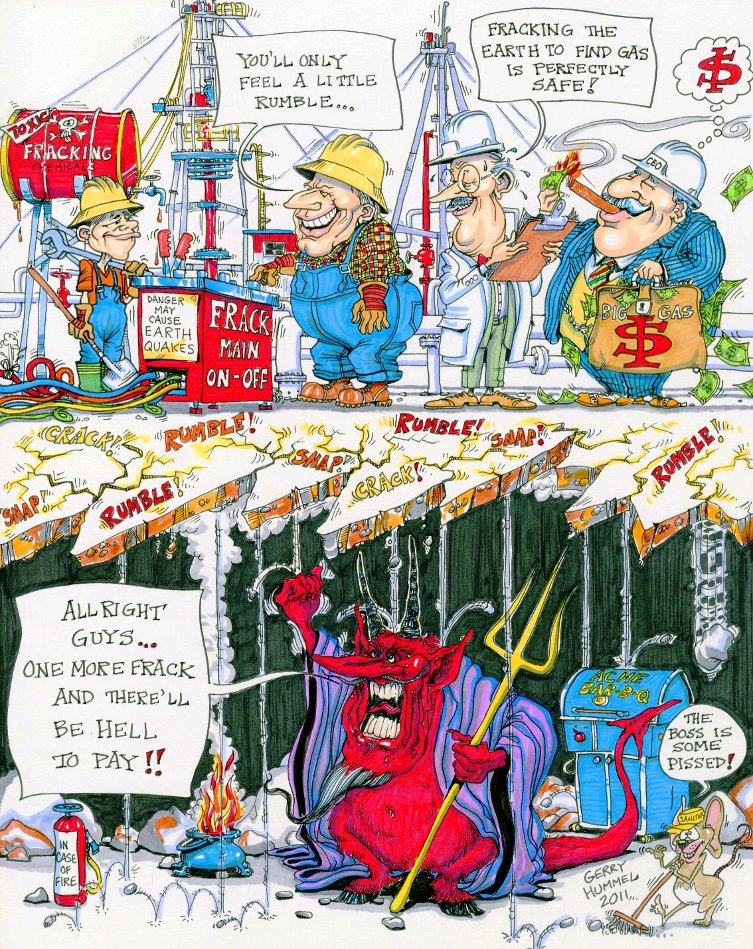
Check out the latest from our cartoonist Gerry Hummel. Hydraulic Fracturing, or “fracking” – a relatively new method for extracting natural gas – involves shooting a mixture of highly pressurized water, sand, and unknown chemicals deep underground in order to crack open shale formations to release gas. The value of the resource in BC has been pegged at $750 Billion – and while we’re going gangbusters to develop our local industry, concentrated in northeast BC, other jurisdictions throughout the US and Canada are putting the brakes on fracking until we have a better grasp of its ecological and geological consequences, and how to better manage the enormous volumes of water currently being used in the process.

Share

New Enbridge Film: Risking it All – Oil on our Coast

Share

Watch this new 13 min short documentary from BC filmmaker Twyla Roscovich and CallingFromTheCoast.com on the proposed Enbridge Northern Gateway Pipeline and oil supertankers on BC’s coast.


From CallingFromTheCoast.com: “The north and central coast of British Columbia is one of last great wilderness areas that still supports a vibrant & productive ecosystem.  Home to thousands of runs of salmon, steelhead, grizzlies, wolves, orca, rare white bears, dolphins, porpoises and hundreds of other species, the coast is a natural spring of wealth & wonder.  The plan to build the Enbridge pipeline, with ensuing tanker traffic, threatens all of this- the coastal ecosystem, the coastal economies and local food security.

The BC coast supports many economies through commercial fishing, sport fishing & tourism, as well as providing massive natural food sources that feed thousands of people- serving up salmon, crab, halibut, clams, cockles, oolichan, herring, sea cucumbers, urchins, rockfish, lingcod, geoduck, seaweed, etc. A natural resource that just keeps giving. Enbridge plans to risk all of this to transport the dirtiest oil in the world to market. It’s your coast, province, and country. This short video outlines the plans for the pipeline and tanker route, the company behind this proposal, and what it means for our beautiful coast. Oil on our Coast was produced with Hartley Bay & the Gitga’at Nation with the goal of inspiring & educating in order to help save what sustains us.”

Share

Risking it All – Oil on our Coast

Share

Watch this new 13 min short documentary from BC filmmaker Twyla Roscovich and CallingFromTheCoast.com on the proposed Enbridge Northern Gateway Pipeline and oil supertankers on BC’s coast.


From CallingFromTheCoast.com: “The north and central coast of British Columbia is one of last great wilderness areas that still supports a vibrant & productive ecosystem.  Home to thousands of runs of salmon, steelhead, grizzlies, wolves, orca, rare white bears, dolphins, porpoises and hundreds of other species, the coast is a natural spring of wealth & wonder.  The plan to build the Enbridge pipeline, with ensuing tanker traffic, threatens all of this- the coastal ecosystem, the coastal economies and local food security.

The BC coast supports many economies through commercial fishing, sport fishing & tourism, as well as providing massive natural food sources that feed thousands of people- serving up salmon, crab, halibut, clams, cockles, oolichan, herring, sea cucumbers, urchins, rockfish, lingcod, geoduck, seaweed, etc. A natural resource that just keeps giving. Enbridge plans to risk all of this to transport the dirtiest oil in the world to market. It’s your coast, province, and country. This short video outlines the plans for the pipeline and tanker route, the company behind this proposal, and what it means for our beautiful coast. Oil on our Coast was produced with Hartley Bay & the Gitga’at Nation with the goal of inspiring & educating in order to help save what sustains us.”

Share

Enbridge CEO Pattrick Daniel: “Northern Gateway: Energy Crossroads”

Share

From The Vancouver Sun – April 7, 2011

by Patrick Daniel – Enbridge CEO

With the second-largest proven petroleum reserves in the world,
Canada may like to flatter itself that it is a global energy superpower.
This may surprise you – coming from a Canadian energy industry CEO –
but I’m afraid it’s not true.

Canada could be. One day we might be. But we are not an energy superpower yet.

Our
energy reserves are a tremendous strategic advantage but they will
deliver true value to Canada only if we choose to develop and make them
available to the world.

The Northern Gateway pipeline project is
Canada’s energy crossroads. With Northern Gateway we will safely move
energy to the West Coast, open new markets for Canadian petroleum and
create thousands of construction and supplier jobs -and significant
permanent employment right across Canada. We will generate millions of
dollars in direct, lasting and meaningful benefits for the first nations
and other communities involved and hundreds of billions of dollars for a
generation of Canadians.

An economic superpower is a country with
the influence, impact and standing on the world stage, and that only
comes from delivering to partners across the globe.

Right now we don’t -and can’t -do that with Canadian energy.

Our
proximity to the world’s largest energy consumer is a unique advantage,
one all our competitors would love to have. But our unparalleled
integration with the U.S. market is also a problem: It makes us
complacent, and it makes us a captive supplier. We only have one
customer for our energy, the United States.

There is a second problem with our dependence on energy trade with the U.S.

American markets are projected to remain flat for the foreseeable
future. So with one stagnating market, Canada’s energy future will
flatline as well. Make no mistake, the U.S is, and will remain, Canada’s
most important market and our closest trading partner. The
interdependence of our economies is a huge permanent advantage for
Canadians and Americans.

But Canada’s energy relationship with the
U.S. can more accurately be described as “dependent” not
“interdependent.” Today, virtually all of Canada’s oil exports go to the
United States. At about two million barrels per day, they make up one
out of every five barrels imported by the U.S.

Canada is the
United States’ most important trade partner when it comes to
carbon-based fuels. No competitor can trump our advantage of geography,
capacity and a trading partnership built on shared values on the
environment, human rights, the rule of law and democracy.

We might
be the most important energy supplier to them, but the United States
has other options available for energy trade partners.

Canada doesn’t. But Northern Gateway will change that.

For
too long, Canada has been a price taker in North American oil markets.
Gateway liberates Canadian oil producers from that straitjacket.
Canadian oil will move closer to world oil price levels, from its
current position about $2 to $3 less than that. This transformation will
mean hundreds of billions of dollars flowing into Canadians’ hands, for
generations. Reliable independent estimates of the project’s impact
over 30 years say it will deliver to all Canadians an additional $270
billion increase in Canada’s GDP.

Can Canada be a leader in the
world energy market? Of course we can. But only if we make the smart,
strategic moves, and take the sustainable steps to make it happen, now.

To
succeed in the 21st century and beyond, Canada needs to look west,
across the international date line, to the vast, growing economies and
huge markets of the Pacific Rim nations.

Northern Gateway is a
smart, strategic and sustainable way for Canada to connect our most
important and valuable export commodity to the markets that need it.

The
economic impact of the project on Canada will be significant and
sustained. The hundreds of billions of dollars in increased GDP will be
felt across the nation, in steel mills and manufacturing centres, from
heavy industry to high finance, for a long, long time.

Northern
Gateway is a great Canadian project. It is being reviewed and assessed
by our tough and professional regulators to determine if it is in our
nation’s best interest and if it can be built and operated to Canada’s
world-class environmental and safety standards -I know it can.

Opponents
of energy development go so far as to suggest that Canada should be
ashamed of our country’s abundant energy resources -the oilsands, in
particular. I think this is nonsense. Canada is a leader in the world
energy industry in safety, reliability, environmental performance,
respect for human rights, regulatory oversight and technological
innovation.

Our energy sector employs hundreds of thousands of
Canadian men and women from coast to coast. They work within a strict
regulatory regime. And every day they do their best -and their best
keeps getting better -to provide sustainable and responsibly developed
energy to all our communities.

As Canadians, we need to better
understand the connection between what the energy industry does and the
lives we all lead. There is a direct connection between your car’s gas
pedal, and your house thermostat and Canadian oil and gas.

Some of
those same critics say we are too small to be a global player in any
sector; that we should be grateful for our access to the United States;
that we can’t compete as an equal on a global stage.

Can we be
more than that? Yes, with politicians who are far-sighted, courageous,
strategy-driven nation builders. The world is clamouring for energy, and
will continue to require all sources of energy over the coming decades
as we make the transition to renewables.

We could choose to keep
Canada’s vast supply of oil, which we have developed ethically and
responsibly, landlocked in North America. We could continue to sell it
at a discount, while other nations create the energy supply lines and
energy market access for the rest of the world.

Or we can take the
steps required to bring Canadian oil to markets around the planet. We
can responsibly, sustainably and safely construct and operate
nation-building projects like Northern Gateway. We can make the most of
the opportunities available to us and build on our strategic advantages
as a responsible, democratic trading nation. We can build an even
stronger Canada for future generations. The crossroads lie right before
us. The choice is Canada’s to make.

Patrick Daniel is president and chief executive officer of Enbridge Inc.

Read original article

Share

Alberta conservation plan stuns oil patch

Share

From the Globe & Mail – April 5, 2011

The Alberta government has proposed new environmental rules that would
revoke a number of oil sands leases – including those which already have
active projects – in an effort to protect sensitive habitat, wildlife
and forest land in the most industrialized area of the province.

The government on Tuesday unveiled a plan to set aside two million
hectares, or about 20 per cent, of Alberta’s oil sands zone, for
conservation. Lease maps of the oil sands show that a number of major
energy producers have properties in the area, including Nexen Inc., (NXY-T23.88-0.32-1.32%) Suncor Energy Inc., (SU-T42.76-0.84-1.93%) Canadian Natural Resources Ltd. (CNQ-T47.25-0.70-1.46%) and Imperial Oil Ltd. (IMO-T51.08-0.94-1.81%)

Alberta is under harsh international scrutiny for the way it manages the
development of the oil sands, but Tuesday’s announcement sent shock
waves rippling across an industry that has spent vast sums of money to
acquire land in the region. The prospect of having parts of it ripped
away prompted one executive to compare Alberta to Venezuela, and to warn
that any expropriation of land may frighten away investment crucial to
developing one of Alberta’s most important economic resources.

“It’s like taking away money,” said a senior industry source who requested anonymity. “It’s really messy.”

Fourteen energy companies and 10 mineral outfits have assets in the
proposed conservation areas. Conventional oil and gas companies will be
governed by softer regulations, allowing them to keep their leases and
further develop projects, although under greater scrutiny, government
officials said. New leases will not be issued for land in the protected
zones.

Mel Knight, the provincial minister for Sustainable Resource
Development, said he is prepared to deal with any backlash from affected
companies. However, he said repatriation plans have happened before,
with compensation helping to soothe the pain.

That compensation will be negotiated between companies and the
government and could include refunding what companies paid to the Crown
for the leases and development and reclamation costs, plus interest.

However, Mr. Knight is willing to consider concerns that energy and
mineral companies may have regarding the proposed rules. Tuesday’s
proposal is still a draft.

“This is not written in stone,” Mr. Knight said in a press conference. “This is a consultation.”

The consultation process is scheduled to wrap up in 60 days, and the
minister said he wants to have the final draft of legislation before
Cabinet in 90 days.

While energy companies and other market players were caught off guard by
the announcement, Mr. Knight noted the government has been openly
working on a plan for the Lower Athabasca Region. Energy companies were
part of the consultation process and should have had a reasonable idea
whether they would be among those affected by the new rules, he said.

The new rules will hit some of Canada’s largest oil sands players,
including Canadian Natural Resources Ltd., Cenovus Energy Inc., and
international players like BP plc and Statoil. Small outfits also have
holdings in the protected zones, and companies are already firing back.

One of them is Sunshine Oilsands Ltd. The government is proposing a
massive Birch River conservation area that falls over a substantial
swath of land the company spent last summer drilling. It found an
estimated 7.6 billion barrels of bitumen in place. It’s not clear how
much, if any, of that will be recoverable. But it is clearly a
substantial resource.

The company says the government was using old data that did not show
what it has discovered there – and plans to lobby hard to have the
protected area changed. The prospect of having that land expropriated is
so surprising that David Sealock, the company’s vice-president of
operations, said he can’t imagine the Alberta government carrying
through with its current plan.

The area in question “represents huge amounts of jobs, huge amounts of
royalties, huge amounts of upside for the public,” he said.

If the government does not back down, however, “it could send a very
negative message to those contemplating investment in the oil sands,”
Mr. Sealock said.

The most controversial issue in the weeks and months ahead is likely to
concern compensation. Sveinung Svarte, the chief executive of Athabasca
Oil Sands Corp., said companies will resist letting go of their land in
exchange for simply a refund of the money they have already paid.

Read full article

Share