Category Archives: Energy and Resources

Power for Proposed BC LNG Plants Called into Question

Share

Read this op-ed in the Vancouver Sun from Vancouver businessman and Conservative Party of BC candidate Rick Peterson, raising the question of where all the power is going to come from to support the extraordinarily energy-intensive Liquid Natural Gas Plants proposed for BC’s coast. (May 28, 2012)

The Liberal government is pitching Asian investors and buyers on an ambitious plan for a string of proposed LNG plants on the province’s north coast. Premier Christy Clark is saying that the first three of them will be up and running by 2020.

What she’s not saying, though, is how she’ll come up with the huge amounts of electricity required to compress, cool, and liquefy the gas for these new LNG plants. Here’s maybe why: BC Hydro simply doesn’t have the capacity to provide even close to the amount of power required for these projects.

It also has no plan to build or buy the power that would be needed. The first three LNG proposals alone slated for 2020 would require about half of the electricity that’s currently consumed by the entire province.

Through its Canadian subsidiary, Apache Corp., a large U.S. multinational energy giant, and along with partners Encana Corp. and EOG Resources, is proposing to operate the first of the three LNG projects for B.C, to be located in Kitimat. Under the terms of its application, Apache is required to source its electricity from BC Hydro and not ‘self-generate’ power by burning some of its natural gas reserves to create its own energy source.

That’s a nice idea — but how practical is it when B.C., despite having some of the best electricity generating potential in the world, is a net importer of power? And where do we import our power from? From Washington State and Alberta. And how is it generated? By coal-fired power plants, at more than three times the carbon emissions of natural gas generating facilities.

So while the government continues to extol the virtues of requiring our new industry to purchase ‘clean’ electricity from BC Hydro, the planners are quietly working on plans to import more coal-fired electricity from out of province. Go figure.

If you go to Google Earth and look at the Pacific North West and Alberta, you’ll see no borders. Pollution and carbon emissions know no borders as well. Our policies should reflect this.

Share
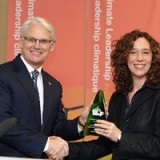
Gordon Campbell receives an award for his

BC Liberals Disguised Oil and Gas Support with Fake Green Label

Share

In my last piece, “The myth of BC Liberal ‘nuetrality’ on Enbridge”, we established that not only are the BC Liberals far from neutral, but rather have been and continue to be complicit in a complex web of legal, administrative and political strategies designed to forward a multi-billion dollar infrastructure development program to enrich the largest most profitable companies on earth at the expense of our Province’s autonomy, economy and environment.
 
Since revealing some of the details that support these claims, issues have been unfolding rapidly on a number of fronts.
 
The NDP has established a “legal team” to look into some of the issues I specifically raised in the piece. This undertaking should fully explore and divulge the many maneuvers the BC Liberals have undertaken over the span of both Gordon Campbell’s and Christy Clark’s time in office which support the largest, most aggressive oil and gas agenda Canadians have ever experienced. As the issues come to the fore from this process I will continue to explore the history of the BC Liberals’ complicity in the oil and gas agenda.
 
Specifically, BC NDP Leader Adrian Dix singled out one pressing issue – the Equivalency Agreement (EA) I and others have worked to bring attention to. This is an action item. Part of the Liberal ‘missing in action’ strategy, defined by the Official Opposition as Government gone “AWOL”, is to let the EA stand despite recent changes by the Harper government which have fatally jeopardized its legitimacy. In legal terms, if BC continues to accept that they have no role or influence while letting the political and jurisdictional wrangling continue unabated, our ability to shape the future of these developments will be further eroded.
 
While there was significant foreshadowing of the BC Liberal desire to streamline approval processes, it was done under the guise of a clean energy strategy. In the 2010 Speech from the Throne, the BC Liberals included their desire to establish Equivalency Agreements in order to overcome “Byzantine” bureaucratic bungling that thwarted the much lauded Climate Change Strategy. Never mind that longstanding bureaucrats responsible for administering these processes see no need for such changes, as duplication was long ago eliminated and further streamlining is hardly required in functional terms.
 
2010 also saw the implementation of the Clean Energy Act and much to do about the green legacy Campbell was establishing; little known to us then was the fact that the augmented approval processes where going to be applied to infrastructure projects to export Alberta’s Dilbit, hardly clean and far from green. In fact, it appears the BC Liberals used their Climate Change Strategy roll-out to couch the required notice needed for the Equivalency Agreement that is now being applied to the Enbridge Pipeline Project, which may explain why no input from stakeholders ever occurred in the 60 days thereafter – a requirement laid out in the act in order to enable these agreements.
 
At the time, it was difficult to see through the puff and pageantry that surrounded the Climate Change Strategy and Clean Energy developments. There was a great deal of very public support for what amounted to a privatized power agenda for some of the largest companies on earth – and a mere two years later we are seeing the that the Clean, Green Energy strategy has served privatized power well.
 
In the next three months, British Columbians will be forking over 180 million dollars to private power producers, paying between $68-100 per Megawatt hour, meanwhile spot markets are hovering around 8 dollars per MWh. Hence, BC Hydro (read you) will be footing the bill for a mark-up of at least 700%! The Campbell “Green” strategy clearly becomes more about cold hard cash for private energy corporations than anything remotely environmentally related.
 
Meanwhile the environment Minister remains “Mum” on the current Joint Review Panel for the propsed Enbridge Northern Gateway pipelines. This despite having revealed his efforts to grease the skids of the project and the uncovering of his government’s coy ‘duck and cover’ media manipulation with respect to Northern Gateway. As a recent letter writer in the Burnaby Now enunciates, “BC Must Take a Stand Now” – in order to pull out of the EA process which affects four major oil and gas developments. However, he closes the piece saying he does not expect the government to do it.
 
And nor do I, which is why I went to great lengths to point out how the EA was established and how we might simply render it null and void.
 
Need further proof that this government will once again sit on its hands and look the other way while our sovereignty continues to erode? Then simply read this excerpt from the Premier’s response to Robyn Allan, whose open letter called for the revoking of the EA:
 
We appreciate the time that you have taken to share your views and insight with us and have forwarded your correspondence to the Honourable Terry Lake, Minister of Environment, for his review and consideration as well. You can be assured that the specific points you have raised in your letter will be included in related discussions between Minister Lake, members of his senior staff and officials in the Provincial Environmental Assessment Office.
 
A diplomatic PFO if I ever saw one. Ms. Allan had to follow up and re-request an actual response from the parties responsible for signing away our right to properly assess, participate and influence the single most pivotal development agenda in the Province’s history. Here is an excerpt of that re-request:
 
I am following up with you as the reply indicates that you will review and consider the letter and discuss the points with your officials.  However, it does not confirm that you will address my comments in a reply to me.
 
Robyn Allan has an impressive breadth of hands-on experience and professional training which dictates her belief that if we do not move now to revoke the EA we will have lost one of our final opportunities to restore our decision-making capacity. This is of great importance and I look forward to hearing exactly what the newly established legal team Dix has appointed does in order to ensure this opportunity is not missed.
 
Everyday British Columbians can act now and pressure those in political office to move on this and if the BC Liberals do not revoke the agreement we can shine the light on how it was established outside the norm – as I did in my last piece – which may work to render it null and void.

Share

Pro-Oil Side a No-Show at Business Community Pipeline, Tanker Discussion

Share

Read this story from the Vancouver Observer on a meeting hosted this week by the Board of Change – a Vancouver-based group of progressive businesspeople concerned about environmental issues – to discuss the pros and cons of new oil pipelines and coastal tankers in BC. (May 25, 2012)

A collection of business-minded Vancouverites gathered at the SAP building in Yaletown Thursday evening, hoping for a lively—and perhaps heated—debate about the merits of pipeline and tankers on the BC coast.

There was just one small problem: almost everybody in the room was on the same side.

The evening’s panel discussion was hosted by the Vancouver Board of Change, a network of local businesses, nonprofits, and students dedicated to the pursuit of both money and meaning. Panelists included outspoken political commentator Rafe Mair; ecologist and author Rex Weyler; and Art Steritt, Executive Director of the Coastal First Nations.

Organizers said they requested the participation of several different companies and individuals to speak to some of the “pro-pipeline” arguments, during a discussion focused on BC’s two major project proposals (the Enbridge Northern Gateway pipeline to Kitimat, and Kinder Morgan’s Trans Mountain pipeline expansion terminating in Vancouver).

Unfortunately, not one of the people or groups they asked actually agreed to take part.

“We asked 15 or 16 organizations and people on the pro side, and nobody said yes,” explained Board of Change director Monika Marcovici.

For a while, the Board was hopeful that North Vancouver blogger Vivian Krause would attend to share her views on the pipeline and politics. But in the end, Krause said she couldn’t make it.

“Everyone has an excuse,” Marcovici said.

In an effort to balance the scales, moderator Robb Lucy introduced the idea of having audience members don their oil industry hats to ask some tough questions, since all three panelists shared the same “no pipeline, no tankers” perspective. Many of the people in the audience were Board of Change members, and organizers hoped this event would help clarify the issues so that the group would feel comfortable taking an official position.

Read more: http://www.vancouverobserver.com/sustainability/2012/05/25/pro-oil-side-mia-board-change-pipeline-panel?page=0,0

Share

Kinder morgan Scales Down Vancouver Pipeline Plan from 850,000 Barrels a Day to 750,000

Share

Read this story from the Vancouver Sun on Kinder Morgan’s decision to scale back the planned capacity for its new twinned pipeline to Vancouver from 850,000 barrels of Tar Sands crude per day to 750,000, following lower than expected demand from shippers. (May 24, 2012)

Kinder Morgan Energy Partners has reduced the size of a planned expansion of its pipeline to the Pacific Coast after fewer shippers than expected signed 20-year con-tracts that would allow surging oil supplies to be shipped to Asia, the company said on Wednesday.

Kinder Morgan now plans a $4.1-billion expansion of its Trans Mountain pipeline to the Vancouver area from Alberta, increasing capacity to 750,000 barrels a day from 300,000. That is down from last month’s estimate of 850,000.

It had expected enough con-tracts to support a $5-billion project with crude production from the Alberta oilsands forecast to more than double over the next decade. But a few potential shippers it thought would sign onto the lengthy obligations had failed to obtain their boards’ approvals by the deadline, prompting the reduction, Kinder Morgan said.

The Trans Mountain expansion is the second multibillion-dollar proposal aimed at opening up lucrative new markets in Asia for Canadian oil producers, now captive to U.S. customers amid a glut that has led to bargain-basement price discounts.

The first, Enbridge Inc’s $5.5-billion Northern Gate-way pipeline to Kitimat from Alberta is the subject of public hearings that began in January.

Both projects face opposition from environmental groups and some native communities in British Columbia. Vancouver city council has also come out against the Kinder expansion, which would increase tanker traffic in the city’s harbour.

Ottawa has signalled strong support for new pipelines to the West Coast, and is making changes to regulatory reviews aimed at speeding up approvals.

Share

Stephen Hume on mismanagement of BC’s most valuable asset – its natural resources

Share

Stephen Hume nails it with this editorial from February in the Vancouver Sun on the decline of good management of BC’s natural resources and the economic consequences of these policies. (Feb 17, 2012)

We pride ourselves on being Super, Natural British Columbia, province of pristine lakes, spectacular wilderness, friendly resource communities and vibrant, sophisticated cities.

We market B.C. as “the best place on earth,” a place where tourists have unparalleled opportunities to view wildlife, hike trackless forests, ski virgin powder, paddle still-wild rivers then relax in splendid surroundings – from remote hike-in campgrounds to five-star resorts.

Even Vancouver and Victoria sell themselves as much for their jewel-like settings in the crown of creation as they do for their restaurants, night-life and cultural attractions.

Yet the engine that all this marketing promotes is in danger of throwing a rod. It hasn’t been serviced properly for years. It’s losing compression on half its cylinders. In fact, it’s evolving into a rusted out jalopy driven by political hicks and hayseeds.

Perhaps we should change that license plate slogan from “Beautiful B.C.” to “The Land of Rip and Run.”

That’s the alarming picture that emerges from research by four retired professionals. They analyze the government’s own data to quantify trends in the management of renewable resources that are mainstays of the provincial economy.

A bit of perspective: renewable resources – forests, fresh and salt water, arable land, range land, fish and wildlife – generate more than $25 billion in provincial economic activity each year.

Industries based on harvesting B.C.’s forests represent a third of B.C.’s exports, more than 30 per cent of Canada’s total exports of forest products and generate almost $10 billion in economic activity.

Renewables like hydro, and agriculture and their associated services generate more than $7 billion.

In 2009, tourism generated almost $13 billion in diversified economic activity. Tourism, by the way, accounts for 129,000 jobs in this province.

Renewable resources and their management are critical wealth-generators in B.C.’s economic well-being.

Yet the study shows convincingly that the provincial politicians to whom we delegate stewardship of these assets have permitted renew-able resource management to deteriorate dangerously.

Diminishing government commitment to managing our renewable resources – and these are the most important resources, for they can still be available long after mines have played out and natural gas reserves pumped dry – risks the province’s future environmental sustainability and threatens social and economic opportunities that arise from it, the paper says.

Read more: http://www.vancouversun.com/travel/resources+need+support/6168223/story.html

Share
Economist and author Jeff Rubin (image: gulfofmexicooilspillblog)

Renowned Energy Economist, Peak Oil Expert Jeff Rubin Speaking at Capilano This Thursday

Share

Former CIBC World Markets Chief Economist-turned Peak Oil spokesperson Jeff Rubin will be discussing his latest book, The End of Growth, at Capilano University this Thursday evening, starting at 7:30.

After building a successful career out of accurately predicting the rise and fall of oil prices for his clients, Rubin shocked many in the financial community when he left his position at CIBC to focus on informing the public about the dangers of an oil-dependent globalized economic model. He and a growing number of energy and economics experts believe the end of cheap, easy-to-get fossil fuels means higher and more volatile energy prices which will render the distance and energy-intensive global economy unworkable in the near future.

Rubin’s first book on the subject, Why Your World is About to Get A Whole Lot Smaller: Oil and the End of Globalization became a Canadian bestseller in 2009, launching his career as an author and public speaker on issues surrounding Peak Oil.

The Toronto-based Rubin’s stop in North Vancouver is part of a speaking tour publicizing his sophomore effort, The End of Growth.

In addition to his two books, Rubin publishes a weekly blog on the Globe and Mail’s website, titled Jeff Rubin’s Smaller World. 

On his own website, Rubin explains:

It wasn’t subprime mortgages but triple-digit oil prices that brought down the world economy.

And unless that economy started to wean itself off an ever-depleting supply of affordable oil, there would be other recessions to follow as economic recoveries would simply push oil prices right back into triple-digit range. But weaning our economy off oil meant, at the same time, making fundamental changes in the way we live.

This is not the kind of message investment banks want their chief economists delivering these days, to either governments or investors. But the urgency of this message grows with every passing day.

Tickets for Thursday night’s show are available online through Capilano University.


Share

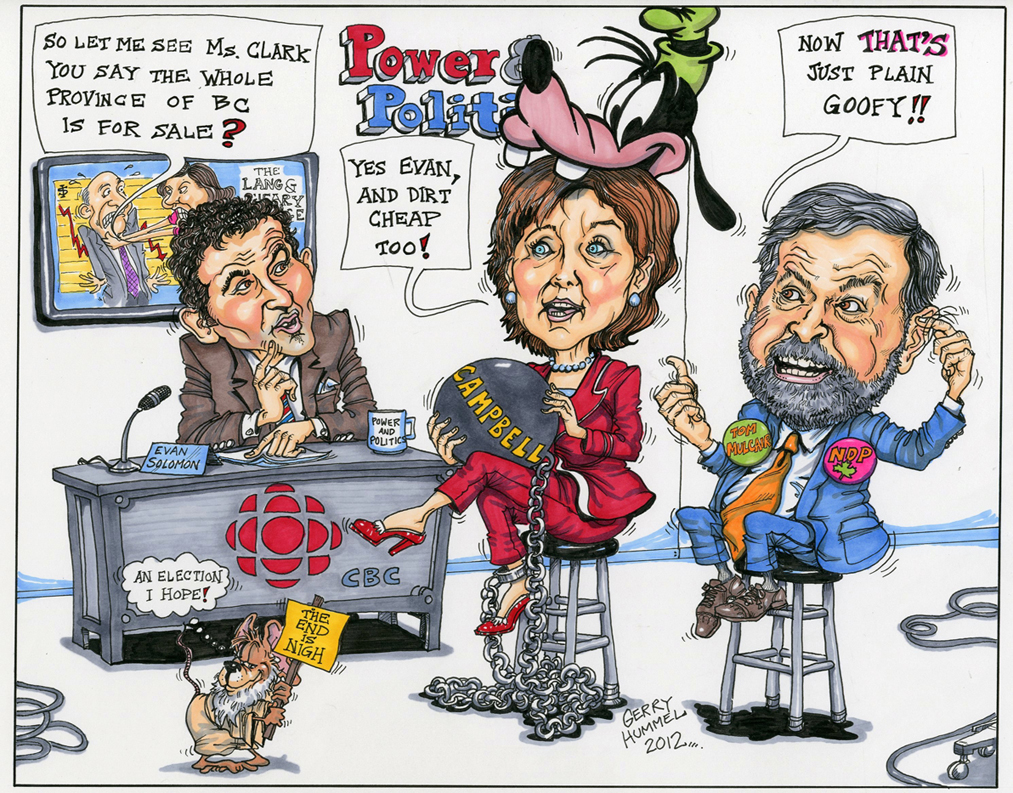
Cartoon: Who you callin’ Goofy? Clark vs. Mulcair on expanding the Tar Sands

Share

Last week, BC Premier Christy Clark attacked Federal NDP Leader Thomas Mulcair for raising the economic downside of becoming a petro-state – namely, the phenomenon known as “Dutch Disease”. Speaking to CBC’s Evan Solomon, Clark referred to Mulcair as “goofy” for questioning the unrestrained expansion of the Alberta Tar Sands to new markets in Asia.

Share
The badly damaged reactor 4 building, with its exposed spent fuel ponds, at Japan's Fukushima Daiichi nuclear plant

Fukushima Reactor 4: The most important story nobody’s talking about

Share

“It is no exaggeration to say that the fate of Japan and the whole world depends on No. 4 reactor.”
-Former Japanese Ambassador to Switzerland Mitsuhei Murata to UN Secretary-General Ban Ki-moon

It’s the most important story nobody’s talking about: the continued dire situation at Japan’s Fukushima Daiichi nuclear plant, ravaged by a massive earthquake and Tsunami last March.

Judging by the official position of the Japanese Government – which maintains the worst of the catastrophe has passed, declaring the plant now “stable” – and drying up of mainstream media coverage, it’s easy to see how most of the world has been lulled into a false sense of security about Fukushima.

But in recent months, increasingly troubling reports from high-ranking Japanese and American politicians, diplomats and nuclear experts have been trickling into the blogosphere and alternate media like the irradiated water still seeping from the plant into the Pacific Ocean. They suggest, in a nutshell, that were another decent-sized earthquake to hit the stricken plant before thousands of highly radioactive spent fuel rods are properly secured, we could see the explosion and diffusion into the North Pacific’s winds and ocean currents of 10 times the radioactive material emitted by the Chernobyl disaster – rendering much of Asia, North America and many other corners of the globe uninhabitable for centuries.

No wonder no one wants to talk about this stuff! 

The force of such warnings has been muted by the fact that most of these alarms are being sounded by relatively fringe politicos and individuals associated with the anti-nuclear movement – albeit highly respected in their respective fields – and carried largely by alternate media sites.

But that has begun to change. This past week, one of Canada’s largest media outlets, CTV News, carried a story titled, “Fukushima Reactor 4 Poses Massive Global Risk”, which echoed many of the concerns being raised through other channels. If you read one depressing thing this week, make it this story.

Here’s how CTV describes the situation, citing renowned nuclear expert and activist Arnie Gundersen:

Reactor 4 – and to a lesser extent Reactor 3 – still hold large quantities of cooling waters surrounding spent nuclear fuel, all bound by a fragile concrete pool located 30 metres above the ground, and exposed to the elements. A magnitude 7 or 7.5 earthquake would likely fracture that pool, and disaster would ensue, says Arnie Gundersen, a nuclear engineer with Fairewinds Energy Education who has visited the site.

The 1,535 spent fuel rods would become exposed to the air and would likely catch fire, with the most-recently added fuel rods igniting first.

The incredible heat generated from that blaze, Gundersen said, could then ignite the older fuel in the cooling pool, causing a massive oxygen-eating radiological fire that could not be extinguished with water.

“So the fear is the newest fuel could begin to burn and then we’d have a conflagration of the whole pool because it would become hotter and hotter. The health consequences of that are beyond where science has ever gone before,” Gundersen told CTVNews.ca in an interview from his home in Vermont…

…Highly radioactive cesium and strontium isotopes would likely go airborne and “volatilize” — turning into a vapour that could move with the wind, potentially travelling thousands of kilometres from the source.

The size of those particles would determine whether they remained in Japan, or made their way to the rest of Asia and other continents.

“And here’s where there’s no science because no one’s ever dared to attempt the experiment,” Gundersen said. “If it flies far enough it goes around the world, if the particles stay a little bigger, they settle in Japan. Either is awful.”

Essentially, he said, Japan is sitting on a ticking time bomb.

Gundersen is far from the only nuclear expert or public figure who has been raising these concerns. A veteran US Senator from Oregon, Ron Wyden – who recently visited Fukushima – and a couple of Japanese diplomats have also been raising alarm bells.

Reuters reported last month on Wyden’s Fukushima tour:
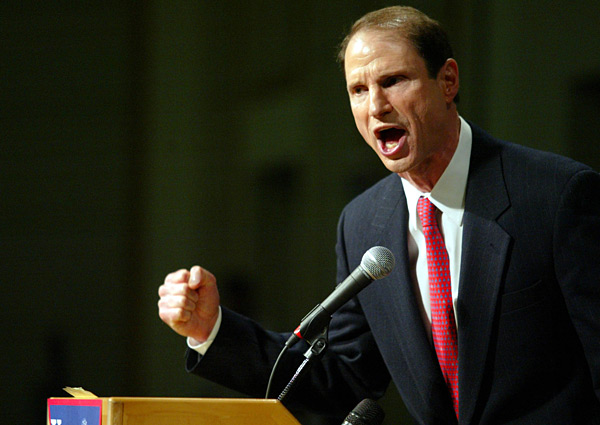
Japan, with assistance from the U.S. government, needs to do more to move spent fuel rods out of harm’s way at the tsunami-stricken Fukushima Daiichi nuclear plant, said U.S. Senator Ron Wyden on Monday.

Wyden, a senior Democratic senator on the Senate Energy committee, toured the ruined Fukushima plant on April 6, and said the damage was far worse than he expected.

“Seeing the extent of the disaster first-hand during my visit conveyed the magnitude of this tragedy and the continuing risks and challenges in a way that news accounts cannot,” said Wyden in a letter to Ichiro Fujisaki, Japan’s ambassador to the United States…

…Wyden said he was most worried about spent fuel rods stored in damaged pools adjacent to the ocean, and urged the Japanese government to accept international help to prevent further release of the radioactive material if another earthquake should happen.

The senator expressed concern on his website that all that was standing between the spent fuel ponds and another Tsunami was “a small, makeshift sea wall erected out of bags of rock.” Wyden called for the spent fuel rods to be moved to safe storage sooner than the 10-year time frame laid out by the Japanese Government under its Fukushima remediation plan.

Dr. Robert Alvarez, a former top advisor at the US Department of Energy, confirmed the fears of Wyden and Gundersen when asked by Japanese diplomat Akio Matsumura to review the situation at Fukushima. Alvarez responded:

The No. 4 pool is about 100 feet above ground, is structurally damaged and is exposed to the open elements. If an earthquake or other event were to cause this pool to drain this could result in a catastrophic radiological fire involving nearly 10 times the amount of Cesium-137 released by the Chernobyl accident. (emphasis added)

Another Japanese diplomat, former Ambassador to Switzerland and Senegal Mitsuhei Murata has also joined the chorus of concern over reactor 4, writing in a letter to UN Secretary-General Ban Ki-moon, “It is no exaggeration to say that the fate of Japan and the whole world depends on No. 4 reactor.” (emphasis added)

Experts in communicating environmental themes to the broader public tend to stress the importance of providing people with hope and tangible actions they can take to help resolve the issue at hand. Perhaps that’s one reason I’ve resisted covering this story up until now. I confess, every time I read about the dire situation at Fukushima, I can’t help but feel depressed and powerless to affect a situation that threatens to destroy everything I hold dear: my wild salmon and marine ecosystems, my coastal home, the health and welfare of my family and community, my whole country and the very planet as I know it. If we take to heart the warnings of people like Senator Wyden, Dr. Alvarez, Ambassador Mistuhei – or even if at minimum we apply the Precautionary Principle to the situation, which seems well-warranted – then we have to acknowledge the very real possibility that nothing short of the fate of human civilization and the natural world hang on the teetering frame of Reactor 4.

Is that melodramatic? So what if these fears prove overblown in the end? This is one situation where I don’t mind being labelled a Chicken Little, for the chance that the danger was real and my actions helped in some way to mitigate it.

By all accounts, solving the problem is an extraordinary undertaking requiring enormous funding, highly specialized equipment and incomprehensible danger for the brave Japanese workers required to carry out the job. Which is why the International Community – and Ron Wyden’s own government, who have yet to act on his concerns – must heed these calls to get off their butts and start pitching in. Of course, that requires Japan’s acknowledgement of the problem and receptiveness to outside help, yet its leaders remain in full denial mode.

The combination of the scale of this looming disaster – which is beyond anything contemplated by humanity since the Cuban Missile crisis – the relative lack of profile and perceived collective credibility of the small number of messengers bearing these unwelcome tidings to date (though these are some highly credible people), and the lack of coverage by the mainstream media have all contributed to the paralysis currently afflicting the powers that be vis-a-vis Fukushima.

Yet, just today, the Wall Street Journal too chimed in on the emerging story. While the brief article, titled, “Fukushima Daiichi’s Unit 4 Spent-Fuel Pool: Safe or Not?”, presents the official line parroted by Japanese vice-minister for reconstruction, Ikko Nakatsuka – namely, that recent efforts to fortify reactor 4 have rendered it relatively safe – the paper retained some healthy skepticism, concluding: “But just how big an earthquake could Unit 4 withstand before it collapses? That’s one of many questions from reporters that Mr. Nakatsuka and the head of the Nuclear and Industrial Safety Agency’s seismic safety unit evaded or wouldn’t answer.”

Thanks to the efforts of the above politicians and nuclear experts, the story is beginning to break through in the mainstream media, forcing the Japanese at least to appear to step up their efforts. What is required now is for this issue to gain enough prominence in the mainstream media and, consequently, the public consciousness, to compel a unified political effort to move those bloody fuel rods to safety before another earthquake topples them and takes us all with them.

It is my hope, in talking about this thing no one wants to contemplate, that I’m doing my small part in inching the world closer to the action necessary to avert a crisis of unthinkable proportions. And perhaps if you take a moment to share this story and others you come across with your social media network, friends, colleagues and family – and write your political representatives and media – we can help build the movement required to keep our air and water clean, our children’s future preserved.

I’m all for prayer in these situations…but action’s preferable.

Share
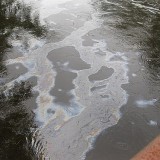
Spilled diluted bitumen separates in Michigan's Kalamazoo River (photo: NRDC's Switchboard)

Bitumen Spills from Enbridge, Kinder Morgan Are Certain Disasters Waiting to Happen

Share

I urge you to read again Rex Weyler’s blog on the Common Sense Canadian on the consequences of a bitumen spill in Vancouver Harbour. And “consequences” should very much on our minds, front and centre.
 
We are talking three pipelines and two tanker routes.
 
For the Northern Gateway project we have two pipelines. The reason is that bitumen, the Tar Sands gunk, is too thick to transfer and must have what they call “condensate” mixed in to move it. This natural gas addition does nothing to reduce the damage if there’s a leak or a rupture. Thus Enbridge takes the mixture, known as diluted bitumen (Dilbit), to Kitimat while pumping “condensate” imported by tanker to the Tar Sands by a second pipeline. This highly toxic Dilbit substance will move in huge tankers down what is probably the most dangerous coastline in the world.
 
The other pipeline is the old Trans Mountain pipeline now used by Kinder Morgan company (a clone of the disgraced Enron) and, if their latest application is accepted, will be twinning that line, thereby increasing their shipping capacity from current levels of 300,000 barrels a day to 850,000 barrels a day, with a tanker a day going through the treacherous Second Narrows.
 
It is not my intention here to discuss the risks involved in these three pipelines and two tanker routes – there is no need to because ruptures and spills are a lead pipe certainty. The only issue is clean-up.
 
Anthony Swift writes for Switchboard, which is the staff blog of the Natural Resources Defense Council, the US’s most effective environmental group. Here’s what he has to say on clean-up:
 
Raw tar sands bitumen is nearly solid at room temperature and must be diluted with toxic natural gas liquids to create the thick sludge that travels in high pressure pipelines. This sludge is between fifty and seventy times as thick as conventional crude oil. When spilled, the light natural gas liquid in the tar sands vaporizes, creating a toxic flammable gas that poses a health hazard to emergency responders and nearby landowners. The bitumen, which is heavier than water, sinks into rivers and mixes with sediments.  Bitumen contains significantly more heavy metals than conventional crudes and does not biodegrade. (emphasis mine)
 
This is an oversimplification but this may help – with ordinary crude, a process called “rafting” is used, whereby the spilled crude oil is pushed into a smaller area then removed. Even then, as the Exxon Valdez demonstrated, only a relatively small proportion of the spill can be cleaned up. Unfortunately bitumen sinks, so rafting is of no use.
 
It’s like a clear cut without reforestation. It’s death.
 
The bottom line is this: spills or ruptures are certain and the damage immense and all but impossible to clean up.
 
This is what Prime Minister Harper wants to have approved quickly and his poodle, Premier Clark, because she needs Harper’s generosity over the HST mess.
 
We simply cannot let these catastrophes happen to us.

Share

Harper Plans Massive Auction of Arctic Oil Drilling Rights

Share

Read this story from the Globe and Mail on the Harper Government’s expected auctioning off oil drilling rights in the Canadian Arctic. (May 16, 2012)

Ottawa has placed 905,000 hectares of the northern offshore up for bids, clearing the way for energy companies to snap up exploration rights for an area half the size of Lake Ontario. The scale of the offer indicates eagerness in the oil patch to drill for new finds in Canada’s northern waters less than two years after such plans were put on hold following the BP spill in the Gulf of Mexico and a major Arctic drilling safety review.

The Arctic exploration auction resumes as the Harper government is promoting greater development of the country’s resources. It has taken steps to speed regulatory approvals for major energy projects such as the proposed Northern Gateway pipeline, promising to limit the ability of environmental groups and other opponents to block or delay new developments.

The prospect of further northern drilling fits squarely with that mandate, said Jason MacDonald, spokesman for John Duncan, Minister of Aboriginal Affairs and Northern Development Canada, which oversees the northern land auction.

“The bid call reflects the potential that we see for resource development,” he said. “The North is home to world-class natural resources that represent a tremendous economic growth and tremendous jobs potential for northerners – and, frankly, for all Canadians.”

The North is in the midst of change, as melting ice promises more open northern shipping routes, which might help companies bring northern oil to global markets.

The Arctic exploration auction resumes as the Harper government is promoting greater development of the country’s resources. It has taken steps to speed regulatory approvals for major energy projects such as the proposed Northern Gateway pipeline, promising to limit the ability of environmental groups and other opponents to block or delay new developments.

The prospect of further northern drilling fits squarely with that mandate, said Jason MacDonald, spokesman for John Duncan, Minister of Aboriginal Affairs and Northern Development Canada, which oversees the northern land auction.

“The bid call reflects the potential that we see for resource development,” he said. “The North is home to world-class natural resources that represent a tremendous economic growth and tremendous jobs potential for northerners – and, frankly, for all Canadians.”

The North is in the midst of change, as melting ice promises more open northern shipping routes, which might help companies bring northern oil to global markets.

Read more: http://www.theglobeandmail.com/news/politics/reviving-arctic-oil-rush-ottawa-to-auction-rights-in-massive-area/article2435284/


Share