Category Archives: Energy and Resources

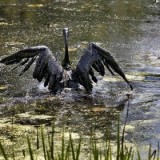
A casualty of Enbridge's recent oil spill in Battle Creek, Michigan, which has fouled up the Kalamazoo River - photo by Jonathon Gruenke

Enbridge pipeline: what’s in it for us?

Share

The Enbridge proposed pipeline from the Tar Sands to Kitimat has been much in focus since the terrible spill by Enbridge into the Kalamazoo River recently. This is the same company – which has a pathetic safety record, incidentally – that proposes a “1,170-kilometre pipeline moving petroleum from Edmonton to the deep-sea port of Kitimat on the central B.C. coast, and a smaller companion pipeline moving condensate along the same route”.
(See Fallout from Enbridge’s Michigan oil spill spreads to B.C., by Carrie Tait and Julie Fortier in the Financial Post.)

British Columbians should be asking a lot of questions, which they no
doubt will, which will be answered by the first class PR division of
Enbridge. One of their favourite answers – and I’m not sure the example
is right but it’s only by way of illustration – is that there are only 300
barrels of oil spilled for every 1,000,000 shipped. As I say, the
numbers could be different but they ignore, conveniently, that the
oil/sludge isn’t spilled 100 barrels at a time.

Let’s look at what’s in it for BC.

In a word, virtually nothing.

This isn’t a BC company employing the people of BC. There are no taxes from
Enbridge. At best perhaps some “peppercorn” rent for the right-of-way.

And what do we get?

A disaster waiting to happen!

A gloomy prediction?

Of course it is but it’s a fact. It’s simple mathematics and logic.

If you took a revolver with one hundred chambers and just one bullet and
started pulling the trigger with the barrel at your temple, and you
decided to do it 10 times, you run a risk and you can calculate it.

If you decided to do it steadily for one hour, you run a risk and can
calculate it.

If, on the other hand, you pull that trigger with no limit as to numbers
or no time limit, it ceases to be a risk but is a certainty waiting to
happen.

Thus it is with a pipeline. And thus it is with the Trans-Alaska
pipeline which spilled 5,000 barrels last May, which is only one of many.
The citizens of Alaska wish to God they’d never approved it in the first
place.

Now we’re not only dealing with a certain rupture of the pipeline, we’re
dealing with the uncertainty as to where the breach will come, how much will be spilled, and what damage will be done. The pipeline traverses some of the
most important grazing regions of caribou, not to mention our great
wilderness which, according the Campbell government, is the “best place
on earth”.

Enbridge presents this undertaking as great news for Northern BC and
Alberta. No doubt it helps Alberta to move its product – oil sludge – to
its market (China) but what does it do for Northern BC?

We hear of employment but never are told that most of that employment will
come from outside the province – nor that it will come mainly as short term construction jobs. In this regard it’s reminiscent of the
so-called “run-of-river” projects where the projects typically hire only a third local, and they are the lowest paying jobs.

Who’s going to patrol this pipeline and make sure that safety measures
are observed?

Presumably the same people who police the fish farms and the private
power people in whose interest it is to exceed their flow regimes.

It’s interesting to note that the oil/sludge, when it reaches Kitimat,
is no longer Enbridge’s responsibility but that of the tanker outfit
which probably flies a flag of convenience and is effectively not only
ill equipped to handle a spill but has no assets to speak of as well.

Do you think for a moment that Gordon (Pinocchio) Campbell will insist
upon a very large bond to be posted by Enridge or the tanker companies?

Right! And pigs can fly.

This project, then, does nothing for BC and presents the certainty of oil spills both on land and, once it gets to the tanker to China, on our coast.

This is, plainly, a great deal for Enbridge and oil/sludge producers but a lousy one for BC and ought not to be even countenanced.

Share

Federal MPs cancel oilsands pollution probe, destroy report

Share

Article by Mike De Souza in the Vancouver Sun.

“The government is in the process of categorizing industry-produced substances that could either be toxic or harmful, but has excluded naphthenic acid from the list, and left it off another list of substances that companies are required to track and report.

“The exclusion is ‘alarming,’ according to a letter sent Tuesday to Environment Minister Jim Prentice and Health Minister Leona Aglukkaq, since the federal and Alberta governments have already identified it as a primary source of pollution in liquid waste dumped into ponds after companies extract oil from the region.”

Read article

Share

Fallout from Enbridge’s Michigan oil spill spreads to BC

Share

Article by Carrie Tait and Julie Fortier in the Financial Post. “[Enbridge CEO Pat] Daniel said earlier Wednesday that the company will sit down with opponents of its proposed Northern Gateway pipeline to the Kitimat, B.C. to discuss the concerns they may have in the wake of the Michigan spill.”
Read article.

Article by Tim Martin of the Associated Press: Gov’t warned company about oil pipeline monitoring

Share
UNESCO biosphere reserve status has done little if anything to protect Clayoquot Sound

Clayoquot under siege: Ecological gem still threatened by logging, mining, fish farms

Share

“Every normal man must be tempted, at times, to spit upon his hands, hoist the black flag, and begin slitting throats”. (H.L. Mencken)

Those who fought to save the trees at Clayoquot and the tens of thousands of their fellow citizens – indeed environmental defenders from all over the globe – would, if they knew the truth, be appalled and ashamed and fighting mad at what has happened since 1994 when then Premier Mike Harcourt thought he had protected much of the Clayoquot old growth timber.

The battle known as the “War In The Woods” solved little if anything when all’s said and done. In 1993, the war commenced with almost 1000 protesters winding up in jail. The “war” became international with eco-stars like Robert F. Kennedy getting in the trenches. Clayoquot Sound was named a Biosphere Reserve by UNESCO. An independent panel of scientists got into the act as did the NDP government of the day – but once the fine print was read, the various agreements and legislative efforts following 1993 did little to change things. Tragically, as too often is the case, destitute First Nations – aided by newer, smaller outside companies only too eager to help them harvest and sell Clayoquot’s forests – wound up doing the logging. And they were no better able to do it in an environmentally sound way than were the large companies which left because they couldn’t make money if the new rules were enforced. The bottom line is that whether the area was clear-cut, helicopter logged, or a combination of methods, they could no longer turn a profit, so they left. But the First Nations need money and the forest suffers accordingly.

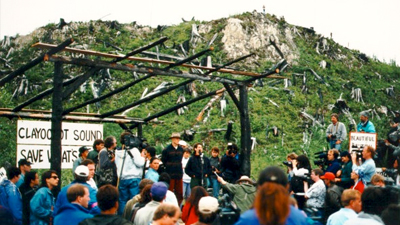
“War in the Woods” protests in Clayoquot Sound two decades ago

In the final analysis, Clayoquot Sound is an international symbol of how environmental fights usually end with the environmental groups winning the battle yet losing the war.

In fact, Clayoquot Sound environmentalists resemble a prize fighter who valiantly gets off the canvass only to be knocked down again, for in addition to the forestry battle they thought they had won, they might now be down for the count with several other environmental catastrophes in the ring wielding knockout punches.

Clayoquot Sound is an unbelievable gem in a coast of gems. Famous for its waves which attract thousands of surfers every year, it is, or was, also famous for its salmon fishing. Perhaps most of all, Clayoquot Sound is a place you want to be – a spectacular rain forest close enough to “civilization” to be reachable, yet seemingly remote.

As if the logging weren’t bad enough, there is a proposed copper mine on Catface Mountain, which, if it is approved and brought to fruition, will literally lop off a third of the mountain – and mine deep into its core. The good news is that the test drilling thus far shows low grade copper, calling into doubt its viability; the bad news is that if world prices of copper are high, this means huge open pit mining because extracting low grade mineral means much more rock must be taken for the undertaking to work. As I write this, 22 further holes are being drilled and results will be known by year’s end.

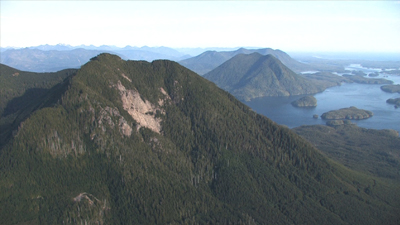
Catface Mountain, where Imperial Metals wants to build a mine

Clayoquot Sound has always been known for spectacular fishing, supporting substantial commercial and sports fisheries. Enter the salmon farmers. Much attention has been paid to the ruinous contact of Broughton Archipelago migrating salmon and the clouds of sea lice from fish farms there. More recently, thanks to the vigorous scientific work by Alexandra Morton, the environmentalist hero of the Broughton tragedy, we now know that sockeye from the Fraser are all but certainly facing the same fish farm-induced perils faced by the pinks and chum in the Broughton Archipelago. While the research into the impacts of salmon farms continues at Clayoquot Sound, every indication is that it’s Broughton Archipelago re-visited, and then some. (See my colleague Damien Gillis’ new film on the salmon farm situation in Clayoquot here).

The Department of Fisheries and Oceans is on the matter, but how comforting is that? Will it be the same DFO we’ve come to have contempt for? Will it again be like lying sick in hospital and the undertaker comes to visit with a tape measure in his hand? Unhappily, that’s not all. Tofino dumps its raw sewage into the ocean, sewage that increases as tourists arrive. The mayor and council know the harm this does but say, simply, that with the tax base they must work with they simply cannot provide the treatment that’s needed.

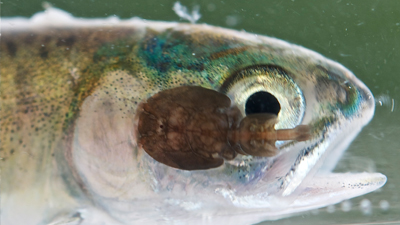
Clayoquot Sound salmon smolt with sea lice from nearby fish farms

The mayor and council have done their damndest to protect their beautiful unique sound, as have environmental groups, but as long as the situation I’ve described continues, it will be one pace forward, two paces back.

History tells us that DFO, who is supposed to protect wild fish, is mandated to support fish farms by a government of ignorant cretins which hasn’t a soupçon of care for the environment. We also know that the provincial government can’t wait to have private companies destroy our rivers for power and the profits destined for out-of-province shareholders of large international corporations – indeed one private power dam (the industry prefers we call them weirs) is under construction in Clayoquot, with several more to follow.

Clayoquot Sound, the place everyone thought had been made safe for nature, sits on the edge of the precipice overlooking utter destruction while industry – and it must be said some First Nations – and the two senior governments are fighting to see who will give it the last and fatal push.

If we are to have any hope of truly protecting this magical place, it’s high time we hoisted up that black flag again.

Share

Stopping Oil Supertankers in Vancouver

Share

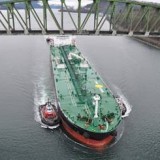
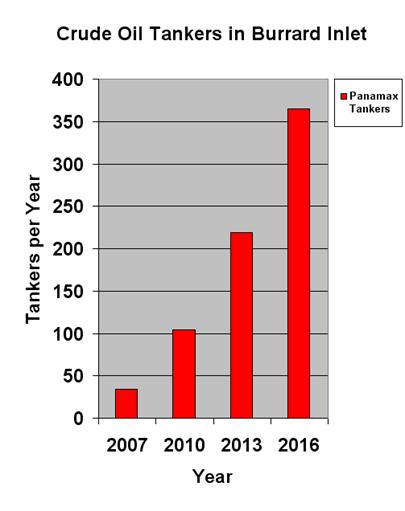
Did you know that massive tankers are shipping oil from the tar sands through Burrard Inlet, putting the entire south coast in grave jeopardy? Or that current plans are to increase volumes to up to 10 tankers per week? Concerned citizens gathered recently in Vancouver to hear from experts about the risks from these tankers and what British Columbians can do about it.

Tankers in Burrard Inlet graph

Share

Canadians Say No to Enbridge Pipeline and Tankers

Share

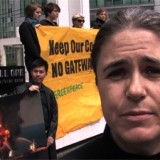
Greenpeace Canada and other environmental groups and citizens gathered outside the regional office of Enbridge in downtown Vancouver to say no to the company’s proposal to pump bitumen from the Tar Sands across BC and into coastal supertankers in the Great Bear Rainforest.

The demonstration was staged in conjunction with a similar one in Calgary outside Enbridge’s Annual General Meeting today. Concerns over the company’s BC proposal have been heightened by the recent environmental catastrophe in the Gulf of Mexico that has seen millions of gallons of oil pollute the marine environment and threaten coastal communities, fish, and wildlife.

Share
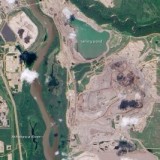
The Athabasca Tar Sands

The tar sands and us

Share

I cannot begin this article without mentioning the great column by Mark Hume
in the BC section of the Globe and Mail for March 27 on the proposed Enbridge
pipeline from the Alberta Tar Sands to the BC coast and thence down the coast
of BC: ‘It’s going to be bigger than Clayoquot Sound’.

The Battles of Battles

I spoke, in my recent column on Fish Lake, of the looming “battle of all battles” coming up on this lake issue but as the man said, “You ain’t seen nothing yet” for this is a multi-faceted fight, a war with plenty of wars within wars.

Here are the combatants: producers in the Alberta Tar Sands, the pipeline company and all they use for the construction, a large number of First Nations, the government of British Columbia, the Government of Canada, the United States (big time) and the Environmental Movement.

What are the Tar Sands?

Here’s the skinny on the Tar Sands: They are located in Northern Alberta, comprised of three major deposits making Canada an oil producing superpower like Saudi Arabia. These projects cover an area larger than England, with proven oil reserves amounting to 175,000,000,000 barrels.

We’re talking heavy, thick oil which requires serious processing before it becomes usable. It’s a dirty, dirty business. In fact, the Alberta tar sands oil holds three or four times the greenhouse gases found in “traditional” crude, making Canada the largest per capita polluter in the world.

Andrew Nikiforuk, a noted writer on energy matters, in an interview with seasoned journalist Charlie Smith of the Georgia Straight had this to say: “the Alberta tar-sands developments is the world’s largest construction project, the world’s largest capital project, and the world’s largest energy project – one that uses as much water in a year as a city with a population of two million”. More in fact than Edmonton and Calgary combined!

Points to ponder

  • The Tar Sands produces 40 million tonnes, annually, of greenhouse gas emissions currently; nearly the emissions of the Czech Republic
  • Tar sands GHG emissions may double by 2015
  • Producing oil from the tar sands releases three to five times more GHG emissions than oil from conventional sources
  • Every day the tar sands burn 600 million cubic feet of natural gas to produce tar sands oil, enough natural gas to heat three million Canadian homes
  • By 2020 tar sands GHGs will likely increase to 141 million tonnes, double the current emissions of all cars and trucks in Canada

Have we lost our minds?

What madness this all is! Wasn’t the idea that we’d wean ourselves off oil and concentrate our efforts and our money on substitutes? Can’t we see that by extracting oil that can only be viable if the price of oil is near $100 a barrel that we’re in fact making the high price of oil a self-fulfilling prophecy?

Who’s fighting whom?

In this corner we have the producers, the pipeline company, the governments of BC, Alberta, Canada, the United States of America, and more recently China and Korea – plus in all likelihood all the Chambers of Commerce along the way. Opposed are a number of First Nations and various environmental groups.

The governments don’t care

Ottawa, Edmonton and British Columbia will be thick as thieves and all will be
scheming in every way imaginable to get this job done. BC has already consented
to the tanker route so that problem is off the table. It must be borne in mind
that contrary to many assumptions, Canada supplies more oil to the US than does
any other country.

The pipeline is ostensibly being driven by a desire to reach new markets in Asia
as dirty tar sands oil comes under greater scrutiny from US lawmakers and a
public concerned about climate change. While this is true, the American market
for oil is growing – and its reliance on the Middle East is an increasingly
questionable policy. It’s thus fair to assume that some of those new Pacific tankers will be destined for the West Coast of the United Sates.

American politicians will be under enormous voter pressure across party lines because America’s entire economic future depends upon oil and power from Canada – which will put pressure on all three Canadian governments to play ball. In fact – and don’t laugh because it isn’t funny – as the demand for oil and power increases, be it BC energy or Alberta tar sands oil, if it appears that this oil and power is not forthcoming they are not going to let themselves have a massive depression and would threaten, at first behind closed doors and then publicly and meaningfully, to send in the troops. (If you were president of the United States and suddenly saw your economy in grave jeopardy – not a strong enough description – would you stand by and say “well Canada is our friend and as a sovereign nation can do as it pleases even though it beggars its neighbour?”)

The Constitution at rest

Under our constitution, the provinces control natural resources while Ottawa has power over exports backed up with the power of the purse. The Environment is a shared power. I don’t believe for a moment that the three Canadian governments will raise constitutional matters on this issue – from a social point of view (as in all things) Ottawa is too far away to care and for the two provinces, the economy will be all that matters.

They’ll not care that a pipeline goes through highly sensitive areas putting many animals, especially the caribou at risk.

It will not concern them for a nano second that an oil spill on the coast is not a risk, but a certainty; for a “risk” is an event waiting to happen. The question a “risk” raises is not “if” but “when”.

Enter First Nations


As I see it, then, the governments will continue their hypocritical two faced attitude towards the wishes of the people on things like the environment and other social issues.

It gets down, then, to the aboriginal peoples.

Gerald Amos, director of the Coastal First Nations, said recently “Natives have always understood the importance of protecting the environment, but with so many big resource projects proposed in B.C., it’s time to take a harder stand”.

“Perhaps we haven’t been strong enough… from here on out… we are going to be firm,” said Mr. Amos, who lives in Kitimat, near the terminus of Enbridge’s proposed Northern Gateway Pipeline.

Mr. Amos said legal challenges and political pressure will be used to stop the
pipeline, but “if it goes ahead and tankers come through our waters, we are
preparing to put boats right across the channel and stop them… Whatever it takes.
Our position right now is that this project is not going to happen.”
[Emphasis mine]

Wet’suwet’en hereditary chief Alphonse Gagnon said “This Energy Summit was a reminder that the tar sands affects us all – from Fort Chipewyan to Haida Gwaii and beyond. We can only protect our lands and waters if we stand together.”

Will money do the trick?

There are two fights as First nations see them – the pipeline itself and the tanker trade down the coast – meaning, to put it bluntly, the governments must come up with a huge and complicated pay-off, if a pay-off will do the trick. Before First Nations people get angry with me, I hope they remember that on fish farms and private energy schemes some tribes have indeed been bought off. (When I say that, I dare not be critical because I’ve never been in the dire economic straits that some bands have been coping with since the European arrived.)

But while Gordon Campbell responded to a recent unified declaration led by BC and Alberta First Nations against the pipeline by touting the jobs it would create, these aboriginal leaders have been quick to address and dismiss that argument. Grand Chief Edward John of the First Nations Summit countered Campbell: “We do need jobs and work for sure in our communities. But…first nations have looked at this very carefully and said the risks outweigh the benefits.”

Conclusion

The long and the short of it is that none of the three governments involved give a fiddler’s fart for social and environmental issues. They look at those who do as simpleminded “lefties” who “are just always against everything”.

The opposition to the pipeline will win or lose based on whether or not the First Nations involved along the pipeline and along the proposed tanker route will stay the course they have now set.

Share