Category Archives: Oil&Gas

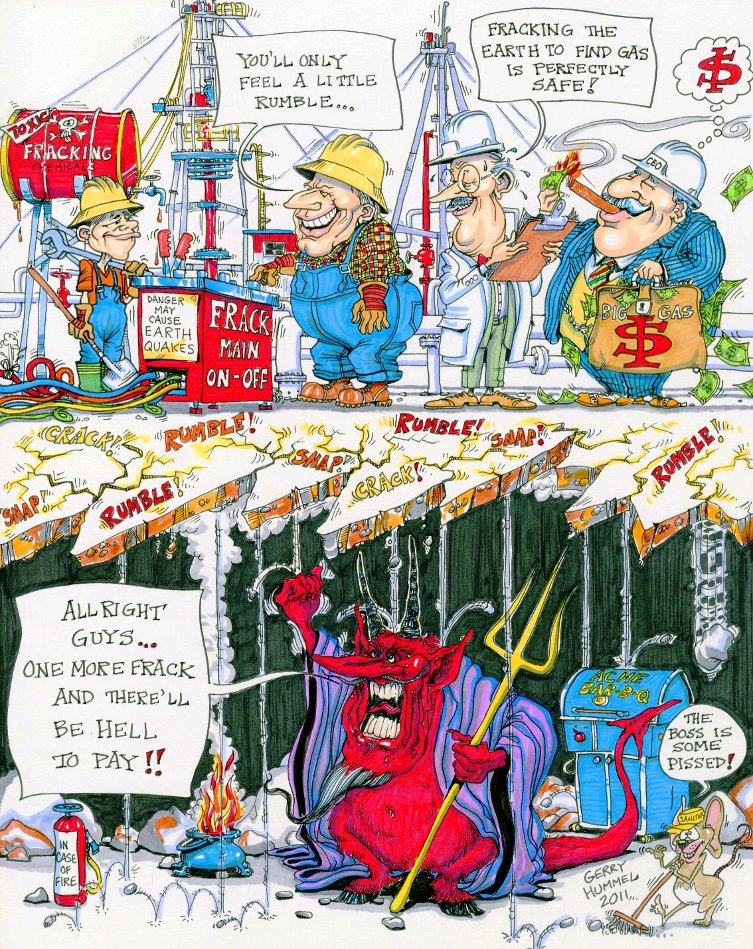
New Cartoon: The Unforeseen Consequenses of Natural Gas Fracking

Share

Check out the latest from our cartoonist Gerry Hummel. Hydraulic Fracturing, or “fracking” – a relatively new method for extracting natural gas – involves shooting a mixture of highly pressurized water, sand, and unknown chemicals deep underground in order to crack open shale formations to release gas. The value of the resource in BC has been pegged at $750 Billion – and while we’re going gangbusters to develop our local industry, concentrated in northeast BC, other jurisdictions throughout the US and Canada are putting the brakes on fracking until we have a better grasp of its ecological and geological consequences, and how to better manage the enormous volumes of water currently being used in the process.

Share

B.C. to continue ‘fracking’ for gas, despite bans elsewhere

Share

From the Vancouver Sun – March 30, 2011

by Jeff Lee

British Columbia has no worries about the controversial use of
hydraulic fracturing in natural gas production, even though other
governments have recently instituted moratoriums on the process, Energy
and Mines Minister Rich Coleman said Tuesday.

Earlier this month
Quebec halted the use of so-called “fracking” technology, which involves
pumping large volumes of water, sand and chemicals into shale gas
deposits to fracture the rock and force the gas into collection pipes.
Several U.S. states, including New York, and France have also halted the
use of fracking over concerns that not enough is known about the
long-term effects of the extraction method.

A number of
jurisdictions have worried that the method may lead to the contamination
of groundwater supplies and there have been periodic complaints from
neighbours, including allegations of gas seeping from domestic water
taps.

But Coleman said B.C. gas extraction companies have been
using fracking for many years without problems and have to meet what he
termed “the world’s most stringent environmental regulations.”

“I’m
actually pretty comfortable with the maturity we have in this
particular field,” he said. “I have seen nothing to date that would tell
me that we are not out front on all the environmental issues compared
to other jurisdictions.”

Doug Bloom, the president of Spectra
Energy Transmission’s western division, says he doesn’t believe
“fracking” in B.C. is as much an environmental problem as it is one of
access to sufficient water supplies.

“We know it has become an
issue elsewhere, but frankly … fracking is not a new technology,” said
Bloom. “We’ve been fracturing wells in Western Canada for decades and to
my knowledge there haven’t been any problems associated with that.”

Spectra
Energy, a Fortune 500 company, has five natural gas-processing plants
in B.C. In North America it has more than 30,000 kilometres of
transmission lines and more than eight billion cubic metres of storage
capacity.

Natural gas is one of B.C.’s most valuable resources.
This year royalties from gas exploration will deliver nearly $1.4
billion into provincial coffers. Nearly a third of Canada’s entire
natural gas reserves are in B.C. But it comes with the use of technology
that some opponents and environmentalists say has yet to be proven.

The
Canadian Centre for Policy Alternatives suggested in a recent paper the
long-term effects of fracking have yet to be understood.

And in
the Peace region, a group of residents called the Peace Environmental
and Safety Trustees Society has asked the province for a formal inquiry
into the health effects from sour gas wells.

But Bloom said the
use of fracking in B.C.’s northeast gas fields “has more to do more with
the water supply” than any long-term environmental concern.

“The
bigger issue in British Columbia is water use, what water supplies you
will use for fracking. Increasingly, what we’re seeing producers do is
recycle water so that they can reuse it and not use as much.”

He said Spectra isn’t concerned about the technology’s safety.

“We worry to the extent that the debate is informed and that it is science and fact-based.”

But not everyone is convinced that fracking is environmentally harmless.

John Walker, president of FortisBC, thinks B.C. will likely have to look at the impacts of the technology at some point.

“There
is a challenge. I think it is a challenge [of] how you manage this from
a regulatory point of view,” said Walker, whose company is the largest
natural gas distributor in Western Canada.

“You have to manage
the environmental impacts as you go forward and that is absolutely one
of the challenges that we have to work with.”

Bloom and Walker
were part of a Vancouver Board of Trade panel Tuesday that looked at the
benefits and business opportunities of natural gas in B.C. Both believe
natural gas production will lead to the continued development of new
forms of use, particularly in the area of transportation.

Fracking
has in recent years led to the revival of natural gas exploration
because it has solved a problem that has long vexed companies: how to
unlock gas trapped in shale deposits.

Ten years ago when B.C.
began to seriously expand gas exploration, it had a 10-year supply of
gas reserves, Coleman said. Now it has more than 100 years of proven
reserves in the northeastern part of the province, the Horn River and
Montney Basin deposits, and that doesn’t even include new reserves being
developed in the Liard, he said.

But that same technology has
also led to the development of numerous shale gas reserves elsewhere in
North America, with the result that the U.S. also has a 100-year supply.

As a result, gas prices have plummeted from a high of about $14 to $4 per gigajoule.

Walker,
who is not opposed to fracking, said the moratoriums against it in
other jurisdictions may have an impact on B.C.’s market.

“If you
curtail the use of fracking, there is no doubt that is the technology
and methodology that drove the ability to exploit these shales.

“I think we are going to have to find a way to manage it.

“Life
is always about trade-offs, whether we build a hydroelectric dam and
dam a river, whether we put windmills in bird migration routes. We’re
trading on that balance we have to strike between energy policy, the
environmental policy and economic outcomes.”

Read original article

Share

Gasland Filmmaker Josh Fox in Lethbridge: Solidarity, determination needed to halt fracking

Share

From the Lethbridge Herald – March 25, 2011

by Sherri Gallant

Josh Fox, the Pennsylvania producer of the Oscar-nominated documentary
“Gasland,” told those assembled Thursday at a conference on fracking in
Lethbridge that stopping the controversial drilling practice will take
solidarity and determination.

The sought-after filmmaker explained
to the crowd – mostly First Nations people from the Blood Reserve – how
his movie began as a grassroots project that started when he was asked
to lease his land for natural gas. His investigations took him down a
road he hadn’t anticipated, and the project quickly evolved into a force
for change, the notoriety of which has brought him both praise,
criticism and outright attack.

Today, he’ll be filming segments in southern Alberta which could end up in the “Gasland” sequel he’s working on.

“These interviews were so compelling and the stories started to become
so vast, I started showing them to people, friends of mine, with a
little voiceover that sort of explained the situation, and they said,
‘what have you got your hands on here? You have the ‘Inconvenient Truth’
on your hands, you have to set some time aside and work on this.'”

It wasn’t an easy commitment to make. Fox’s film and theatre company had
several long-term projects on the go and the fracking iceberg showed
signs of being a hulking monster under the surface. But he knew he
couldn’t ignore it.

Hundreds of hours of interviews and 15 months
on the road later, the film premiered at the Sundance Film Festival – an
immense coup.

“We were making a project for our friends, for our
neighbours, for our community, so that people could see what was
happening – and not just our community, but then our friends and
neighbours that we met in Colorado, and Wyoming, and Texas. So that they
had a resource, because information about what was happening with
hydraulic fracturing wasn’t available, it was scarce.

“Anyway, all of a sudden, everybody starts talking about fracking. The festival was a great success.”

Before long “Gasland” aired on HBO, was picked up in Canada, Australia
and the U.K. Fox has taken it on tour to 110 cities in all those
countries.

“I’ve witnessed such an unbelievable outpouring of
concern and support,” he said, “and resilience and integrity and dignity
on behalf of an enormous amount of people across the world. Hundreds of
thousands, if not millions who are right now directly in the crosshairs
of a huge natural gas development campaign that rivals anything that’s
ever happened before.

“I did find the same story again and again –
water contamination, air pollution, health problems, a sense that the
people had been lied to. And governments that were unresponsive to their
plights.”

People need to invest in and use renewable forms of energy, he said, and lobby their governments to make the same commitment.

“It’s no longer about ‘oh, don’t drive so much,’ or ‘conserve energy at
home.’ This is right here. It’s going to be a defining struggle for the
next 20 or 30 years. How do we get away from fossil fuels? We know we
have to. We can see what’s going on with climate change. We can see
what’s going on with all the toxic poisoning. The Gulf of Mexico.
Nuclear is the not the answer. The solar fields in Germany generate as
much power as that whole reactor in Japan.”
Every house, he said, can be its own power plant.

In a special naming ceremony after his talk, Fox was given the
Blackfoot name Ih Ka Mo Dahm (phonetic spelling), meaning survivor or
people who have survived. Elder Martin Eagle Child said it was chosen
not only because of the work Fox is doing, but because his father and
grandparents were survivors of the Holocaust.

The Blood Tribe
Conference on Fracking was organized by Kainai people in response to a
deal made by band chief and council with two oil companies to allow
fracking on two thirds of reserve lands. The deal came with a
$50-million signing bonus and potential for further revenue down the
road. A full slate of speakers throughout the day included Fiona
Lauridson, producer and director of the film “Burning Water,” which will
be screened tonight at 7 p.m. at the Lethbridge Public Library as part
of the International Film Festival.

Tribal officials have stated
they will go through every environmental step necessary to make sure the
drilling is safe. To date, no public notice has been made of any actual
applications to drill under the new agreement.

Read original article

Share

B.C. shale gas holds promise of new era in resource investment

Share

From the Vancouver Sun – March 14, 2011

by Gordon Hamilton

METRO VANCOUVER – Locked within the shale deposits of northeastern
British Columbia lies a natural gas reserve of unparalleled wealth that
could push the province into a resource boom unrivalled since the
development 50 years ago of the pulp-and-paper industry.

This
resource is nothing more than individual, tiny bubbles of hydrocarbon,
all that remains of a single organism that lived and died in a
primordial sea and was buried in the mud millions of years ago.

But
the accumulation of billions of such organisms over time adds up to gas
deposits of 250 trillion cubic feet to 1,000 trillion cubic feet,
according to the provincial energy ministry.

How much of that is
recoverable is a work in progress as companies drill into it. But even
at today’s low price for natural gas of $3 per 1,000 cubic feet at the
wellhead, those reservoirs could have a value beginning at $750 billion.

And the more companies drill, the more gas they find.

“We
haven’t finalized booking the reserves in the shale gas plays,” said
Ken Paulson, chief engineer and deputy commissioner at the B.C. Oil and
Gas Commission. “We are still getting information from some of the plays
which allows us to refine our estimates as to how much hydrocarbon is
actually in these reservoirs. But it’s a lot.”

Energy Minister Steve Thomson said shale gas is becoming mainstream development for the petroleum industry in B.C.

“The
magnitude and nature of B.C.’s shale gas resources creates
opportunities for long-term development planning by both industry and
government,” he said in an email to The Sun.

Northeastern B.C.
contains four major gas formations: The Montney basin near Dawson Creek,
the Horn River and Liard basins northwest of Fort Nelson, and the
Cordova Embayment, east of Fort Nelson. But the promise of wealth that
they offer is tempered by several facts: They are far from North
American markets for gas; they are more costly to get out of the ground
than conventional reserves; and the way the gas is being extracted is
drawing growing public concern.

The shale gas deposits have
triggered a slew of deals worth billions of dollars as global companies
jockey to gain a foothold in this new resource gold rush. Petro China’s
$5.4-billion investment with Encana, for a 50-per-cent stake in one B.C.
gas deposit alone, is the largest, while South African synthetic fuel
producer Sasol’s $2-billion investment in two of Talisman Energy’s gas
holdings perhaps brings the most promise.

Sasol is a world-leader
in technology of converting natural gas to synthetic diesel, and it has
agreed with Talisman to conduct a feasibility study around the economic
viability of a facility in Western Canada to convert natural gas to
liquid fuels.

“It’s exciting, innovative stuff,” said Travis Davies of the Canadian Association of Petroleum Producers.

Development
of the shale gas deposits brings with it a whole new way of looking at
the province’s resource wealth. But it also brings questions on how the
gas is being extracted and whether it will trigger a round of
value-added investment similar to the sprouting of pulp and paper mills
that came when new provincial forest tenures and policies spurred
logging in Interior forests in the 1960s.

Or, will the gas simply be exported as a raw commodity, the equivalent of exporting logs?

The
province has three options: Tap into new offshore markets where gas
prices are higher, add value by converting it to liquid fuels, or use it
to generate electricity.

“We need to find new markets. There are a
number of projects on the books right now … such as a liquefaction
plant and possible export terminal in the Kitimat area. These projects
have big implications for markets for gas, not just for B.C. gas but
North American gas, ” said Paulson.

The potential for a
petrochemical plant converting gas to liquid fuel in the province’s
northeast is particularly tantalizing, but B.C. has no policy framework
to encourage a petrochemical plant here. It could be built in Alberta.

The
third alternative, using gas to generate electrical energy, is far from
being a perfect solution. It’s cleaner than coal, but is still a fossil
fuel releasing greenhouse gases, even if only half those of coal. But
when the price of gas rises above the equivalent price of coal, power
producers can switch back to burning coal.

To access B.C. shale
gas, companies use a technique called hydro-fracturing, or fracking, to
release the trapped bubbles, which can be in shale deposits one to two
kilometres below the surface. The technique involves drilling a vertical
well about 18 centimetres wide until it reaches the shale layer. The
drill bore then is gradually curved to horizontal, where it can go for
another two kilometres through the shale.

Water, sand and a lubricating solution are then pumped at high pressure into the well.

The
water pressure fractures the shale into tiny pieces, creating millions
of surfaces, which release their gas. The sand keeps the pieces apart
and the gas within the shale is then forced to the well by the pressure
of the rock above.

But fracking is raising concerns over the
chemicals being used and the wisdom of fracturing part of the earth’s
crust. (Some are blaming it for a series of mini-earthquakes in
Arkansas, a region that is generally quake-free.)

Further, environmentalists fears of contamination of the aquifer if gases or chemicals escape.

Last
week, the province of Quebec placed a two-year moratorium on fracking
in shale gas deposits in that province while it develops regulations.

Energy minister Thomson said the situation in Quebec is far different than here.

“This
is a province where oil and gas exploration has been taking place for
decades. Quebec, on the other hand, is only beginning to establish an
oil and gas sector,” he said in the email. “It makes sense for Quebec to
take a prudent approach as they do not have the background and
regulatory structure in place like we do.”

Paulson said the province has kept abreast of technological change by expanding its regulatory regime to include fracking.

The
Oil and Gas Activities Act, which came into effect last October,
contains regulations that specifically address drilling of shale gas
wells and hydro-fracturing, Paulson said. Water stewardship is addressed
in regulations and companies are required to dispose of chemicals
safely.

Companies keep their chemical solutions secret, saying
they are proprietary. It amounts to less than one per cent of what is
injected, according to the Canadian Association of Petroleum Producers.

The
commission does not require them to divulge their chemical mix, but
they must keep on-site a list of the chemicals they use in fracking. If
for example, cross-contamination by one fracture full of fluid extended
into an adjacent fracture created by another well, then the commission
would want to know what exactly is in the solution.

That has never happened, Paulson said.

Read original article
Share

Tyee Special Report: In America’s Capital, a Fierce Fight over Oil Sands

Share

From TheTyee.ca – Match 14, 2011

by Geoff Dembicki

In the hallways and offices of America’s capital city, a
war is being quietly waged out of view of most Canadians and Americans.

The outcome will decide North America’s energy future and its impact on the planet’s climate.

The tactics are all the high pressure
persuasion and hard-ball politicking that tens of millions of dollars
can buy — many of those dollars contributed by Canadian taxpayers.

The war pits America’s largest
environmental groups against some of the world’s wealthiest corporations
and their “allies” in the Canadian and Albertan governments.

The battle line divides two viscerally
opposed camps: Those arguing that North America’s deepening dependence
on Alberta’s oil sands industry represents a pragmatic solution to
looming energy crises, and those who say relying on oil sands crude
marks an irreversible step closer to climate change catastrophe.

The prize, at end of the day, will be votes cast by politicians.

Will Washington’s legislators pass laws
that have the effect of opening the oil sands spigots wider, assuring
that Alberta’s bitumen crude increasingly, and permanently, flows into
the U.S. market?

Or will they legislate against high carbon
emissions fuel sources as a measure to reduce climate change? That could
severely constrict the flow of oil sands’ output into the U.S., dashing
the profit dreams of corporations — and some Canadian officials — who
have already bet hugely on providing bitumen-derived crude for American
consumption.

The Tyee goes to the story

With so much on the line, there has been
surprisingly scant coverage of how this battle is being waged and by
whom. Until now. Beginning today, The Tyee is publishing The War for the
Oil Sands in Washington, an in-depth, multi-part series that begins
with three stories this week and many more in the coming weeks.

The reporting comes out of months of research capped by a week spent
in Washington late in February, during which I interviewed oil sands
lobbyists, environmental advocates and the congressional insiders either
side hopes to influence.

What I found was an intense lobbying
campaign being waged by each camp, both battling for the sympathies of
Congress and the White House administration. The odds are clearly in
favour of the oil sands coalition, which holds enormous political
influence and has won major legislative victories on several fronts. But
the green coalition, especially with Barack Obama in power, has more
clout than its limited resources might suggest. 

Read full article

Share

Environmental group is concerned about the potential dangers of the gas released in northern B.C. fracking operations

Share

From the Vancouver Sun – March 9, 2011

by Ben Parfitt

Early last year, an army of workers at a remote
natural gas operation in northern British Columbia set a world record
for hydraulic fracturing or “fracking,” a procedure that is rapidly
becoming the norm in the global gas industry.

They pumped nearly
400 Olympic swimming pools worth of water along with 500,000 kilograms
of sand underground to fracture deeply buried shale rock, thereby
releasing its trapped gas.

As fracking becomes more common, people
living in natural gas-rich northeast B.C. are increasingly alarmed over
the associated public health and safety risks.

The pressure at
which water, sand and undisclosed chemicals is pumped below-ground is so
intense that it triggers tiny earthquakes. In using such brute force,
unforeseen and unwelcome problems can -and do -surface elsewhere,
problems that may include dangerous releases of gas containing hydrogen
sulphide, also known as sour gas.

Long before fracking arrived on
the scene, the health threats posed by chronic exposure to sour gas with
low levels of hydrogen sulphide were well known and ran the gamut from
irritated eyes to miscarriages. But it was the uncontrolled releases of
gas containing 300 parts per million or more of hydrogen sulphide that
filled people living in B.C.’s Peace River region with dread. Such
releases killed or seriously injured industry workers; caused deaths,
birth defects or miscarriages in cattle; forced people to abandon their
homes by dead of night; and led at least one school district to station
buses outside an elementary school in case sour gas escaped from a
nearby well site, forcing an emergency evacuation.

These and other
uncomfortable realities of living in the heart of B.C.’s natural gas
development zone, recently prompted a local citizens group -the Peace
Environment and Safety Trustees Society (PESTS) -to call upon the
provincial government to launch a formal inquiry under B.C.’s Health Act
to delve into the health risks associated with sour gas. The
justification for such an inquiry was laid out in chilling detail with
the assistance of Calvin Sandborn, at the University of Victoria’s
Environmental Law Clinic, and Tim Thielmann, an environmental lawyer.

The
initiative has since snowballed. Letters of support for an inquiry have
come from the Peace River Regional District, public health officers,
first nations and others. A common refrain in the correspondence is that
when it comes to key decisions on oil and gas industry activities -for
example, the locating of gas wells and pipelines that can release toxic
gas -public health officials are cut out of the loop. Yet it is they,
and the public they serve, who are forced to respond when things go
wrong.

Things most decidedly did go wrong in November 2009, when
failed piping at a gas well in the Peace region spewed 30,000 cubic
metres of gas into the air. Hydrogen sulphide levels in the escaping gas
were six times above lethal levels. The estimated eight-hour gas leak
forced the evacuation of 18 residents living near the community of Pouce
Coupe, killed a horse and resulted in at least one emergency
hospitalization.

B.C.’s Oil and Gas
Commission (OGC), which approved the well owned by Encana Corporation,
later concluded that frack sand corroded the pipes and caused the
potentially fatal leak.

Over the past three decades, at least 34
workers in B.C. and Alberta have been killed in sour-gas related
incidents and hundreds more disabled. By sheer luck, massive
uncontrolled sour gas releases in B.C. have often occurred far away from
local communities. In 2003, residents near Gao Qiao, in Chonquing,
China, weren’t so lucky. A sour gas leak there forced the evacuation of
64,000 residents and killed 243 people in what became a
25-square-kilometre death zone.

Escalating fracking activities
increase the likelihood of such leaks. As a recent OGC “safety advisory”
notes, high-pressure fracking operations have on at least 18 occasions
resulted in what are euphemistically called “communications” between
northern B.C. gas wells.

What this means is that fracking at one
well causes unwanted problems at another. In one such event, the same
type of corrosive frack sand linked to the Pouce Coupe disaster was
blown between two gas wells spaced 670 metres apart.

Under the
circumstances, members of the Peace Environment and Safety Trustees
Society should be lauded for being “pests.” By highlighting the public
health and safety risks associated with sour gas, they may force the
provincial government to do the right thing: Call an inquiry that is
clearly in the public interest, but most particularly in the interests
of the women, children and men who call the Peace River region home.

Ben
Parfitt is a resource policy analyst with the B.C. office of the
Canadian Centre for Policy Alternatives and author of Fracture Lines:
Will Canada’s Water be Protected in the Rush to Develop Shale Gas?, a
report for the Program on Water Issues at the Munk School of Global
Affairs.

Read original article

Share
A gas station in Delta shows the recent surge in fuel prices

Oil Roller Coaster Gets Wilder

Share

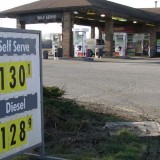
With the price of oil
soaring in recent weeks, politicians around the world are scrambling
to react. The price of the benchmark ‘Brent’ crude oil has
increased by almost 90%
in just 12 months
, to around $115 a barrel. Now some
speculators are betting that the price is headed towards $200
a barrel
, which would spell global economic chaos.

In Spain, the
government has already moved to reduce the highway speed limit and
lower train fares to save fuel. In the UK, the Conservative coalition
government was proposing to increase the speed limit but is now
suddenly reversing course and looking to take sudden action to cut
oil consumption. According to the Observer,
UK energy secretary, Chris Huhne, says they don’t have much choice.
“Getting off the oil hook is made all the more urgent by the
crisis in the Middle East. We cannot afford to go on relying on such
a volatile source of energy.” The problem for the UK government
is that they were counting on cheap oil, and made no preparation for
anything else.

The fact is that our
governments were warned about the potential for a destructive cycle
of oil price spikes and economic crashes years ago. For example in
the wake of the 2004 oil price spike, the US Department of Energy’s
Hirsch
Report’
warned of exactly this likelihood. Hirsch
recommended an immediate crash program to reduce US dependence on
oil, noting that even 20 years would be a tight time frame to make
the necessary changes.

In 2005, the
International Energy Agency published Saving
Oil in a Hurry
which focused on emergency
measures that could be taken to rapidly reduce transportation oil
consumption with some advance preparation. Recommended measures
include having plans to quickly create networks of bus and cycling
lanes. But it seems that most governments are not prepared, and are
now flailing about instead of implementing plans.

In BC, governments are
still acting as if oil was going to be cheap and plentiful forever.
Instead of taking logical steps to reduce oil dependency and protect
families from oil price shocks, the Campbell administration has spent
more and more on road and freeway expansions. For example, according
to Transport
Canada
, in 2008/2009 the BC provincial government
spent over $2.2 billion on roads and Bridges, up from $1.2 billion in
2001/2002. Much of this was spent on roadway expansions. In
contrast, the provincial government reported spending only $660
million on transit and nothing on BC railways.

Some of these roadway
expansion projects, such as the Golden Ears and Port Mann freeway
bridges, are supposed to be paid for by tolls. But even before the
most recent oil price spike, traffic and toll revenue was far below
what is needed to break even on the Golden Ears Bridge so TransLink
funds have been diverted from transit to pay for a mostly empty
freeway bridge. The new Port Mann Bridge and freeway expansion
represents $3.1 billion dollars that could have been invested in
transportation for the future such as electric
trains
, light rail and trolley buses.

The Port
Authority recently restarted plans to build another
container terminal
on the environmentally sensitive
Roberts Bank in Delta, on the assumption that international trade
will increase drastically in the coming decades. Our ports have a
large amount of excess capacity after Port Metro Vancouver recently
increased capacity at Deltaport by 50 percent and a new container
port was opened in Prince Rupert. The director of SFU’s urban
studies program, Anthony Perl, maintains that with
increasing oil prices long-distance trade
will decline
in the future rather than increase.

It is time to admit
that the age of cheap and easily accessible oil is over. The
remaining oil and petroleum gas is largely ‘unconventional’
supplies such as the tar sands. The cost of production of these
sources is high, but the environmental and social costs are even
greater concerns. For example, much of the gasoline and diesel we
burn in BC is now produced from tar sands bitumen – a process that
uses huge amounts of petroleum gas. Much of the gas burned in the tar
sands comes from BC and is extracted by hydraulic
fracturing or ‘fracking
‘ which result in
widespread water contamination.

The problem is not only
that our politicians are not prepared to make the changes needed to
overcome our excessive oil dependence. It is also that as soon as the
oil price roller coaster heads down hill again, they will once again
try to convince themselves that nothing significant has changed.

Like with global
warming, our leaders are mainly not prepared to lead. Ordinary people
are going to have to propose real solutions and oppose the most
destructive megaprojects our politicians dream up – such as the
North and South
Fraser Perimeter Road
freeways.

Share

Several injured in Alberta oil well blast

Share

From the Montreal Gazette – March 7, 2011

by Brent Wittmeier

EDMONTON — A 24-year-old man is in critical condition after an explosion at a sweet gas well southwest of Edmonton.

The
explosion happened at about 11:30 a.m. on Monday at a Husky Energy site
near the hamlet of Robb, Alta., said Occupational Health and Safety
spokesman Barrie Harrison. There were no fatalities, Harrison said, and
OHS is investigating the incident.

An air ambulance
transported a 24-year-old man in critical condition to the University of
Alberta hospital, said spokesman Cam Heke. Other patients were also
transported to Edmonton via fixed wing aircraft and ground ambulance,
Heke said.

The RCMP reports 12 injuries, saying patients
were transported to hospital in nearby Edson, Alta., by ground
ambulance. Three were sent to a burn unit in Edmonton. The Edson Fire
Department extinguished the fire, and RCMP secured the scene, said
spokeswoman Doris Stapleton.

The incident was caused by a
flash fire, said Graham White, spokesman for Husky Energy. The injured
patients were contract employees.

White called it “an extremely rare” occurrence and said the company has sent an investigation team to the site.

The
men were preparing to fracture the well with propane, said Energy
Resources Conservation Board spokesman Bob Curran. Fracturing involves
sending high pressure liquids down a well bore to cause fissures in
dense rock, allowing trapped natural gas to escape into the well and be
pumped to the surface. Curran said it’s common to use propane in
fracking operations.

He said no natural gas was released in the explosion.

The site is approximately 40 kilometres southwest of Edson and 265 kilometres southwest of Edmonton.

Read original article

Share

Enbridge Ready for its Close-up: Pipeline Sparks Creative & Cultural Movement

Share

If there’s one thing – and I do mean one – that we can thank Enbridge for, it’s the way the company’s plan to bulldoze a massive crude oil pipeline from the Alberta Tar Sands to BC’s spectacular and rugged coast has inspired an increasingly creative and vibrant cultural movement in opposition to the project. It seems the company is caught in a Chinese finger trap – the harder they sell their scheme, the stronger the resistance grows. Indeed, the usual inducements – temporary jobs, bonus payments, and the recent dangling of 10% profit sharing to First Nations along the pipeline and tanker route – don’t appear to be gaining any traction this time around.

On the contrary, the project is awakening and drawing together coastal indigenous communities – celebrating their culture and connection to the land and water threatened by the proposal. It has attracted global focus from world-class photographers and major international media outlets. It’s helping to forge unprecedented close-knit relationships between First nations, conservation groups, and citizens around the province. And it’s spawned a boutique creative genre unto itself, characteristic of the new media era in which we live. That is, a plethora of films, photography, animation, music, and other artistic endeavours dedicated to showing Canadians and the world the incredible places and people at risk from the pipeline and associated supertankers.

In other words, this revolution is definitely being televised…and screened, streamed, podcast, social networked in powerful ways – and it’s only getting started. It has been my distinct privilege to be some small part of it.

This whole creative movement was on full display during a special event held as part of the Vancouver International Mountain Film Festival last month. A crowd of some 700 people crammed into the Centennial Theatre in North Vancouver to take part in “spOILed”, an evening filled with films, photography, and amazing guest speakers, each with an important story to tell (watch highlight video – story continues below).

Looking at the packed program (the event ran from 6:30 to nearly 11 o’clock) I wondered if it wouldn’t be a tad overwhelming for the audience – yet nearly everyone stayed to very end. And with good reason. They were treated to a veritable visual feast – juxtaposing spectacular natural images with the Tar Sands and myriad oil-related disasters of late that have only reinforced the concerns of Enbridge’s critics (three of these big spills from last year came from Enbridge itself, including the infamous disaster on Michigan’s Kalamazoo River).

The crowd also heard from some some terrific speakers throughout the evening, expertly emceed by one of the campaign’s tireless leaders, conservationist and photographer Ian McAllister of Pacific Wild. The event was co-sponsored by the International League of Conservation Photographers, a group of the world’s top photojournalists – many of them regular National Geographic Contributors – who journeyed to the Great Bear Rainforest last year. A sampling of their stunning work was on display throughout the evening.

Among the event’s highlights was renown photographer Garth Lenz – whose work Alberta bitumen cheerleader Ezra Levant has referred to as “Tar Sands Porn” (a high compliment, considering the source). Lenz has produced some of the most iconic images of the world’s largest industrial project, which he shared with the audience during a compelling presentation on the other end of the pipeline. An exhibition of Lenz’ work opened the day after this North Vancouver event at a major gallery in Los Angeles.

The audience was also treated to a presentation by enigmatic adventure filmmaker Frank Wolf on his 2,400 km journey from the Tar Sands along the proposed pipeline route to BC’s coast. Wolf previewed his upcoming feature documentary on the expedition – which he and a colleague made through a combination of hiking, paddling, and cycling over several months last summer.

Norm Hann, a veteran wilderness tourism guide in the Great Bear Rainforest, discussed his own unique journey by paddle board – a surf board-type device atop which he paddled 400 km along the the proposed pipeline route. He too is producing a documentary titled “Stand Up for the Great Bear Rainforest”.

Among the numerous other speakers throughout the evening was Marven Robinson – a spirit bear guide from Hartley Bay and impressive photographer in his own right. Robinson was instrumental in initiating the iLCP expedition to his traditional territory. He and Ian McAllister were the stars of the evening’s highlight – a new feature documentary by EP Films on the iLCP expedition and Enbridge issue. The film, SPOIL, claimed the environmental film prize at the Vancouver International Mountain Film Festival that week. SPOIL also features renowned Canadian photojournalist Paul Nicklen, who worked with Robinson on a forthcoming cover spread for National Geographic on the sprit bear.

South African photographer Thomas Peschak – one of the world’s top underwater cameramen and chief photographer for the Save Our Seas Foundation – reported in via video address from his latest shoot in the Middle East, highlighting some of the amazing work he did recently capturing the underwater life of the Great Bear Rainforest during the iLCP expedition.

Closing out the night was a stirring speech by Heiltsuk First Nation leader Frank Brown, thanking the above filmmakers and photographers for their work exposing the Enbridge battle to the world and calling on non-aboriginal people to join forces with First Nations to help protect the Great Bear Rainforest from oil tankers.

These films and projects are just a sampling of the creative bonanza Enbridge’s proposal has unleashed. And as the company, provincial and federal governments show no signs of throwing in the towel, one can only imagine the cultural connections and creative resistance they will continue to inspire.

So, smile, Enbridge: You’re on candid camera.

Share

Libya’s Gadhafi threatened to nationalize Petro-Canada operations: WikiLeaks

Share

From the Winnipeg Free Press – Jan 31, 2011

by Jim Bronskill

OTTAWA – A newly leaked U.S. diplomatic note says Libya
threatened to nationalize Petro-Canada’s operations in the North African
country over a spat with the Conservative government.

It’s the latest revelation in a bizarre international saga that first grabbed headlines two years ago.

Libyan leader Moammar Gadhafi cancelled a late September 2009
stopover in Newfoundland after Foreign Affairs Minister Lawrence Cannon
promised a tongue-lashing for the hero’s welcome Libya extended to a man
convicted in the Lockerbie bombing.

The U.S. cable, obtained from WikiLeaks by British
newspaper the Daily Telegraph, says Libya’s state oil company called in a
senior Petro-Canada official with a threat to nationalize the firm’s
operations in Libya if Canada did not apologize.

At the time, Petro-Canada had just merged with fellow Canadian oil giant Suncor.

The cable says Canada’s ambassador to Libya, Sandra
McCardell — whose name is misspelled throughout — told the U.S. Embassy
in Tripoli the Libyans demanded the apology within 24 hours.

“McArdle said she has advocated some kind of public and
private statements from the Canadian (prime minister) and (foreign
minister), which would indicate a Canadian welcome for the Libyans and
hopefully turn the situation around,” the cable says.

“Libyans here are frantically calling the Canadian
Embassy, concerned that if the issue is not resolved, Gadhafi’s trip
home will be complicated by lack of a place to stop for necessary
refuelling.”

The Sept. 28, 2009, cable also says McCardell told her
U.S. counterpart that Ottawa had initially planned to refuse the
eccentric Gadhafi permission to stop on Sept. 29-30 in Newfoundland en
route to Spain from the United Nations.

“On instructions from Ottawa, McArdle said that she
informed the Libyan government in mid-September that Gadhafi was not
welcome to visit Canada at this time,” the cable says.

It adds that McCardell, who had just arrived in Tripoli
and had not yet presented her diplomatic credentials, seriously believed
she could become persona non grata or have her agreement revoked.

“Fearful of delivering bad news to Gadhafi, McArdle
explained that the notoriously slow Libyan bureaucracy delayed passing
Ottawa’s message to the Leader for several days.”

In the meantime, Canadian companies with business
interests in Libya “launched a furious lobbying effort” and persuaded
Stephen Harper’s Conservative government to allow the trip to go
forward, the note says.

“However, McArdle said that the Canadian government’s
precarious domestic situation and upcoming elections pressed the Foreign
Minister (Cannon) to go public with his very stern message.”

Though Gadhafi’s government did not follow through on its
apparent threat to take over Petro-Canada’s operations, a second
WikiLeaks cable obtained by the Daily Telegraph indicates it doled out a
milder punishment.

The Libyan government issued an order Sept. 30, 2009,
forcing Petro-Canada and its operator, Libya’s Hrouj company, to cut
production by 50 per cent, the note says.

The move came less than a day after McCardell had told
the U.S. ambassador that she and Libya’s foreign minister had settled
the issue.

The U.S. cable says while reasons for the production cut
were unknown, a source whose name is excised from the note “intimated
that the order had come from the highest levels, i.e. Moammar Gadhafi
himself.”

The move may be a “cheap” way for the Libyans to punish Petro-Canada for Ottawa’s gruff words, it adds.

Diplomats from Britain and Italy, nations with significant investments in Libya, appeared unsettled by the news, the note says.

Indeed, the earlier cable reveals both Britain and the
United States were prepared to intervene on Petro-Canada’s behalf “to
emphasize that it is not good for Libya to threaten existing and
potential investors and violate the sanctity of contracts with such
abandon.”

“The situation between the Libyans and the Canadians
reflects vintage Libyan policy to strike hard at any quarter that
insults the Leader publicly.”

In October 2009, Libya retaliated further, making it
clear that Canadian travellers were not welcome in the country by
refusing to grant visitor visas.

Read original article

Share