Category Archives: Energy and Resources

CBC on NEB Cancelling Day 1 of Bella Bella Enbridge Hearings – incl. Audio Clip

Share

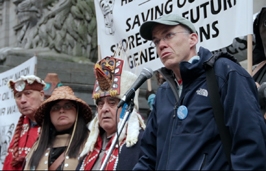
Read this report from CBC on the National Energy Board’s decision to cancel the first day of the Joint Panel Review hearings on Enbridge in Bella Bella after the panel was greeted by a demonstration at the local airport – featuring images and commentary by Damien Gillis. (April 2, 2012)

A public hearing for the Northern Gateway Project has been unexpectedly cancelled after panel members were met by protesters at the Bella Bella airport in B.C. on Sunday afternoon.


The review panel was scheduled to hold four days of hearing in the remote community to gather local concerns about the controversial proposal to build a crude oil pipeline from Alberta to the West Coast.

A large crowd greeted the panel members when they arrived in Bella Bella, but later on Sunday afternoon, Monday’s hearing was cancelled. Some high school students in the community reportedly began a 48-hour hunger strike after the panel arrived.

Heiltsuk First Nation Chief Marilynn Slett told a community meeting that the review panel had sent a notice that it would not be proceeding with the sessions because of security concerns.

“It was their perception that it wasn’t a very secure or safe environment,” Slett told CBC News on Monday morning.

But Slett says the protest and the community are peaceful…

…Documentary filmmaker and environmental activist Damien Gillis said the protesters were not threatening anyone.

“The RCMP was in attendance, I’ve spoken to the detachment commander. They are baffled at this reaction. They didn’t observe anything unlawful or remotely threatening.”

North Coast NDP MLA Gary Coons arrived on the plane with the panel members and said all he witnessed was a peaceful gathering.

“It is insulting to the Heiltsuk community and those that were there that they would feel that way. The members of the joint review panel have been welcomed in respectful ways to every First Nations community that they have gone to and this would be no different.” said Coons.

Both Coons and Slett are hopeful a meeting with panel members on Monday morning will help resolve panel’s concerns and get the public hearings back on track.

Read full article and listen to audio clip: http://www.cbc.ca/news/canada/british-columbia/story/2012/04/02/bc-bella-bella-gateway-hearing.html


Share

Budget: Harper Govt. Goes After Charities who Question its Resource Development Plans

Share

Read this story form the Hill Times on the Harper Government’s intention laid out in its recent budget bill to go after charities who are critical of its oil and resource development plans. (March 29, 2012)

Opposition MPs say a surprise allegation in the federal budget that Canadian charities are violating federal rules limiting their political advocacy is retribution for widespread opposition from environmental groups to the massive Northern Gateway oil sands pipeline across British Columbia.

PARLIAMENT HILL—Opposition MPs say a surprise allegation in the federal budget that Canadian charities are violating federal rules limiting their political advocacy is retribution for widespread opposition from environmental groups to the massive Northern Gateway oil sands pipeline across British Columbia.

The obscure provision in the budget Thursday to beef up the Canada Revenue Agency’s “enforcement tools” to monitor political activities of charities demonstrates the partisan nature of the Conservative government, opposition MPs said.

NDP MP Megan Leslie (Halifax, N.S.) told The Hill Times the measure is one of several provisions that show the budget, aside from its main thrust of public service spending cuts, is all “pipeline, pipeline, pipeline.”

“The over-arching theme here is this is a budget for the great pipeline to China,” Ms. Leslie said. “This is about pipelines, pipelines, pipelines, and at any cost.”

“Whether it is going after charities, who might have a different opinion, cutting the National Roundtable on the Environment and the Economy and cutting Environment Canada and not relying on science and evidence, or whether it’s going after the Environmental Assessment Act and weakening it, that’s what this budget says to me, it’s all about pipelines,” Ms. Leslie said.

The reference to political activities of charities was a needle in the haystack of the budget’s total $5.2-billion in broad spending cuts the government of Prime Minister Stephen Harper (Calgary Southwest, Alta.) is proposing for the next three years, with a projection that the spending reductions, combined with other economic forecasts, will result in a surplus by 2015, the next federal election year.

But the measure was so unexpected at the traditional pre-budget lockup for journalists that Reuters news correspondent David Ljunggren asked Finance Minister Jim Flaherty (Whitby Oshawa, Ont.) about it at a news conference before Mr. Flaherty tabled the budget in the Commons, asking Mr. Flaherty why the budget was putting the “tax police” on charities.

“We’re not making any changes in the rules relating to charities, we are providing some resources, some additional resources for enforcement of the rules by the Canada Revenue Agency,” Mr. Flaherty said.

“Quite frankly, we’ve had a lot of complaints and concerns expressed by Canadians that when they give money to charities they expect the money to be used for the charities purposes, not for political or other purposes,” he said.

“This not black and white, because the Canada Revenue Agency permits a small percentage of dollars to be used for advocacy and other purposes, but there is clearly a need, in our view, for more vigilance, that charities obey the rules as they are now,” Mr. Flaherty said.

The main budget document noted charities are allowed to engage in political activities, centered primarily on advocacy, as long as the activities are related to their charitable goals and represent a limited portion of their resources—no more than 10 per cent for larger charities.

Read more: http://www.hilltimes.com/news/politics/2012/03/29/feds-attack-charitable-sector-in-budget-for-being-too-political-say-opposition/30234

Share

Watch CTV First Story on Enbridge Pipeline: “Crude Awakening”

Share

Watch this new CTV First Story investigation of the debate over the proposes Enbridge Northern Gateway Pipeline, “Crude Awakening.” The 23 min documentary examines the conflicts within coastal communities over the promises of jobs from the pipeline vs. the very real threat of an oil spill disaster.

Watch “Crude Awakening”: http://www.ctvbc.ctv.ca/servlet/an/local/CTVNews/20120321/bc_ctv_first_story_1404_crude_awakening_120322/20120325?hub=BritishColumbiaHome


Share
BC Conservative Party Leader John Cummins and his new MLA, John van Dongen (photo: Adrian Lam/Postmedia)

Conservatives’ Van Dongen Grab Raises Questions About Cummins’ Integrity

Share

The resignation of John Van Dongen from the Liberal caucus to become an instant one-man Conservative caucus has, for me at any rate, put the focus on John Cummins.
 
Let’s look at Mr Cummins’ record and positions.
 
Mr. Cummins’ claim to fame is his integrity – his record of standing up for BC and his constituency in the House of Commons and paying for this integrity by permanently putting himself offside with Stephen Harper thus disqualifying himself from cabinet.
 
What was the issue that came up time after time in Cummins’ parliamentary career?
 
No prize for saying BC’s wild salmon. He flouted the law in the cause, risking jail. He fought against First Nations accusing them of illegal fishing. Whenever the subject of BC salmon was raised you would find John Cummins fighting for the symbol and very soul of our province – our wild salmon. I shared platforms at protests with him. On the question of fish farms Cummins stated that there were serious problems that had to be addressed.
 
This raises two questions – the first was raised by Charlie Smith in the Georgia Straight in the March 27 edition which I sent in a mail-out and is posted on Facebook, namely, how does Mr. Cummins welcome to his new caucus a man who was so steadfast in his defence of fish farmers he even warned them when the enforcement officers were coming and had to resign in consequence?
 
Is that the Cummins integrity we hear so much about?
 
I go further, why didn’t either Cummins or Van Dongen deal publicly with this apparent major conflict on a huge issue – why was it left to Smith?
 
This is small potatoes and will no doubt be brushed aside by noting that fish farms are now a federal matter.
 
Let’s go to the main issue that will keep Cummins contained within the boundaries of the far right – the Enbridge pipeline and the consequent tanker traffic down our beautiful yet extremely hazardous coast as well as through Vancouver.
 
Some questions for Mr Cummins:

  1. It is a mathematical certainty that the pipeline will have ruptures and spills – do you agree? If not, are you saying that it won’t happen?
  2. Enbridge has an appalling accident record – 811 since 1998 – does this not concern you?
  3. Are you aware that the pipeline would cross over 1,000 rivers and streams, most of which have fish in them, many tributaries of major spawning rivers and creeks with at least three being essential to large runs of spawning salmon? Assuming that you are aware, where is your concern for the fish you claim to love so much?
  4. Are you aware that the 1,100km line passes through the Rockies and Coast ranges thence through the Great Bear Rainforest? Assuming you are aware, how does Enbridge fix a leak or rupture? How does Enbridge get men and machines into the afflicted area when it’s only accessible by helicopter?
  5. Are you aware that Enbridge has admitted that there will be spills and have set up clean-up protocols even though they’ll not do any good? Are you aware of the fact that even if Enbridge could get to the site, there’s bugger all they can do? Have you examined the Kalamazoo case where 20 months later Enbridge is still trying to clean up a spill – which they categorized as minor – exposing that even though it happened in a populous state by a highway it never will be cleaned up? Do you know about this Mr. Cummins?
  6. Are you aware that Environment Canada, scarcely filled with eco-freaks, has said that there will be tanker accidents on a regular basis with a major one every 10 years?
  7. Here’s what long time fisherman in the area, John Brajcich has to say:

With our family’s 80 plus years of fishing in the Whale Channel area we have firsthand knowledge of tides, weather, types of fish and bird life. The area from Kitamaat to Hecate Straits is designated Area 6, by Fisheries and Oceans Canada and is the most consistent salmon producing region in British Columbia with runs in the odd and even years.

In Area 6 there is:

  1. Within the Central coast area 128 salmon bearing streams
  2. Kitasu Bay to McInnes Island is a major herring spawning  ground
  3. All 5 species of salmon, herring, crab, mussels, clams, abalone, prawns, eulachons, pilchards, hake, geoduck, mackerel, halibut cod, pollock, otters, eagles and many birds, plus whales and porpoises
  4. Tides that fluctuate over 20 feet causing currents of up to 5 knots
  5. Being a region of heavy snow and glaciers there are very strong freshets from May to the end of July
  6. The outflow winds from Douglas Channel can be extreme during summer and winter
  7. Weather in Hecate Straits – because of strong complex currents, waves have been recorded up to 30 metres. The highest wind gusts recorded for November, December, January, February and March is 180 -190-plus km per hour.

If a ship enters Laredo Channel from Hecate Straits at McInnes Island the tanker would have Lenard Shoal and Moody Bank at the bottom of Aristazabl Island. On the east side of Aristazabl Island there are 2 very  dangerous rocks known as Wilson and Moorhouse. Campania Sound is also a very treacherous body of water from Dupont Island to Hecate Straits.

There are many rocks and to name a few, Bortwick, Cort, Ness, Evans, Cliff and Janion also Yares Shoal. This area is a minefield of reefs. These rocks are spread out between Rennison Island, Banks Island and Campania Island. This route would be extremely dangerous to tanker traffic. Using the Otter Pass route, Nepean rock becomes a very prominent problem for ships’ travel.

On the question of damage Mr  Brajcich says:

Should a major oil spill occur I feel an oil boom would not be able to contain it because of the velocity of the current in this area and the oil could travel 20-50 miles in one 6 hour tide. This area is not the Mediterranean or a lagoon.
 
If a spill occurred in Laredo Channel the herring spawning area at Kitasu Bay to Price Island could be totally destroyed, possibly forever. The eel grass which the herring need to spawn on could be wiped out. Some years over 10,000 tons of herring spawn in this area.
 
A spill at freshet time would be the  most devastating. Due to the differences of its viscosity, salt water is heavier and would be lower and the fresh water being lighter, becomes a shallow layer at the surface. The juvenile salmon live in this fresh water layer as they  migrate to sea. The juvenile salmon jump like raindrops and if they were migrating in a spill area the oil could wipe out an entire run. Some streams could become barren of salmon.

Do you accept that evidence, Mr. Cummins? If not, where do you quarrel with your fellow commercial fisherman’s evidence?

Let me be blunt.
 
With the forgoing, how can you possibly support the Enbridge pipeline and tanker traffic of more than 200 per year out of the port of Kitimat?
 
How can you possibly expect the public of BC to vote for a man and a party that approves the certainty of massive damage to our beautiful wilderness accompanied by huge, irreparable damage to our coast and destruction of hundreds of thousands of BC wild salmon – likely permanently.
 
Let me tell you this, Mr. Cummins – you are a man I’ve long admired for the courageous stands you have taken on the preserving and enhancing of our BC salmon.
 
But that’s before you looked just like the political phoneys you used to fight so hard when you had a halo.

Share

Ta’Kaiya Blaney Sings “Shallow Waters” at Vancouver No Tankers Rally

Share

Eleven year-old Ta’Kaiya Blaney of the Sliammon First Nation sings her hit song “Shallow Waters” to some 2,000 people outside the Vancouver Art Gallery. She tells the audience one year ago on this day she was chased from Enbridge’s Vancouver office when she tried to present her song to company officials. 


Share

Bill McKibben at No Tankers Rally in Vancouver

Share

World renowned climate activist Bill McKibben of 350.org lent his voice to the “Our Coast, Our Decision” rally in Vancouver Monday. McKibben told the crowd of close to 2,000 outside the Vancouver Art Gallery, “This is one of these great moments in human history and you guys are absolutely at the white, hot centre of it.”

Share

Sandra Steingraber’s Dear John Letter to Sierra Club Over Millions in Secret Donations from Fracking Industry

Share

Read this letter by celebrated environmentalist and author Sandra Steingraber – published on the Orion Blog – on the story that’s been sending shock waves through the American environmental community over the past month. Steingraber takes her once beloved Sierra Club to task for accepting $25 million in secret donations from major unconventional gas player Chesapeake Energy. (March 23, 2012)

Dear Sierra Club,

I’m through with you. 

For years we had a great relationship based on mutual admiration. You gave a glowing review of my first book, Living Downstream—a review that appeared in the pages of Sierra magazine and hailed me as “the new Rachel Carson.” Since 1999 that phrase has linked us together in all the press materials that my publicist sends out. Your name appears with mine on the flaps of my book jackets, in the biography that introduces me at the speaker’s podium, and in the press release that announced, last fall, that I was one of the lucky recipients of a $100,000 Heinz Award for my research and writing on the environment.

I was proud to be affiliated with you. I hoped to live up to the moniker you bestowed upon me.

But more than a month has past since your executive director, Michael Brune, admitted in Time magazine that the Sierra Club had, between 2007 and 2010, clandestinely accepted $25 million from the fracking industry, with most of the donations coming from Chesapeake Energy. Corporate Crime Reporter was hot on the trail of the story when it broke in Time.

From the start, Brune’s declaration seemed less an acknowledgement of wrongdoing than an attempt to minister to a looming public relations problem. Would someone truly interested in atonement seek credit for choosing not to take additional millions of gas industry dollars (“Why the Sierra Club Turned Down $26 Million in Contributions from Natural Gas Interests”)?

Here, on top of the Marcellus Shale, along the border between Pennsylvania and New York—where we are surrounded by land leased to the gas industry; where we live in fear that our water will be ruined, our mortgages called in, our teenage children killed in fiery wrecks with 18-wheelers hauling toxic fracking waste on our rural, icy back roads; where we cash out our vacation days to board predawn buses to rallies and public hearings; where we fundraise, donate, testify, phone bank, lobby, submit public comments, sign up for trainings in nonviolent civil disobedience; where our children ask if we will be arrested, if we will have to move, if we will die, and what will happen to the bats, the honeybees, the black bears, the grapevines, the apple orchards, the cows’ milk; where we have learned all about casing failures, blow-outs, gas flares, clear-cuts, legal exemptions, the benzene content of production fluid, the radioactive content of drill cuttings; where people suddenly start sobbing in church and no one needs to ask why—here in the crosshairs of Chesapeake Energy, Michael Brune’s announcement was met with a kind of stunned confusion.

Read full story: http://www.orionmagazine.org/index.php/newsfrom187/entry/6799/


Share
Independent MLA for Cariboo-North Bob Simpson recently toured natural gas fracking operations near Dawson Creek, BC

Audio: Sean Holman, Damien Gillis Talk Fracking, MLAs’ Trip to Peace Country

Share

Get MP3 (23 MB)

Listen to this interview by Sean Holman of documentary filmmaker Damien Gillis on his recent trip to Northeastern BC to learn about some of the effects of the unconventional gas industry on farming families around the Dawson Creek area. Gillis has been working for the past year on a feature documentary film involving the controversial fracking business and recently followed independent BC MLAs Bob Simpson and Vicki Huntington to the community of Farmington to engage with local landowners on the issue. The pair have worked hard to raise in the Legislature issues surrounding the regulation of the industry and its impacts on water, health, and the province’s economy. (March 24 – 20 min)

Share

Trailbreaker: Yet Another Tar Sands Pipeline in the Works

Share

With all the recent controversies and media attention surrounding the proposed Northern Gateway and Keystone XL pipelines, you would not be remiss in thinking that these are the only projects currently being considered to get tar sands crude to foreign markets. But you would be wrong.

It seems the Canadian government is quite serious about plans to triple production of tar sands bitumen and would not be satisfied even if they were somehow able to bulldoze public opposition to Keystone and Gateway. Although the project has not been officially confirmed, plans are in the works to pump bitumen from northern Alberta through Montreal to the Atlantic coast city of Portland, Maine, where tankers would then transport about 200,000 barrels a day of the heavy crude to U.S. Gulf Coast refineries and foreign markets.

This so-called Trailbreaker project would appear to present fewer regulatory obstacles, as it would not require construction of a new pipeline. Instead, the flow of the existing Portland-Montreal pipeline, which currently brings oil from Africa and the Middle East into eastern Canada, would simply be reversed.

According to the Portland Daily Sun, David Cyr, treasurer of the Portland Montreal Pipeline Company, is on the record recently as saying, “We do not have an active project…in terms of bringing western Canadian crude here.” While it may well be true that there is no “active” project, Cyr’s comments hardly amount to a rigorous denial and they fly in the face of active rumours I have been hearing out of Canada’s Department of Foreign Affairs and International Trade.

Indeed, as recently as last summer Mr. Cyr was quoted in The Globe and Mail as saying, “We’re still very much interested in reversing the flow of one of our two pipelines to move western Canadian crude to the eastern seaboard. We’re having discussions with Enbridge on their Line 9 and what it means to us.” Moreover, other insider industry sources have previously confirmed that discussions are underway to expand the Enbridge proposal to carry tar sands bitumen to the Atlantic.

Enbridge, the company behind both Trailbreaker and Northern Gateway, has already requested fast-track approval from the National Energy Board of their $16.9 million plan to reverse the flow of tar sands crude from western Canada to Montreal. Yet according to Dylan Voorhees, Clean Energy Director of the Natural Resources Council of Maine, this is merely phase one of a plan that would then be followed by a reversal of the Portland Montreal Pipeline. The NRC believes that by splitting the project into pieces, Enbridge is attempting to bypass full regulatory and public scrutiny.

Enbridge had secured permission in 2010 from the Quebec Commission for the Protection of Agricultural Land to build a pumping station near the town of Dunham, Quebec. Just last month, however, the environmental group Equiterre and a citizen from Dunham won a Quebec Court ruling by arguing successfully that the issues surrounding the pumping station were not fully aired at the commission. This ruling would appear to stall, for the time being, an attempt to ship oil from Montreal to Portland.

The NRC recently joined three other environmental groups in Portland to educate the public on the dangers of transporting tar sands bitumen. “The larger context is that there’s a large effort of getting tar sands crude oil out of Canada,” said Voorhees. “It doesn’t seem prudent on us to wait until there’s an application to start learning about this because it’s very clearly on the radar.”

Share

Mainstream Media, Former Politicians Finding Religion on BC Libs and Fish

Share

It’s wondrous to behold! So many have seen religion at the same time!
 
Vaughn Palmer of the Postmedia Sun has finally got religion and is openly questioning the Liberal government’s position on the use of Telus resources to help build the new roof on BC Place Stadium! One looks in vain to see any criticism of consequence over the deal to build the roof in the first place so that the jock world had a better playpen at taxpayers’ expense.
 
Where, oh where, has there been any coverage in Vaughn’s columns over the years on fish farms, private power development, Enbridge’s pipeline project and tanker traffic down our coast and increased tanker traffic through Vancouver Harbour?
 
Mike Smyth of the Postmedia Province has got religion at long last and is highly critical of the Clark government’s refusal of the $35 million Telus offered to have the jocks’ publicly financed sand box named for them.
 
Where, oh where, has there been any coverage in Mike’s columns over the years of fish farms, private power development, Enbridge’s pipeline project and tanker traffic down our coast and increased tanker traffic through Vancouver Harbour?
 
There’s a guy named Fletcher, I think, who works, I believe, for the David Black newspapers, who manages to kiss the establishment’s backside while anointing its feet – a daunting task which he has easily managed. I somehow doubt that he’ll see the light – although he did come out against the Enbridge pipeline not too long ago.
 
Tom Siddon, formerly Federal Fisheries Minister, has seen religion and is critical of his old party for removing “habitat” from the Fisheries Act. Here’s the story from the Edmonton Journal.

Siddon said the wording would turn fish into a commodity and overlook the importance of the broader ecosystem that, for instance, allows British Columbia’s famous salmon resource to thrive.

“It’s like saying as long as we have a happy lifestyle and can go to the rec centre and keep fit, it doesn’t matter what the air is like that we breath or the water that we drink,” Siddon said.

“If we want to preserve and protect our fish stocks, it’s more than a commercial equation.”

Wasn’t Siddon the federal Fisheries Minister when a so-called compromise was brokered between the senior governments and Alcan which agreed to lower the Nechako River – which Alcan’s Kemano II project would do despite a Department of Fisheries study condemning the project in no uncertain terms? A report of 1985 which didn’t see the light of day until it was leaked to me at the height of the battle in the 1990’s?

Here’s what I said during the fight against this hideous project. Scientists were giving evidence that the proposals were catastrophic to salmon runs. The deal was struck in the absence of all seven DFO scientists who had worked on the project and the commission was, in effect, given Alcan’s figures to work with. The chairman of the Settlement Group, Dr. David Strangway, wouldn’t know a sockeye salmon from a sea cucumber.

I strongly support what Mr. Siddon said last week and hope his former mates take him seriously. I say – in all  seriousness – that we all should be like Mr. Siddon and ponder on positions we took in earlier times. As Emerson put it, a foolish consistency is the hobgoblin of little minds.
As environmentalists, the Common Sense Canadian welcomes Mr. Siddon’s support. With his long government experience and his position as Fisheries Minister his words carry considerable weight.

When one looks at the entire picture of the Harper government in the environment, a thought occurs. That bunch are for fish farms, private river projects, pipelines carrying toxic gunk over 1,100kms of our pristine wilderness, huge tankers down our extremely dangerous coast, all without much meaningful public input.

It seems clear that our MPs join the Prime Minister in giving British Columbians the finger, leaving civil disobedience the only option left for thousands of British Columbians who condemn Harper’s wanton abandonment of our heritage.

May I respectfully suggest that you post on the fridge this list of 21 Conservative toadies who have abandoned their province to the Harper whip:

Ed Fast Abbotsford ed@edfast.ca
Dick Harris – Cariboo – Prince George Harris.R@parl.gc.ca
Mark Strahl – Chilliwack – Fraser Canyon mark.strahl@parl.gc.ca
Kerry Lynne Findlay – Delta – Richmond East MP Kerry-Lynne.Findlay@parl.gc.ca
Nina Grewal – Fleetwood – Port Kells Grewal.N@parl.gc.ca
Cathy McLeod – Kamloops – Thompson – Cariboo McLeod.C@parl.gc.ca
Ron Cannan – Kelowna – Lake Country ron.cannan@parl.gc.ca
David Wilks – Kootenay – Columbia David.wilks@parl.gc.ca
Mark Warawa – Langley Warawa.M@parl.gc.ca
James Lunney – Nanaimo – Alberni Lunney.J@parl.gc.ca
Andrew Saxton – North Vancouver Saxton.A@parl.gc.ca
Dan Albas – Okanagan – Coquihalla http://www.danalbas.com/contact-dan.html
Colin Mayes – Okanagan – Shuswap Mayes.C@parl.gc.ca
Randy Kamp – Pitt Meadows – Maple Ridge – Mission Kamp.R@parl.gc.ca
James Moore – Port Moody – Westwood – Port Coquitlam Moore.J@parl.gc.ca
Bob Zimmer – Prince George – Peace River Bob.Zimmer@parl.gc.ca
Alice Wong – Richmond Wong.A@parl.gc.ca
Russ Hiebert – South Surrey – White Rock – Cloverdale Info@RussHiebert.ca
John Duncan – Vancouver Island North Duncan.J@parl.gc.ca
Wai Young – Vancouver South info@waiyoung.ca
John Weston – West Vancouver – Sunshine Coast – Sea to Sky Country Weston.J@parl.gc.ca

Share