Category Archives: Energy and Resources

Globe and Mail Editorial: Feds Should Quit Smearing Pipeline Opponents

Share

Read this editorial from the Globe and Mail, which argues that the Harper Government should stop its campaign of smearing environmental groups who oppose the proposed Enbridge Northern Gateway pipelines and alleging criminal activity on their part, such as “money laundering”. (May 7, 2012)

Environment Minister Peter Kent’s unsupported accusations of “money laundering” involving foreign and Canadian environmental charities are part of an apparent campaign of the Conservative government to smear and intimidate groups opposed to the Northern Gateway pipeline.

Mr. Kent’s accusation in Parliament and media interviews, and the pattern they are a part of, suggest the government is improperly taking sides between the environment and business – trying to discredit those who raise environmental concerns in a public-hearing process mandated under federal law.

This pipeline may well prove a financial boon to Canada, but there are legitimate environmental concerns that need to be heard, including the danger of oil spills in environmentally sensitive waters. The pipeline will take bitumen from Alberta to Kitimat, B.C., before it is loaded on ships bound for Asia. Business and the environment do not exist on two separate planes, where one matters and the other doesn’t.

The Environment Minister has accused unnamed environmental charities of criminal activity, and yet provides no specifics, except to point to the work of Conservative Senator Nicole Eaton. “There is political manipulation,” she said. “There is influence peddling. There are millions of dollars crossing borders masquerading as charitable foundations into bank accounts of sometimes phantom charities that do nothing more than act as a fiscal clearing house.” There is paranoia, there is partisanship, there are wild allegations. But evidence? No.

Read full editorial: http://www.theglobeandmail.com/news/opinions/editorials/ottawa-should-cease-and-desist-its-smear-campaign-of-environmental-groups-opposing-northern-gateway-pipeline/article2423344/

Share

Civil Disobedience Warranted for Pipelines, Tankers, Fish Farms, Private River Power

Share

What is civil disobedience?

I ask because I’m going to be urging such a course in the times to come.

Although he didn’t invent the idea, Mahatma Gandhi invented the modern term when he protested a tax on salt imposed by the British which hurt the poor Indian especially. He broke the law deliberately and went to jail for doing so.

A more current example was that of the Freedom Marchers of the 1960s who challenged the segregation laws of the Southern US by “sitting in” at segregated restaurants; by Rosa Parks who defied the laws of Montgomery, Alabama, by sitting in the white only section of a bus; and by Dr. Martin Luther King who in the same time urged peaceful demonstrations.

Many would go back much further in time to Jesus.

What are some of the rules?

  • It must be non violent. That is a very important rule.
  • The law being protested must be unjust in one or more ways. It must be imposed unfairly or itself contrary to law or justice or both.
  • Those protesting must be prepared to go to jail.
  • There must be no other reasonable way to attain justice.
  • They must be effective.

Where do I suggest civil disobedience?

Fish farms, for one area. Government policy allows them yet they are not only in violation of the UN law requiring the Precautionary Principle but against Canadian law in this regard.

So-called “run of river” projects which, without fail, severely damage the river and its ecology usually to the point of – for all intents and purposes – utter destruction.

Pipelines – especially the proposed Enbridge Northern Gateway pipelines taking the ultra toxic bitumen from The Tar Sands to Kitimat – which don’t pose a risk of huge environmental damage but the certainty of it.

The utter lack of government concern for the environment and the public that wishes to preserve it is underscored by the recent decision of the federal government to dam the Kokish river near Port McNeill – a river that is home to all species of salmon, resident Rainbow, Cutthroat, Dolly Varden and has both a winter and summer run of steelhead.

Tanker trafficking of bitumen from Kitimat or through Vancouver Harbour which, again, don’t pose risks but certainties of huge environmental damage.

Civil Disobedience has had successes in the past in BC but too often there have been one or two who have refused to obey the law and once they have been jailed, the protest has petered out.

We must organize such that scores, even hundreds, defy the law and are ready to do time.

There has been very little by way of organization in the overall community but First Nations appear to be ready and, if nothing else, the rest of us must be prepared to support them and face the same consequences.

Our first step must be, in my view, a clear statement by environmental organizations and individual British Columbians that we will stand shoulder with First Nations  – and we at the Common Sense Canadian plan to meet with their leaders and see how we can help.

Share
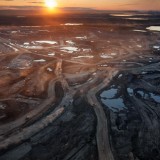
The Alberta Tar Sands (National Geogrpahic photo)

Ecocide: Crimes Against Nature and Humanity

Share

On September 30, 2011, a mock trial by judge and jury at the University of Colchester in England found two oil executives of Canada’s tar sands guilty of ecocide. The jury deliberated a mere 50 minutes before reaching its unanimous verdict. During the trial, the evidence supported the contention that development of the tar sands was the biggest crime against nature on the planet, exceeding even BP’s 2010 huge oil spill in the Gulf of Mexico.

The trial, conducted with real judges, lawyers and jury, respected all judicial procedures. It proceeded “as if ecocide were an international crime against peace, alongside genocide, crimes against humanity, war crimes and crimes of aggression, and placed under the jurisdiction of the International Criminal Court” (Toronto Star, March 31/12). The only difference, of course, was that the corporate oil executives were fictitious.

The trial was the creative effort of an international lawyer and environmental activist, Polly Higgins, who has dedicated her life to eradicating ecocide, which is defined as, “The extensive destruction, damage to or loss of ecosystem(s) of a given territory, whether by human agency or by other causes, to such an extent that peaceful enjoyment by the inhabitants of that territory has been severely diminished” (Ibid.).

Polly Higgins’ story is illuminating and inspiring. Until 10 years ago, the Scottish-born lawyer was representing corporations charged with pollution offences. That’s when she had an epiphany, a realization that “the executives and directors of corporations” are legally bound “to maximize profits for their shareholders”, making “it illegal for them to prioritize the environment in their business decisions” (Ibid.).

Higgins’ epiphany changed her perspective and her life. Everything corporations do, she realized, is subservient to their legal obligation to shareholders. Corporations worship at the Altar of Profit in the Temple of Mammon under a set of rules that have evolved over the course of centuries. Their security as legal entities has been entrenched and supported by law to safeguard their historic role in the fabric of an economic system. Environmental protection has never been a consideration, except when beneficial to investors. It is still incidental, a recent and intrusive inconvenience that has only occurred as we have become aware of the terrible ecological consequences of unfettered economic activity.

But a paradigm shift is underway — although some people and governments are more aware of this transition than others. To those who don’t believe the system can be changed, Higgins has two wise and ready replies. The first pertains to slavery, an entire economic system of 200 years ago that was wholly based on the brutal exploitation of others. When the British parliamentarian, Wilbur Wilberforce, spoke for the abolition of slavery, he confronted widespread opposition. The status quo insisted that slavery was “necessary”, the “public” demanded it, and eliminating it would “lead to economic collapse”, Higgins said in an interview with the Toronto Star — precisely the present arguments used against eliminating fossil fuels and giving priority to environmental health. Slavery’s end became inevitable when Charles Grant, the man who owned the British East India Company and controlled over half the world’s slave trade, publicly declared that slavery was morally wrong.

Higgins’ second argument pertains to World War II. In January, 1942, American industry was too busy tearing up railway tracks and building cars, she said, to make the 50,000 planes required for the war effort. “The government came back the next day and said it is now illegal for you to make cars; you will make planes” (Ibid.). So they did. The war was won and industry became more powerful and profitable than ever.

If we can win huge economic benefits by eliminating slavery, Higgins argues, and if we can win a world war by revolutionizing production objectives, then we can rebuild an economic system on a sustainable foundation by respecting environmental imperatives. All that’s needed is the political will.

Environmental concerns are rapidly gaining profile. Indeed, they are quickly moving from issues of interest to issues of worry, emergency and crisis. Unanimous public opinion may still be elusive but the trend is clear. Environmental considerations are gaining precedence over corporate interests. The time is fast approaching when all economic considerations will be founded upon sound ecological principles, simply because to do otherwise will be deemed foolhardy and immoral. Governments that resist this trend will be seen as irresponsible, anachronistic and dangerous. In Higgins’ words, “Now we’re starting to have a narrative emerging in big business which says we have to stop destroying the Earth. We have to put people and planet first. This is about the moral imperative trumping the economic imperative” (Ibid.).

The ground is already destabilizing beneath the old economic model, and a new one is emerging. Its form is still taking shape. Like any profound idea, it is reaching a critical mass and a momentum that will not be stopped by resistance, denial or obstruction. Indeed, efforts to thwart its arrival simply draw attention to its validity and imperative. Those who do not yield to its oncoming weight and authority will soon be judged by history for crimes against nature and humanity. Except this time, the trial of ecocide will be real.


Share

Global TV Video Report on Developing Fuel Slick in Great Bear Rainforest, Near Harley Bay

Share

Watch this Global TV report on a developing slick of bunker c fuel in Grenville Channel near Hartley Bay, BC. The provincial government downplayed the spill today in the Legislature. (May 3, 2012)

Watch 3 min video: http://www.globaltvbc.com/video/fuel+slick/video.html?v=2230597754&p=1&s=dd#video

Share

Gitga’at First Nation Report Oil Spill in Great Bear Rainforest – Sunken US Army Boast Leaking Bunker C Oil

Share

Read this blog post from Andrew Frank on reports from the Giga’at First Nation of Hartley Bay, BC, that oil is leaking up from  sunken US Army Transport boat into Grenville Channel in the waters of the Great Bear Rainforest. (May 2, 2012)

HARTLEY BAY, BRITISH COLUMBIA (May 2, 2012) – The Gitga’at Nation of Hartley Bay is reporting an oil spill, between two and five miles long and 200 feet wide inside the Grenville Channel, not far from the proposed tanker route for the Enbridge Gateway pipeline. The spill was spotted by a commercial pilot and reported to the Gitga’at Nation and the Canadian Coast Guard yesterday evening.

A Coast Guard landing craft from Prince Rupert is on its way to the spill, and expected to arrive by 12pm. The Gitga’at are sending their own Guardians to take samples and have chartered a plane to take aerial photos of the spill.

“If this spill is as big as the pilots are reporting, then we’re looking at serious environmental impacts, including threats to our traditional shellfish harvesting areas,” says Arnold Clifton, Chief Councillor of the Gitga’at Nation. “We need an immediate and full clean-up response from the federal government ASAP.”

Heavy oil, known as “bunker c” is thought to be upwelling from the USAT Brigadier General M.G. Zalinski, a U.S. army transport ship that sank in 1946 with 700 tonnes of bunker fuel on board. The Canadian government has been saying it would remove the oil and munitions from the ship since 2006, but with no results.

“Right now we’re focused on getting a handle on the size of the spill and the clean-up that’s required,” says Clifton. “But this incident definitely raises questions about the federal government’s ability to guard against oil spills and to honour its clean-up obligations. As a result, our nation has serious concerns about any proposal to have tankers travel through our coastal waters, including the Enbridge proposal.”

Read more, see photos: http://andrewfrank.ca/2012/05/02/oil-spill-reported-in-the-great-bear-rainforest/

Share

Washington Post: Trans Canada Likely to Reapply for Keystone XL Pipeline Permit Friday

Share

Read this report from the Washington Post, suggesting Trans Canada Pipelines will likely reapply for a permit for its controversial Keystone XL Pipeline from the Alberta Tar Sands to the US Gulf Coast. (May 3, 2012)

The Canadian firm behind the controversial Keystone XL pipeline will reapply as early as Friday for a federal permit to ship carbon-intense crude oil from Alberta to the United States, according to people familiar with the company’s plans.

In January, the Obama administration denied a permit for TransCanada, the firm hoping to build the project, on the grounds that a congressionally mandated deadline of Feb. 21 did not give officials enough time to evaluate the pipeline’s impact. Since then TransCanada has said it would proceed with plans to construct the segment running from Cushing, Okla., to Port Arthur, Tex., and unveiled a new route for the pipeline in Nebraska.

President Obama, environmentalists and many Nebraskans — including the state’s Republican governor Dave Heineman — had raised concerns that the project’s original Nebraska route could imperil the ecologically sensitive Sandhills region, as well as the Ogallala aquifer, a major source of drinking water for the state’s residents.

The move will revive one of the year’s most contentious political issues — which has divided the Democratic base between environmentalists and some unions, and has unified Republicans in support of what they view as a critical source of energy supply for the U.S. — just months before the November elections.

The new route TransCanada proposed in mid-April would steer clear of northwestern Nebraska’s Sandhills region, though it still runs over parts of the Ogallala aquifer. The state’s environmentalists argue that Nebraska officials have defined the Sandhills region too narrowly and say that the revised route will traverse the Sandhills in Nebraska’s northern Holt County.

Read more: http://www.washingtonpost.com/national/health-science/transcanada-to-reapply-for-keystone-pipeline-permit-sources-say/2012/05/03/gIQAfbksyT_story.html

Share

Pennsylvania Doctors Barred from Revealing Toxic Chemicals Used in Fracking to Patients

Share

Read this story from Mother Jones on a new law that will bar doctors from revealing to their patients the chemicals used in hydraulic fracturing that may be affecting their health. (March 23, 2012)

Under a new law, doctors in Pennsylvania can access information about chemicals used in natural gas extraction—but they won’t be able to share it with their patients.* A provision buried in a law passed last month is drawing scrutiny from the public health and environmental community, who argue that it will “gag” doctors who want to raise concerns related to oil and gas extraction with the people they treat and the general public.

Pennsylvania is at the forefront in the debate over “fracking,” the process by which a high-pressure mixture of chemicals, sand, and water are blasted into rock to tap into the gas. Recent discoveries of great reserves in the Marcellus Shale region of the state prompted a rush to development, as have advancements in fracking technologies. But with those changes have come a number of concerns from citizens about potential environmental and health impacts from natural gas drilling.

There is good reason to be curious about exactly what’s in those fluids. A 2010 congressional investigation revealed that Halliburton and other fracking companies had used 32 million gallons of diesel products, which include toxic chemicals like benzene, toluene, ethylbenzene, and xylene, in the fluids they inject into the ground. Low levels of exposure to those chemicals can trigger acute effects like headaches, dizziness, and drowsiness, while higher levels of exposure can cause cancer.

Read more: http://www.motherjones.com/environment/2012/03/fracking-doctors-gag-pennsylvania

Share

Former Bank of Canada Governor Dodge: Look East with New Pipelines, Not West with Enbridge

Share

Read this article on former Bank of Canada Governor David Dodge’s recent speech at Edmonton’s McEwan University, in which he questioned the fundamentals and viability of the proposed Enbridge Northern Gateway pipeline – suggesting instead that Tar Sands producers look to supply oil-importing Eastern Canadian provinces with Alberta bitumen. (May 1, 2012)

EDMONTON – The former Governor of the Bank of Canada says it may make more sense to ship Alberta’s bitumen to Eastern Canada, in view of the vocal opposition to two proposed pipeline projects to the West Coast.

“I think it’s going to be difficult, right. You’ve got all the loony tunes in Vancouver who don’t want to see Kinder Morgan’s pipeline expanded,” said David Dodge, in an interview with the Journal.

Dodge, who was in Edmonton Tuesday to deliver a speech on the global economic outlook at MacEwan University, said Enbridge’s proposed Northern Gateway pipeline to Kitimat looks like even more of a long shot.

“I think the project to Kitimat looks, objectively, more risky. So why hasn’t much greater effort gone into looking at Prince Rupert and taking (bitumen) out that way? My guess is, the easiest place to get B.C. to buy into the project would be to go to Rupert.”

Dodge’s views echo those of former Alberta Premier Peter Lougheed, who also favours looking at an alternate pipeline route to Prince Rupert, where ocean-going supertankers can navigate more easily.

But given the level of opposition to any oilsands pipelines in B.C., where Vancouver Mayor Gregor Robertson has been among the harshest critics of the Kinder Morgan project, Dodge said it may be more feasible to simply ship bitumen east.

“You’ve got to get the stuff out of here somehow, and not necessarily send it all south (to the U.S.). And maybe it’s going to be difficult for other reasons to send it west. So I’m intrigued with the option of getting it to tidewater going east,” he said.

Read more: http://www.edmontonjournal.com/business/Lamphier+Loony+tunes+make+pipelines+long+shot+Bank+Canada+boss+warns/6549836/story.html

Share

Rafe Mair, Robyn Allan Draw Over 4,000 Listeners to Telephone Townhall on Exporting Alberta Bitumen Through BC

Share

Read this story from the Chilliwack Times on a recent telephone townhall meeting held throughout the riding of Chilliwack-Hope to discuss proposed oil pipelines and tankers in BC in advance of the recent provincial byelection there. (May 1, 2012)

Thousands of residents in the provincial Chilliwack-Hope riding took part in a telephone townhall meeting on the topic of Kinder Morgan’s oil pipeline expansion before Thursday’s byelection.

The call was organized by Victoria-based Dogwood Initiative and went out to everyone listed in the phone book, approximately 14,000 homes.

Dogwood campaigns director Eric Swanson said 4,572 people opted in to the discussion, although most did not stay on the entire time.

“At any given moment we were talking to just under 400 people,” Swanson said.

The call involved a number of poll questions about oil tankers and pipelines. On the line for a discussion were three panelists: former Socred MLA and current political commentator Rafe Mair; economist and former ICBC CEO Robyn Allan; and Abbotsford resident John Vissers, an outspoken critic of the pipeline.

The three main Chilliwack-Hope byelection candidates were asked to provide their positions on the issue, but only New Democrat Gwen O’Mahony responded.

When asked if those on the line supported or opposed projects like Kinder Morgan’s, or the Enbridge Northern Gateway pipeline, 39 per cent supported, 44 per cent opposed and 17 per cent said they didn’t know.

Sixty-eight per cent of respondents said the issue of pipelines and tankers would be a voting issue in the byelection, as opposed to 32 per cent who said it wouldn’t be.

Read more: http://www.chilliwacktimes.com/technology/Thousands+participate+pipeline+conference+call/6545242/story.html


Share

Fraser Institue Took Half Million in Foreign “Charitable” Funding from US Oil Billionaire Koch Brothers

Share

Read this story from the Vancouver Observer, revealing that the Texas oil billionaire Koch Brothers have given some $500,000 in charitable funding to the BC-based ultra-right wing Fraser Institute – which has been a supporter of the oil industry and climate change denial campaign. (April 25, 2012)

As the Conservative assault continues against Canadian environmental charities, the Vancouver Observer has learned that since 2007, foreign oil billionaires the Koch brothers have donated over half a million dollars to the “charitable” right-wing Fraser Institute.

According to U.S. tax documents, the Fraser Institute received $150,000 from the Charles G. Koch Charitable Foundation in 2008, $175,500 in 2009, and another $150,000 in 2010. The grants were purportedly for “research support” and “educational programs”.

Prior to 2008, the Institute received another $25,000 in funding from the Claude R. Lambe Foundation, which is under the umbrella of Koch Family Foundations.

It has long been known that the ultra-conservative Koch Brothers have been donors for the conservative policy think-tank—though this information is not listed the Institute’s Annual Reports—however, the extent of their funding in the past few years demonstrates the foundation’s more recent influence in Canadian politics.

Read article: http://www.vancouverobserver.com/politics/2012/04/25/%E2%80%9Ccharitable%E2%80%9D-fraser-institute-accepted-500k-foreign-funding-oil-billionaires


Share