Category Archives: Oil&Gas

Why the Tar Sands are a Net Job Loser for Canada

Share

Read this piece in the Huffington Post Canada which makes the case for why, despite all the rhetoric about jobs from the Tar Sands, Canada’s oil economy actually costs us more jobs in other areas. (Jan. 5, 2011)

Just because something is a bit complicated, it doesn’t mean you can ignore it, especially when it’s hurting you.

And yet, this appears to be the case with the loss of hundreds of thousands of manufacturing jobs in the past several years — 627,000 by one measure — mostly in Ontario and Quebec where these jobs have historically existed.

The phenomenon even has a name already: “Dutch Disease.” Canada now has a bad case of it, yet you won’t hear the government in Ottawa talk about it, since that would run counter to its blinkered agenda of accelerating the strip mining of Northern Alberta to push more oil through pipelines to China and America.

The term “Dutch Disease” was coined in the 1970s after the Netherlands discovered a large natural gas field. The country’s exchange rate became tied to the rising price of natural gas, pricing its manufacturing goods out of international markets and leading to job losses.

In 2011, the Canadian dollar traded on average above the U.S. dollar for the first time since 1976. This puts an extra burden on Canadian companies who export, since it makes their products less competitive versus products from other countries.

Read more: http://www.huffingtonpost.ca/matt-price/canadian-oil_b_1180255.html


Share

Stephen Hume’s Must-Read Dissection of the “Ethical Oil” and Foreign Intervention Argument

Share

Read this outstanding piece by Stephen Hume in the Vancouver Sun, dissecting the argument from the Harper Government and oil lobby, which alleges “foreign billionaires” are unduly influencing the opposition to Enrbidge’s proposed Northern Gateway Pipeline and influencing the National Energy Board’s review of the project. (Jan 9, 2012)

EthicalOil.org, founded by conservative gadfly Ezra Levant, adopts this argument, declaiming against “foreign puppets” like West Coast Environmental Law, Alberta’s Pembina Institute and others challenging expansion of oilsands development, transportation infrastructure and diversified global markets for synthetic crude. Even Prime Minister Stephen Harper is on the bandwagon, claiming that foreign money seeks to subvert Canada’s regulatory process.

American foundations have donated about $300 million to such organizations over the last decade or so, therefore these groups must be part of a sinister conspiracy by Americans seeking to influence Canada’s policy agenda.

But wait a minute, if this crude nationalism applies to a few environmental groups, shouldn’t it also apply to other organizations that receive funding from “foreign billionaires?” Enbridge, for example, says it has organized about $100 million in backing from oil industry interests, some of them foreign-owned corporations. Are they trying to hi-jack the regulatory process?…

…The Fraser Institute reports nine per cent of its funding from non-Canadian sources — about the same amount of non-Canadian funding reported by the Pembina Institute — although exactly who the foreign donors to the Fraser Institute might be isn’t listed in annual reports. However, according to a report by Greenpeace using U.S. sources, some comes from American foundations. Another puppet?

Shell Canada, Imperial Oil, British Petroleum Canada, Ultramar Fuels, Enbridge, Sinopec International and so on are all owned and controlled offshore. Are they puppets of foreign billionaires?

If foreign control is a genuine concern for EthicalOil.org, should it turn its attention to Canada’s oil industry? More than 35 per cent of all the assets and more than 40 per cent of the profits from oil and gas extraction and related activities in Canada are under foreign control.

Read more: http://www.vancouversun.com/business/Opinion+Spin+cycle+pipelines+foreign+interests+hits+warp+speed/5970190/story.html


Share

Watch CTV Debate on “Ethical Oil”, Enbridge

Share

Watch this video from CTV, featuring a discussion with federal industry minister Joe Oliver and a lively debate between representatives of First Nations, environmental groups and the organization “Ethical Oil.” (Jan. 8, 2012)

Watch video: http://www.ctv.ca/CTVNews/TopStories/20120108/Northern-Gateway-pipeline-hearings-to-start-in-BC-120108/#ixzz1itu47dVh

Share
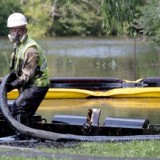
Enbridge's 2010 spill of over 4 million barrels in Michigan - still not cleaned up

Enbridge Admits There Will Be Spills

Share

Enbridge is proposing two pipelines to Kitimat BC to take Tar Sands gunk (more politely “bitumen”) to tankers who at 300 per year will take it to China as is, or to the United States for refining, thence China.
 
Today I want to deal with the pipelines only. The horrible consequences of tankers on our coast are for another column.
 
First off, there is no question that there will be leaks and that any leak will be serious and in a remote area. The lines will cross over 800 rivers and streams, all fish bearing – three of which are important salmon spawning rivers.
 
Two questions arise. When there’s a spill somewhere in the heart of wilderness, how long does it take to find it and, once found, what can you do about it?
 
The answer is you don’t know and there’s nothing you can do about it.
 
Here is the interesting point – in their promotional materials, Enbridge expressly admits that there will be spills because they talk not of eliminating leaks but of “managing” them.
 
That last line is critical because it’s Enbridge’s confession that they cannot prevent spills – in fact the confession is certified by this release called Enbridge Line 6B Response, wherein Enbridge talks about “risks”, opening with this:

Because of their location and the products they carry, pipelines may come in contact with water, bacteria and various chemicals, all of which can corrode steel. Both the interior and exterior of the line are potentially subject to corrosion. We combat [not eliminate – my comment -RM] corrosion by:

  • using high-quality materials and anti-corrosion coatings
  • scheduling regular monitoring and inline inspections to check for corrosion
  • scheduling excavation and repair programs identified by inline inspections
  • using cathodic protection (a low level electrical current) to inhibit corrosion of underground pipelines
  • using modelling tools to predict corrosion growth rates along pipelines
  • using inline devices known as “pigs” to clean and inspect pipelines from the inside
  • using specialized corrosion inhibitors within the pipeline to address internal corrosion”

Thus the candid admission that there will be spills.

Under Managing Stress Corrosion and Cracking, Enbridge says:

Stress corrosion cracking (SCC) is a crack initiation and growth process that can occur in steel pipelines. Research has shown that SCC is caused by a number of factors, including pipe material, stress and the environment surrounding the pipe. SCC typically occurs on the exterior of the pipe. This type of cracking has the potential to penetrate the steel and cause a pipeline break.

You will note that there is no action to eliminate stress corrosion
.

Under Setting Leak Reduction Targets And Performance Goals: ”
We believe that pipeline safety and reliability begin with prevention. This means recognizing conditions that have been known to cause failures in the past – then working to minimize the risk.”

Again, Enbridge does not talk about eliminating the “risk” but managing it!
This release confirms what The Common Sense Canadian has been saying all along: spills from pipelines are not “risks” at all but dead certainties.

There is more to it than this. Throughout the debate there has been no mention of outside causes such as terrorism or vandalism. Think on that a moment – 1070 km of dangerous Tar Sands gunk over a wilderness area and no one is considering these threats!

If there is a leak from any reason, how does Enbridge respond? How do they find the problem and once having found it, how do they get to it? Moreover, how do they get heavy equipment to the site, and once there, what the hell do they do about it?

A good example of how Enbridge handles spills is found in the spill in July 2010 in the Kalamazoo River in Michigan, a highly populated area. It took several days to get to the spill and in nearly 18 months Enbridge has not come close to cleaning it up!

In fact it’s not possible to clean up oil spills – the Exxon Valdes spill in 1989 is still not cleaned up.

No matter what is said, and by Enbridge’s confession, Pipeline ruptures cannot be stopped but are dead certainties, the only question being the damage done. In our case, by the nature of the location the resultant spills will create appalling, ongoing and long-term consequences.

We simply cannot let this happen.

Share

Peter Ewart on Recent Enbridge-Ipsos Poll and Disinformation Tactics

Share

Read this column form Peter Ewart on Opinion250.com about the recent Ipsos poll for Enbridge claiming to show more British Columbians support the company’s controversial proposed pipeline from the Alberta Tar Sands to Kitimat than oppose it. Ewart sets this poll within the larger context of a disinformation campaign in which Postmedia has played a critical roll – including its much criticized recent handling of the Gitxsan story. (Jan 6, 2012)

One of the aims of disinformation campaigns is to shake the resolve of people. And we are seeing ample evidence of this in the campaign to sell the Enbridge pipeline which, if constructed, will stretch across the lands and waterways of Northern BC and result in major oil tanker traffic in the ocean waters off BC’s Pacific coast.
 
Recently, an Ipsos-Reid poll, released exclusively to the Postmedia News chain, is alleging that, by a whopping 48 to 32 percentage, most people across the province are now in favour of the controversial pipeline. This poll, of course, was commissioned and paid for by the Enbridge Corporation. The results are almost the exact opposite of another poll conducted by the Mustel polling group in 2010 and commissioned by pipeline opponent group “Forest Ethics”. That poll showed a 51 to 34 percent margin against the pipeline. The gap between the two polls is stunning.
 
Nonetheless, despite the huge disparity in poll results, the Postmedia News chain was quick to punch out headlines such as: “New poll points to pipeline support”, as well as articles claiming that the poll could be a “game changer” for project opponents. For its part, Enbridge has issued a statement that the “new poll” will set a “’proper context’ for the launch of National Energy Board hearings into Northern Gateway that begin this month in northern B.C.”
 
Share

Former “Ethical Oil” Chief and Conservative Staffer’s Mom Gets Plum Govt Appointment

Share

Read this story from Embassy Magazine on the recent appointment of former top federal Conservative staffer and Ethical Oil spokesperson Alykhan Velshi’s mother to the Canadian Nuclear Safety Commission – which has led the Opposition to denounce the move as a patronage appointment. (Jan. 6, 2011)

The mother of a top Conservative staffer and former adviser to Immigration Minister Jason Kenney is the newest member of the Canadian Nuclear Safety Commission, raising opposition concerns over whether it was a patronage appointment.

Rumina Velshi recently retired from a decades-long career with Ontario Power Generation. She is the mother of Alykhan Velshi, a lawyer in his late 20s from Toronto, who made a name for himself on Parliament Hill over five years on and off as a Conservative staffer.

Most notably, he worked as Mr. Kenney’s director of parliamentary affairs and communications before the 2011 federal election. He defended Mr. Kenney on several controversial topics, including when the federal government blocked outspoken former British MP George Galloway from Canada in March 2009, based on what it believed was his support for the Palestinian group Hamas. Mr. Galloway later filed a lawsuit against Mr. Velshi and his boss, claiming that they had defamed him.

Read more: http://embassymag.ca/dailyupdate/view/top_conservative_staffers_mom_gets_nuclear_regulator_gig_01-05-2012

Share

BC Government to Review Fracking for Impacts on Human Health

Share

Read this story from The Globe and Mail on the BC government’s decision to launch a review into controversial oil and gas practices, including hydraulic fracturing and flaring to determine what impacts they may be having on human health. (Jan. 3, 2012)

The B.C. government has launched a review to determine if controversial practices by the oil and gas industry such as fracking and flaring pose a threat to human health.

“We want to do this so we can all have some peace of mind,” Peace River South MLA Blair Lekstrom said Tuesday.

Premier Christy Clark promised a review during a public meeting in Fort St. John last March in response to a question from Lois Hill, a hay farmer who lives on top of the Montney Shale gas field near Dawson Creek.

“It’s a start,” Ms. Hill said Tuesday. “We had asked for something much broader, but I’m hopeful that we can turn this into something we need to happen.” She wants a formal registry of residents who have suffered adverse health effects because of exposure to toxic gases. Some northeastern B.C. residents have blamed sour gas leaks, for example, for severe health issues ranging from cancer to depression, but it’s a link that industry has not accepted.

Read more: http://www.theglobeandmail.com/news/national/british-columbia/bc-politics/bc-launches-review-of-oil-and-gas-industry-practices/article2290621/

Share

PetroChina Taking Full Ownership of Tar Sands Project

Share

Read this report from The Washington Post on the Chinese state oil giant’s purchase of 100% control of the MacKay River Tar Sands project – the first time a Chinese company has done so. (Jan 2, 2012)

China will take over full ownership over a Canadian oil sands project for the first time after Athabasca Oil Sands Corp announced Tuesday it sold the remaining 40 percent of the MacKay River oil sands development to PetroChina for US$673 million.

The deal continues a trend that has seen China’s state-owned oil companies invest billions of dollars in exploration or production ventures in Canada, Africa, Latin America and elsewhere.

But China’s state-owned oil companies have preferred to take non-operating or minority stakes in oil sands projects in Canada until this latest deal.

The deal does not need the approval from the Canadian government under the the Investment Canada Act.

Athabasca had previously sold PetroChina a 60 percent stake in two oil sands projects, including MacKay river, and the possibility of the Chinese taking over full ownership was included in that deal and approved by the Canadian government.

Read more: http://www.washingtonpost.com/business/athabasca-strikes-deal-to-sell-rest-of-mackay-river-oil-sands-project-to-petrochina/2012/01/03/gIQAHS18XP_story.html


Share

Earthquake Prompts Closing of Ohio Gas Fracking Wells

Share

Read this story from CNN on Ohio’s KTBS.com regarding the closure of fracking wells in the state following a 4.0 earthquake that may be linked to nearby shale gas operations. (Jan. 1, 2011)

State leaders have ordered that four fluid-injection wells in eastern Ohio will be “indefinitely” prohibited from opening in the aftermath of heightened seismic activity in the area, an official said.

Ohio Department of Natural Resources Director James Zehringer had announced on Friday that one such well — which injects “fluid deep underground into porous rock formations, such as sandstone or limestone, or into or below the shallow soil layer,” the U.S. Environmental Protection Agency explains — was closed after a series of small earthquakes in and around Youngstown.Then on Saturday, a magnitude 4.0 earthquake struck that released at least 40 times more energy than any of the previous 10 or more tremors that had rattled the region in 2011.

Read article: http://www.ktbs.com/news/30113791/detail.html

Share

Gitxsan Battle Enbridge with Video Cameras and Social Media

Share

In the wake of the bogus deal Enbridge attempted to foist on the Gitxsan people of Northwest BC last month to help pave the way for its controversial proposed Northern Gateway pipeline, the community has banded together in inspiring fashion – with camcorders and the Web as their weapons of choice. The Enbridge resistance has given birth to a new website, youtube and facebook pages and twitter feed which thoroughly document the opinions of elected and hereditary chiefs and citizens, community gatherings, and interactions with the RCMP and ousted treaty negotiators who sparked the crisis by signing the since-invalidated agreement with Enbridge.

The Gitxsan fired and evicted these treaty negotiators last month, in the wake of the deal signed by head negotiator Elmer Derrick, and have continued to occupy the treaty office in New Hazelton ever since. A recent failed attempt by some of the ousted treaty office staff to re-enter the building – facilitated by the RCMP – was documented on camera (scroll down). Watch some of these videos below and stay tuned to the Gitxsan’s website, video and facebook pages and twitter feed to follow the issue through the eyes of the community.

RCMP Attempt to Facilitate Return of Ousted Treaty Negotiators to New Hazelton Office

Share