Category Archives: Oil&Gas

Stephen Hume: Campbell/Clark Government May Have Surrendered BC’s Sovereignty on Enbridge Pipeline Proposal

Share

Read this column from the Vancouver Sun’s Stephen Hume on a respected analyst’s Robyn Allan’s warning that BC has surrendered its provincial sovereignty with regards to the review process on the proposed Enbridge Northern Gateway Pipeline. (April 20, 2012)

Hearings assessing the proposed Enbridge Northern Gateway pipeline project and legislative changes planned in Ottawa compromise the province’s sovereignty and threaten its authority to defend British Columbians’ interests, warns a letter from Robyn Allan, the former president of ICBC, to Premier Christy Clark and other leading provincial politicians.

The planned pipeline would carry 190 million barrels of diluted bitumen from Alberta’s oilsands to Kitimat each year. Tankers the size of three football fields would then move the bitumen through the Inside Passage to upgraders in China. Another proposed pipeline expansion by Kinder Morgan would more than triple capacity to move oil from Alberta to a tanker terminal in Burnaby from 100 million to more than 300 million barrels per year.

Potential environmental risks, first nations issues and municipal government objections have been a major source of controversy in both the public and political discussion of the Northern Gateway project. Clark has said the province won’t take a position until the environmental assessment and economic review process are complete. The mayors of Burnaby and Vancouver have both vowed opposition to the Kinder Morgan proposal.

Allan, an economist who has been analyzing the Enbridge proposal, says that an agreement quietly signed by the provincial government under former premier Gordon Campbell on June 21, 2010, relinquished the province’s right to its own environmental assessment process for major resource projects and instead accepted the federal NEB’s findings as an equivalent.

The assessment now underway combines the NEB review and the federal ministry of environment’s review under what’s known as the Joint Review Panel.

Allan says the B.C. government made its equivalency agreement in the belief that the NEB review would provide a neutral, objective, arm’s length assessment.

But since then, she says, the process has been compromised, the federal government has unilaterally moved to change the rules and B.C.’s sovereignty is now threatened with subordination to the interests of Alberta and Ottawa while input from provincial departments has effectively been muzzled.

“The federal government, as I am sure you are aware, has publicly endorsed the project, stated it is in the national interest of Canada, and has systematically demonized individuals and groups who oppose the project,” Allan writes. “This behaviour has made a travesty of the necessary arm’s length relationship between government and an independent regulatory body.

Read more: http://www.vancouversun.com/news/Hume+surrendered+sovereignty+pipeline+hearings+analyst+warns/6495354/story.html#ixzz1sjW3PcVf


Share

Disgraced Gitxsan Treaty Negotiator Rewarded with Appointment to Prince Rupert Port Authority

Share

Read this story from the Vancouver Sun on the controversial paid appointment by the Harper Government of Elmer Derrick – the former Gitxsan treaty negotiator who was fired for cutting an unauthorized deal with Enbridge behind his nation’s back – to the board of the Prince Rupert Port Authority. (April 20, 2012)

The northern B.C. first nation chief who signed a controversial deal to support Enbridge’s $5.5-billion oil pipe-line has been appointed by the federal government to the Prince Rupert Port Authority.

As a director of the board, Gitxsan hereditary chief Elmer Derrick will receive payment, although it is not clear exactly how much.

“It’s a strange appointment. It raises the possibility it’s a quid pro quo for supporting the pipeline,” said NDP Skeena-Bulkley Valley MP Nathan Cullen, whose riding includes a large stretch of the Northern Gateway pipeline route.

Cullen noted that Prime Minister Stephen Harper’s government is a supporter of the pipeline, meant to open up new markets in Asia for crude from the Alberta oilsands.

When Derrick, who is the chief negotiator with the Gitxsan Treaty Office, announced he had signed a pipe-line ownership deal with Enbridge that would provide $7 million over a 30-year period, it sparked an immediate battle with other leaders in the community who said they don’t sup-port the project.

In the face of the opposition to the deal from dozens of Gitxsan hereditary chiefs, Enbridge pulled out of the ownership agreement.

Read more: http://www.vancouversun.com/news/Chief%2Bfederal%2Bpost%2Braises%2Beyebrows/6490353/story.html

Share
Photo: Darryl Dick/Globe and Mail

NDP Byelection Wins Bad News for Both Liberals and Conservatives; Good for NDP, Environment

Share

The two by-elections are very bad news for the Liberals, not much better for the Tories and excellent news for the NDP.

Let’s start with the last first.
 
The loyal opposition is now in the position where a couple of Liberals crossing the floor can bring the government down. I don’t believe that will happen but it’s a worry for the Liberals. Mostly this confirmed Adrian Dix’s leadership. Any time you have a contested election, the losers and their supporters have a death wish for the winner – more about that in a moment. Dix is firmly in control. The NDP made a brilliant move in saying that while they oppose Enbridge and coastal tanker traffic they promise a local referendum for Kinder Morgan. One of the moves of the Campbell/Clark government was to extinguish the right of local governments to pass judgment on environmentally sensitive projects and the NDP understand that the late US Speaker, Tip O’Neill, was right when he said “all politics is local”.
 
For the John Cummins Conservatives this by-election was a bitter blow, for if the Tories can’t win a by-election – governments usually have trouble with them – in a staunchly “conservative” riding, what chance do they have in a general election. This hardly enhances the opportunity for a new party along the Socred lines since Cummins brings nothing to the table.

For the Liberals, these votes can’t be put down to the usual anti-government pissed off voters. Premier Clark’s leadership was on the line and the Liberals know it.

Going into the by-elections all but one caucus and cabinet minister wanted someone else. She has stumbled from one gaffe to another since she took office. She must go and soon; if she stays, it will be the best news the NDP could get. She’s like Bill Vander Zalm was in 1991 – a loser brought to his knees as much by cabinet and caucus disloyalty as personal stupidity.

When a premier is in trouble he/she must be able to rally the troops – this Ms. Clark is utterly unable to do. She must go, with a temporary leader in place pending a leadership convention, for which time is very short.

Never mind the weeping that a split vote cost them Chilliwack and a turncoat won in Port Coquitlam – the fact is that the government lost two elections which were referenda on the Liberals and their leadership.

There was another winner – big time: the environment. In Chilliwack, the Kinder-Morgan pipeline was a big issue – to my memory, the first time the Environment was a large issue there.

These by-elections did more than alter the make-up of the Legislature; they altered politics in BC – Big Time.


Share
Caleb Behn gets a tour of natural gas operations in the Taranaki region of New Zealand

The Canada-New Zealand Fracking Connection

Share

I’m down in New Zealand at the moment, filming for a feature documentary involving the unconventional gas industry – particularly the increasingly controversial practice of hydraulic fracturing, or “fracking” – which I’ve been working on for the past year with a fellow Canadian filmmaker.

Why New Zealand?

We came here to follow the main subject of our film, a young First Nations man from the heart of the Canadian (and one could argue global) fracking industry. Caleb Behn worked for a number of years as a lands manager for several First Nations, addressing both of the major shale gas plays in Northeast BC, where the two sides of his family come from – the Horn River Basin near Fort Nelson and the Montney Shale formation, which extends beneath communities like Hudson’s Hope, Dawson Creek and several hundred kilometres East across the Alberta border.

After years of frustration attempting to respond to the deluge of paperwork inundating his offices over proposed seismic testing, well sites, water extraction and disposal, toxic flaring, access roads, security gates and fences and myriad other incursions onto his traditional territory and way of life, Caleb decided to lawyer up. He felt a legal background could help him more effectively represent his people in dealing with industry, so he has been studying at UVic Law for the past several years.

For his final term he decided to venture down to another Victoria University – this one in Wellington, New Zealand – to learn from Maori people facing similar challenges from the oil and gas industry down here.

Maori and concerned citizens in New Zealand have been dealing with the oil and gas industry for a long time; but Caleb’s timing couldn’t have been more appropriate, as it is just in the past several years – and particularly the past few months – that fracking operations have really been ramping up. And the parallels between the two countries, as we have been learning quickly, are positively striking.

Perhaps most interestingly, a Canadian company I’d never heard before this week – one TAG Oil, based Vancouver of all places – is on the cusp of a major expansion of fracking operations across the North Island of New Zealand, where Caleb is studying and we’re doing most of our filming.

Yesterday, Caleb was invited to speak about his people’s experiences with the Canadian unconventional gas industry at a packed community forum in the town of Napier, in the Hawkes Bay region on the West Coast of the North Island (watch the national news story on the event here). It was an eye-opener for us to hear from other speakers of the mounting concerns amongst New Zealanders about this Canadian company, which has been operating mostly in the Taranaki region on the other side of the North Island – both onshore and offshore. The company has formed joint ventures with Apache Canada, the Canadian subsidiary of Texas gas giant Apache Corp.

Just in the past several months, TAG Oil has been pursuing “aggressive” (their own words) expansion plans, with seismic testing and exploratory drilling in the Hawkes Bay region where the forum was being held. The community gathering heard from a farmer named Sarah Roberts – who has been referred to us by a number of people as the “Erin Brockovich of New Zealand” (a title she wears reluctantly), for her wealth of knowledge on the emerging industry and her principled stand against it. Sarah made the journey across the island from Taranaki, where her farm has been under siege from TAG Oil’s operations. She described to us how the company is flaring fumes over her and her neighbours’ dairy farms (milk is New Zealand’s biggest export and, along with tourism, the cornerstone of its economy). She also told us how some local farmers have been convinced to take “produced” (the industry’s term for contaminated) water from them and dispose of it on their fields a s “fertilizer”.

Both Sarah and Caleb’s words resonated as a warning to the people of Hawkes Bay of the dangers to come if TAG OIl and Apache Canada are able to expand their operations into that region as they are now planning. Following yesterday’s meeting I did some googling on TAG Oil – astonished that I’d never come across this company which is a key player in the emerging New Zealand unconventional gas industry. While its headquarters are located not a kilometre from my home in downtown Vancouver, – at 885 West Georgia St. – in its 10 year history it has focused almost exclusively on New Zealand. It appears as though the relatively small company secured its foothold by obtaining leases and permits here, then reaching out to the larger Apache Canada to provide the capital and industrial muscle to exploit these resources. TAG, Apache and other shale gas companies clearly have big designs on this small island state in the South Pacific.

And yet, there’s clearly a movement afoot to turn the tide on the industry’s expansion. A Maori leader from the Taranaki region Caleb spoke to the other day evinced with tears that it may be too late to save her territory from the impacts of oil and gas development, but that she hoped in sharing her people’s experiences with other New Zealanders, she could help protect them from the same fate. The people of Hawkes Bay took careful note of Caleb and Sarah’s words for the same reason.

The audience also heard from a young, ambitious Green Party MP and Energy Critic, Gareth Hughes, who has been travelling the country of late, drumming up support for a moratorium on fracking while the government conducts a parliamentary review of the industry.

Already the city of Christchurch has recently passed a local moratorium and other communities are considering following suit. We will be traveling to the South Island in a few days to speak to the people who were instrumental in that strong stand against the industry’s planned expansion into their region.

Share

Nova Scotia Joins Growing List of Regions with a Moratorium on Fracking

Share

Read this article from the Calgary Herald on the decision by the Nova Scotia Provincial Government to put a two year moratorium on natural gas hydraulic fracturing while it gathers more science on the controversial practice. (April 19, 2012)

CALGARY – Companies searching for oil and gas in the Maritimes received conflicting messages this week around the use of hydraulic fracturing to develop the resources.

New Brunswick granted a five-year licence to Calgary-based Windsor Energy to explore and drill for natural gas on Tuesday while Nova Scotia banned fracking until the summer of 2014 to have more time to review the contentious technology.

Energy Minister Charlie Parker said the provincial government wanted to study reviews being drafted by the U.S. Environment Protection Agency and Environment Canada on the effects of fracking.

Parker cited other jurisdictions have been reviewing how fracking could affect water re-sources and earthquakes.

“We think it’s important to get the best possible information that’s out there and make an informed decision after we’ve learned all that,” Parker said.

Critics of the NDP administration suggest the government is freezing discussion about hydraulic fracturing until after the next election.

Public concern has in-creased in the past year about the technology, which pumps massive amounts of waters and chemicals down well bores to crack open reservoirs of so-called tight oil and gas. Protests against frack-ing escalated in areas such as the Maritimes, where little onshore oil-and-gas development has occurred.

Monday’s announcement was a setback for companies such as Elmworth Energy, a subsidiary of Triangle Petroleum Corp., which holds a 10-year lease representing the province’s first shale-gas development project.

Read more: http://www.calgaryherald.com/business/Nova+Scotia+issues+year+moratorium+fracking/6481080/story.html

Share

Harper, Oliver Take Control of Pipeline Approval Over Environmental Regulators

Share

Read this story from the Globe and Mail on the Harper Government’s assertion of ultimate control over the approval of the proposed Enbridge Northern Gateway Pipeline and other major industrial projects. (April 17, 2012)

The federal government is asserting its control over pipelines – including the proposed Northern Gateway oil-sands project – taking from regulators the final word on approvals and limiting the ability of opponents to intervene in environmental assessments.

In proposed legislation unveiled by Natural Resources Minister Joe Oliver on Tuesday, the Harper government will clear away regulatory hurdles to the rapid development of Canada’s natural resource bounty.

Ottawa is aiming to reduce the number of projects that undergo federal environmental assessment by exempting smaller developments completely and by handing over many large ones to the provinces. It will also bring in new measures to prevent project opponents from delaying the assessment process by flooding hearings with individuals who face no direct impacts but want to speak against the development.

At a Toronto press conference, Mr. Oliver said the proposed changes are aimed at providing quicker reviews in order to reduce regulatory uncertainty and thereby create more jobs and investment in Canada’s booming resource sector.

“We are at a critical juncture because the global economy is now presenting Canada with an historic opportunity to take full advantage of our immense resources,” he said. “But we must seize the moment. These opportunities won’t last forever.”

Ottawa is aiming to reduce the number of projects that undergo federal environmental assessment by exempting smaller developments completely and by handing over many large ones to the provinces. It will also bring in new measures to prevent project opponents from delaying the assessment process by flooding hearings with individuals who face no direct impacts but want to speak against the development.

At a Toronto press conference, Mr. Oliver said the proposed changes are aimed at providing quicker reviews in order to reduce regulatory uncertainty and thereby create more jobs and investment in Canada’s booming resource sector.

“We are at a critical juncture because the global economy is now presenting Canada with an historic opportunity to take full advantage of our immense resources,” he said. “But we must seize the moment. These opportunities won’t last forever.”

Resource-rich western provinces greeted the proposed changes warmly, saying they are eager to take over environmental assessments. Mr. Oliver said Ottawa will only transfer authority for project reviews to provinces that have similar standards as the federal government.

Provinces in central and Atlantic Canada were more cautious, wanting to know more details before drawing conclusions.

Environmental groups and some aboriginal leaders said the government is sacrificing environmental protection for development, and is intent on railroading all opposition to its vision of rapid development of oil sands and other resources.

Read more: http://www.theglobeandmail.com/news/politics/legislation-curbs-ability-of-green-groups-to-intervene-in-review-process/article2405411/?utm_medium=Feeds%3A%20RSS%2FAtom&utm_source=Politics&utm_content=2405411


Share
Natural Resources Minister Joe Oliver has labelled opponents of Enbridge's proposed Norther Gateway Pipeline

Enbridge Pipeline: Radicals and Conservatives

Share

Enbridge’s proposed Northern Gateway pipeline, a $5.5 billion project that is intended to move the crude from Alberta’s tar sands to BC’s West Coast for shipment by supertankers to Asia and other parts of the world, is providing illuminating insights into the gulf of differences separating proponents and opponents. Perhaps this is most clearly expressed by Canada’s Minister of Natural Resources, Joe Oliver, whose recently released letter (January, 2012) accused “environmental and other radical groups” of attempting to “hijack our regulatory system” to achieve “their radical ideological agenda.”

His accusation may be true. But his terminology is reversed. The so-called “radicals” are really “conservatives” while those in government and industry favouring the pipeline are the “radicals”.

Those attempting to halt the pipeline and slow development of the tar sands are trying to restrain the ideological mania for resource extraction that is ripping across the provinces and country these days. Their objective is not only to protect the natural environment that is the fundamental source of our wealth, but to conserve our non-renewable oil and gas — not to mention the minerals, trees, water, fish and other resources that identify Canada’s natural riches — for a more cautious and careful future use. They are keen to remind Canada’s government that the country has no national energy policy and, therefore, no way of anticipating the effect of present extraction on future energy security, economic opportunity and social impacts. To the opponents of the Northern Gateway pipeline, today’s wholesale extraction and export of raw resources poses innumerable environmental threats but also robs tomorrow of possibilities. This is hardly the position of “radicals”.

With a perspective that is longer than the next election cycle, the 4,300 people who are registered as speakers during the proceedings of the “regulatory system” — most of them will be opposing it — are using the only avenue available to them to indicate their concern for a project that will inevitably cause an oil spill in pristine rivers and valleys, not to mention an ocean coast that is noted world-wide for its marine bounty and wild beauty. If this concern is a “radical ideological agenda”, then their critics must surely be possessed of a reckless irresponsibility that is truly menacing.

Unfolding events suggest that this may be the case. The same established thinking that wants to build the Northern Gateway pipeline has recently engineered the near-collapse of the world’s entire financial system. It is also busily dismantling the fundamental ecological structures that allow for a diversity of life on Earth. The traumatic effect of massive greenhouse gas emissions on climate and weather should give any thoughtful person nightmares. And the eventual consequences of ocean acidification has implications for the planet that are obscene and dire — a similarly acidic ocean once caused 95 percent of marine and terrestrial species to disappear from existence. Anyone who is aware of these prospects and is not taking immediate and drastic remedial measures must be deemed “radical”, if not irresponsible and ideologically dangerous.

Some informed economists question the wisdom of unrestrained resource extraction. Without long-term planning and the accompanying processing infrastructure that benefits a country’s entire economy and society, the end result of an export policy of raw resources will be, as one economist aptly phrased it, an impoverished country “with a lot of holes in the ground” — not exactly a promising prospect.

Such a prospect is worrying an increasing number of people these days. They perceive a hyper-active system of excessive production and consumption that is functioning beyond sustainability and headed for a crash. Some of these worried people are economists, politicians and philosophers. Others are bankers and industrialists. Even those who don’t have the sophistication to articulate their apprehension can sense trouble. And they are becoming increasingly cynical. The Occupy Movement wants financial reform and a re-evaluation of our entire economic system. And the environmental community, in all its many forms, wants the destruction of nature to stop while viable remnants of it still exist. They are “conservative” in the sense that they want to “preserve” the ecosystems that sustain us, hardly the “radicals” of Joe Oliver’s designation.

The real “radicals”, it might be argued, are those with an ideological compulsion to pillage the planet — to drill and mine, to frack and pump, to build and extract, to cut and burn, to take and level with an obsessive abandon that history will deem pathological. An ideology that holds nothing sacred but money and profit is doomed to fail. “The catch with a growth economy,” as the film The Great Squeeze points out, “is that there is no stopping point.” It continues to grow until it self-destructs.

This explains why the Northern Gateway pipeline project has become so important. It is now iconic, a symbol to its opponents of a system out of control, of an ideology on a destructive rampage, blindly undeterred by fatal risks to a primal wilderness and a treasured coast of virgin rainforest. The system is not even deterred by a living planet besieged with life-destroying gases. If such an economy is not stopped here, where will it be stopped?

The language in Joe Oliver’s letter is ideological and challenging. But he has his terms reversed. The “radicals are the “conservatives” and the “conservatives” are the “radicals”.

Share
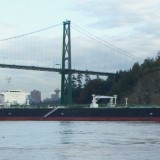
An oil tanker carries Tar Sands bitumen past Stanley Park (Paul Manly, David Maidman)

Kinder Morgan’s Massive Pipeline, Tanker Expansion Plans (Finally) Making Headlines

Share

How wonderful it is to have such breaking news fanatics as the Vancouver Sun and the Vancouver Province. The Sun on Friday the 13th carried a headline story of how Kinder Morgan is planning to increase its pipeline capacity to 850,000 barrels per day at a cost of $5 Billion. The Province with a breathlessness usually reserved for the discovery of a three headed toad in Tasmania, told us this:

Kinder Morgan Energy Partners gave the green light Thursday to its pipeline expansion, which will more than double the current amount of crude oil flowing from Alberta to Burnaby to 850,000 barrels per day, up from the current 300,000 bpd.

The quantity is about 40 per cent more than what the Houston-based company had originally proposed. And it will see annual tanker traffic jump from about 70 tankers per year to 360 to 365 tankers per year, based on one tanker visiting port per day, said Kinder Morgan.

This story is nearly two years old. When a downtown accountant noticed, out his office window, a huge increase in tanker traffic – following Kinder Morgan’s quiet increase of Tar Sands bitumen through its Trans Mountain Pipeline to Burnaby from 200,000 bpd to 300,000 – the matter was the subject of a full Vancouver City Council meeting and investigation in July 2010 (scroll down to story, “Misinformation Given to Vancouver City Council).

Of course, back then the Vancouver media hadn’t noticed fish farms, private river destruction, assaults on agricultural land, schemes ruining the environment and bankrupting BC Hydro or the Enbridge Pipeline and the proposed tanker traffic either. That may, the saints be praised, be changing.

For the past decade, the Postmedia papers in Vancouver have liked to ponder environmental matters for a year or two before dealing with them. Can’t be in a rush, you know – that tends to be irresponsible; far better to offer op-ed  space to fish farmers, private rivers despoilers and the corporate interests that promote the world’s biggest single-source polluter, the Tar Sands, and their proposed disasters in BC on land and sea. That the editor of the Sun op-ed page is a former Fellow of the Fraser Institute has nothing to do with this policy, of course.

One hates to make too general a statement on such matters but perhaps the Newspapers would tell how much any of these subjects have been covered by, let’s say, Vaughn Palmer or Mike Smyth.

There was a time, well within the memory of many readers, when the media in Vancouver truly held the establishment’s feet to the fire. No statements were taken as unchallengeable when delivered by big business or government. The Vancouver Sun and Province were known for their tough journalists as was BCTV. This certainly was the case when I was in government – a long time ago – but as recently as the last NDP government it prevailed. One remembers with admiration the work Mr. Palmer did on the “fast ferries issue”. Since the arrival of the Campbell/Clark government, the plain fact is that government and big business have had even better than a free ride – the editorial policy has supported business and government with nary a tough question.

My old station, CKNW, which was once on the cutting edge of skepticism of the establishment’s statements, now has Vanilla Bill in charge of the morning spot and now has a 10 share of the market when his predecessor had double that audience. Even the CBC, which is scarcely known for hard hitting radio, beats the CKNW morning show.
If I had performed that way I would have been cashiered along with the Program Manager and senior management.

Yes, times have changed and how ironic it is that this happens at a time the Supreme Court of Canada in the case of Simpson v. CKNW, Mair et al made it much more difficult for politicians and other prominent people to maintain a successful defamation action. In addition to showing the statement was untrue they must now demonstrate malice.

You, the public of BC, have been swindled every bit as much as if you’d played 3 Card Monte at the fair. You pay, through subscriptions and advertising revenues, for a gigantic crock of crap being delivered to your doorstep and living room.

What especially outrages me is that once a year the media fills itself with praise, basking in the reflected glory of the late Jack Webster at the annual dinner held in his name. I knew Jack Webster as one who barely survived his interviews, as a competitor then a colleague and I can tell you if he heard and read one day’s coverage of current events he would be thoroughly ashamed of those who carry on what were once honourable outlets of hard hitting journalism.

BUT…are times changing? There is evidence that the mainstream media is covering the environmental corporate/political atrocities being inflicted on British Columbia. Meetings of First Nations are being covered and Damien Gillis’ videos and footage are being shown (watch these recent Enbridge stories on CBC’s the National and Global TV). Especially encouraging is coverage by local papers including those controlled by the mainstream media companies. The Victoria Times-Colonist has been under the parent company’s radar and has, for some months now, challenged those in corporations and governments which would continue and expand their takeover and destruction of our province.

Given my history with the media I don’t think one can say “let bygones be bygones”, but all of us can join in the real battle.

The media have more obligations than just fairly and thoroughly presenting the news – they have a traditional duty to speak for the audience they seek. Until the beginning of the Gordon Campbell/Christy government they did just that. Critics of the “establishment” abounded. For example, it was Vaughn Palmer that almost single-handed exposed the “fast ferries” issue that played a major role in the 2001 election.

What the media faces is a simple question: do you accept as a duty the obligation to defend our wonderful province against the corporate/political assault on our environment?

While those who fight fish farms, agricultural land degradation, private power schemes, pipelines and exposing our shores to sure destruction can’t be expected to suddenly embrace those who have been enablers of the corporate assault on our province; we can and will get behind and speak kindly of a media which has columnists and broadcasters who will speak for British Columbia!

I sense a willingness to do just this and it is welcome indeed. 

Share

Local Governments to Fight Kinder Morgan Over Oil Pipeline, Tanker Expansion Plans

Share

Read this story form the Globe and Mail on BC’s coastal mayors and councilors preparing to fight Kinder Morgan’s plans to triple their bitumen pipeline from the Alberta Tar Sands to Vancouver. (April 14, 2012)

Local governments on B.C.’s west coast are girding for a fight with energy giant Kinder Morgan over its $5-billion pipeline expansion plans to move more Alberta oil to the Vancouver Harbour for transport overseas.

A phalanx of mayors is vowing to fight the project, including coastal communities far from the pipeline but exposed to increased oil tanker traffic.

“This is not a comfortable position for Kinder Morgan, they’ll be relying on the federal government to override local government,” said Burnaby Mayor Derek Corrigan. “This may be the hill the Conservatives die on. The response from the public in British Columbia is, not only is this a potential danger to us, but there’s nothing in it for us.”

Vancouver Mayor Gregor Robertson challenged B.C. Premier Christy Clark to take a stand on the plans, saying city residents – including her own Vancouver-Point Grey constituents – won’t support risking an oil spill.

“I will fiercely oppose the expansion of oil tankers in Vancouver’s harbour and the pipeline that feeds them,” he said in an interview. “The Premier should weigh in and I hope it is on the side of our local economies. It’s hard to imagine an oil spill on Kits Beach and Stanley Park – the impact it would have for generations.”

Ms. Clark did not return calls Friday. The Premier has balked at taking a position on a better-known pipeline proposal, the contentious Northern Gateway project.

That project is a key part of Prime Minister Stephen Harper’s goal to take Canadian resources to Asian markets, but the B.C. government has yet to come out for or against it despite its “Canada starts here” marketing strategy.

The Gateway project is currently the subject of a national review, but the southern pipeline project is further ahead because Kinder Morgan already has a right of way for its relatively small pipeline – called Trans Mountain – from Edmonton to the Vancouver suburb of Burnaby.

On Thursday, Kinder Morgan Energy Partners LP, a Houston energy and pipeline company, announced it has enough customers lined up to begin the official regulatory review process of its plan, which would put another pipeline on the route, nearly tripling the current capacity and bringing an oil tanker a day into Burrard Inlet.

On Friday, at a meeting of Metro Vancouver mayors, talks began on forming a united front, Mr. Corrigan said. “This is something that is going to gain momentum as the mayors put their resources together to respond.”

Mr. Corrigan predicted it will also put the BC Liberal government in a tough position as it struggles to keep federal Conservatives on side. “They are going to be expected by the Conservative government to welcome access for Alberta oil. Their relationship with the federal government is going to be severely tested,” he said.

Read more: http://www.theglobeandmail.com/news/national/british-columbia/bc-politics/bc-mayors-steel-themselves-for-fight-against-kinder-morgan-pipeline/article2402403/

Share

William Housty Addresses NEB on Heiltsuk Culture, Threat of Oil Spill

Share

30 year-old William Housty’s powerhouse presentation to the National Energy Board’s Enbridge hearings in his community of Bella Bella. William describes the history, language and culture of his people in fascinating detail – and how the proposed Northern Gateway Pipeline and Tar Sands supertankers transiting the waters of his people’s territory would destroy their traditional way of life. A must-watch!


Share