
Category Archives: Oil&Gas

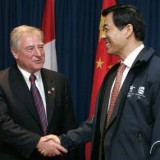
Then-Canadian Trade Minister David Emerson shakes hands with Chinese Commerce Minister Bo Xilai in 2007 (Reuters photo)

Clark’s ‘Tough New Stand’ on Enbridge Not Only Meaningless but EPICly Duplicitous

Share

Here at The Common Sense Canadian, we have established that the BC Liberals have been doing the bidding of the oil and gas agenda behind the scenes while presenting a different story to the people of BC.

In May, we published “The Myth of Liberal Neutrality on Enbridge”, wherein we outlined how compliant mainstream media had been positioning Christy as “neutral” on the Gateway project, despite the many facts to the contrary, in order to provide a political escape hatch for the languishing Premier. More recently, we have seen precisely why they had taken this “neutral” approach as Christy used the political escape hatch they provided in order to kick off her re-election campaign and make her grand debut as a “fighter for British Columbia”.

Had the mainstream detailed her government’s longstanding, non-wavering support for the oil and gas agenda Christy, would not have been able to suddenly take such a position and maintain any credibility all the while claiming she is now putting BC First.

Last week in a story titled “Cross-Border Deals with Alberta Undermine Clark’s Tougher Stance on Enbridge”, we outlined Christy’s new “BC First” positioning as a hollow and baseless facade, given the Equivalency Agreement her government initiated, which leaves British Columbia without any capacity to review, assess or decide the fate of four major oil and gas infrastructure projects, including Enbridge’s Northern Gateway Project. Moreover, we explained how if Christy was to interfere with the flow of oil and gas across the BC/Alberta border in the way she has publicly described, it would expose British Columbians to millions of dollars in fines and penalties as dictated in legislation her own government ushered in when they invoked closure to bring an end to debate on these important details and passed TILMA/NWPTA into law.

Although mainstream media continues to ignore these inconvenient truths, they have clearly illustrated there are various federal laws which also contribute to the now glaring, unavoidable fact that Christy is powerless to deliver on her new tough stance, has absolutely no leverage to wrestle more cash out of these deals, and cannot prevent the federal government from forcing this agenda on British Columbians. They do so with precise detail here at Ipolitics:

To build a robust and effective national energy economy, Harper will be using Ottawa’s constitutional powers under section 91(2), the regulation of trade and commerce clause, and section 121, preventing the taxation of goods across provincial boarders.

And if that was not enough to neuter Christy and her BC First Liberals, there is even more here from Postmedia, where they outline how Harper can “invoke Clause 10 of Section 92 of the British North America Act, which allows Ottawa to assert jurisdiction over interprovincial projects if parliament declares them to be ‘for the general advantage of Canada’.”

At this point, you are probably asking how can Christy claim to be standing up for the rights of British Columbians when her government has signed them all away? Or how can she threaten to stop anything when she has no legal capacity to do so? And how can she possibly ask for more money? She has not a single bargaining chip or any leverage whatsoever as a result of her government’s own actions and the plethora of federal legislative tools designed specifically to stop her from doing so.

The answer is EPIC.

Of course all of this occurs during the height of summer vacation season and at the same time as the spectacle of the Olympics. The few of us left still paying attention have been inundated with a barrage of minutia and detail covering Christy’s tough new stance. We have been literally overwhelmed with all sorts of talk about “Premier Redford’s National Energy Strategy” and how Christy will not “sign off” until her so-called “demands” are met.

Nowhere in all the coverage is there even one mention of the man behind the curtain, David Emerson, the EPIC Chairman and political puppet master who infamously crossed the floor to join Stephen Harper’s Conservatives as Minister of International Trade and Minister for the Pacific Gateway, before returning to the private sector in 2008 to work for the China Investment Corporation. EPIC is the Energy Policy Institute of Canada, the organization building the Energy Strategy “Framework” on behalf of a variety of our corporate overlords. The evidence of EPIC’s ability to dominate the agenda was prominent during Harper’s Omnibus disaster where most of what Bill C-38 entailed was written and published by EPIC months before.

This is where we get down to brass tacks.

Redford, Christy and even Harper are political bit players in a much bigger game.

EPIC represents a stunning array of who’s who in the corporate realm that dominates the Canadian landscape and David Emerson is the corporate titan calling the shots from the EPIC command and control center. In fact, he is quite possibly the most powerful man in Canada. Emerson’s long corporate career has stretched his network the world over. He is plugged into Asia in a bold and very public way, but less public are his far-reaching contacts in all of our country’s most important industries outside of banking, not to mention his rolodex of political contacts from his bold stint in public office.

Our current politicians work for EPIC – their job is to grease the skids, do damage control and generally ensure public acquiescence to the EPIC agenda.

Most people are unaware of EPIC. They operate behind the scenes, which also mirrors the now longstanding BC Liberal management of the agenda. It’s all done out of the limelight, away from the public eye. No stone is left unturned and no detail is overlooked by this immensely bold and powerful lobby.

Let’s take a look at their most recent “statement” – note it is not a press release or an opinion piece or even an attempt to influence the “all-powerful” politicians, but rather it is simply a plain statement of the facts, with very bold language that dictates the entire agenda, and although it was publicly released, it was never reported on. Moreover, as you will note, this statement gave the premiers their marching orders and priorities, and even detailed what they must say:

“The Premiers must speak in terms of what is in it for every Canadian.”

When you read between the bold lines it becomes very clear precisely how and why Redford is now standing up to protect “every penny” of her Province’s royalties, while Clark was suddenly able to stop being neutral and start talking about “what is in it” for British Columbians.

But it does not stop there – the EPIC statement goes on to dictate the policy procedure and the roll-out while explaining how they will be “sending to every Premier, the Prime Minister and all Ministers responsible for energy, our recommendations and discussion on key elements for a national energy framework.”

The statement then proceeds to outline their expectations of the lowly premiers and underscores the need for them to “act fast.”

And then there is this gem:

If we fail, we lose as a nation and we give up the jobs, money and environmental management opportunity to other countries that will gladly compete with us.

According to EPIC, other countries will “gladly” accept the “environmental management opportunity” the massive escalation of Tar Sands extraction and natural gas fracking presents.

Really? Environmental Management Opportunity? Well, I guess that is one way of putting it. The day after they released this statement the good folks in Wisconsin had one of their own “Environmental Management Opportunities” as Enbridge’s most recent pipeline spill released an “estimated” 1200 barrels of oil. On that same day Enbridge received approval to reverse line 9b in their “strategy” to move Alberta’s Dilbit east into Portland, Maine for export, offering a whole new region more “Environmental Management Opportunities.”

This all coincides with our Energy Minister’s taxpayer funded junket to London (one of the destinations for exported dilbit from Portland), to meet with his old buddy Gordon Campbell, who arranged yet another “energy meeting” – this one coinciding with the Olympic kick-off and, as it just so happens, Coleman’s vacation schedule. However, Coleman is bound under confidentiality agreements with the likes of Shell and Petro China, so it is unclear exactly what he will be able to discuss with Mr. Campbell and Premier Redford, except for the fact that those companies just applied for an export license (on the very same day as the Enbridge spill and Christy’s debut as tough new fighter for BC – what you missed it?) to ship 1 million tonnes a year of LNG for 24 years.   

That is one hell of a lot of Fracking natural gas and it all makes you wonder what’s left to strategize about. In fact, if Christy was serious about talking money for British Columbia, this is what she should be talking about while ensuring BC sees a respectable royalty regime in place for this massive liquidation of our resources.

Regardless, the EPIC statement below goes onto explain how they will be “helping” out governments by “releasing comprehensive details for the roll out of the national energy strategy”, which will dictate “how governments will implement their role in the strategy.”

In case you are wondering, this is what a petro-state looks like. Corporations drive the agenda and politicians comply while distracting people from the real issues and deflecting attention away from the things that matter. All the while twisting the narrative to improve their electoral fortunes. This is what we now deem good “leadership” in today’s petro-political environment.

Read the full EPIC statement here

Now you know why Ms Clark’s tough new stance is not only hollow and meaningless but EPICly duplicitous.

She is simply doing what she is told and all she has to do is continue her government’s complete capitulation to the agenda and she will overcome all the laws and restrictions that render British Columbia powerless to negotiate better returns. She will do so with her continued passive compliance – not a “tough stand” – and she will be rewarded by Emerson, who will give the nod for more money to be loosened up while ensuring the corporations he represents meet her “demands”, as unsubstantial and meaningless as they are.

This is how Christy Clark puts BC First, right behind EPIC, and a multitude of now longstanding agreements that limit the Province’s ability to realize responsible returns on our resources.
Share

First Nations Outraged by Clark Government’s Latest Position on Enbridge Pipeline

Share

Read this story and watch a video from The Vancouver Sun on the reaction of a number of prominent  First Nations leaders to BC Premier Christy Clark’s recent posturing on improving BC’s take from the proposed Enbridge Northern Gateway Pipeline. (July 30, 2012)

First nations opposed to the proposed Enbridge Northern Gateway Pipeline project are accusing B.C. Premier Christy Clark of selling out British Columbians and putting a price tag on the future of aboriginal people.

The Yinka Dene Alliance, a group of five first nations in the B.C. Interior, issued a statement Saturday, saying it rejects Clark’s “sales pitch.”

The B.C. government said last week it won’t support the $6-billion Enbridge project until five environmental and fiscal conditions are met, including B.C. getting a much larger share of economic benefits, such as resource royalties or other tax revenue.

Another condition was that legal requirements for aboriginal and treaty rights must be addressed and first nations be allowed to benefit from the project.

However, the aboriginal groups said the premier is bargaining with land that will never be for sale at any price.

“It is absolutely unacceptable for our premier to play a game of The Price is Right while putting our lands, our waters and our futures at risk to devastating oil spills,” said Terry Teegee, tribal chief of the Carrier Sekani Tribal Council.

“This is our lives, the well-being of our families that she is playing with. We won’t let her sell our lands out from under us.”

Chief Martin Louie of the Nadleh Whut’en First Nation said the government can’t “put a price tag on our future,” adding the alliance is committed to fighting the project.

“Clark has admitted that B.C. will take 100-per-cent of the risks from tankers and most of the pipeline risk. For her to turn around the next day and start bargaining for royalties — that’s knowingly trying to sell all British Columbians out,” said Louie.

On Friday, Clark refused to sign on to any national energy strategy until B.C.’s dispute with Alberta and the federal government over the Northern Gateway oil pipeline is resolved.

The Enbridge project would carry oilsands crude, or bitumen, from northern Alberta to Kitimat, for shipment to Asia.

Share

Enbridge Dodges Pipeline Hearings in Shearwater

Share

Read this story in The Tyee on the recent National Energy Board make-up hearings on the proposed Enbridge Northern Gateway Pipeline in Shearwater (a small community adjacent to Bella Bella, BC), which the company chose not to attend. (July 27, 2012)

Preparing to attend and deliver testimony at the Northern Gateway hearing in Shearwater, B.C. this morning, Heiltsuk paddlers canoed across Lama Pass from Bella Bella, only to learn that Enbridge representatives had been unable to travel today.


The news was delivered by National Energy Board lawyer Andrew Hudson who said “their flight was delayed.” Hudson told the crowd at the Denny Island community hall that Enbridge would have the opportunity to submit objections after reviewing today’s transcripts.


The Heiltsuk are in Shearwater to continue testimony before the NEB’s Joint Review Panel (JRP), a body convened by the federal government to study the impacts of the proposed Northern Gateway pipeline.


“We’re really disappointed in Enbridge,” says the Heiltsuk’s elected Chief Councillor Marilyn Slett.


“We’ve accommodated the JRP panel, we’ve worked hard to understand their rules, we’ve worked hard to convey to them the importance of our very sacred lands and waters,” says Slett. “For [Enbridge] not to come out here today to listen to what we have to say is very disrespectful. It tells us that our voice isn’t being heard.”


A Pacific Coastal Airlines staffer in Bella Bella reports that both flights yesterday and both flights today took off on schedule from Vancouver. Pacific Coastal is the only airline offering regular service to the area.


Calls to Enbridge for comment were not immediately returned.

Read more: http://thetyee.ca/News/2012/07/27/Enbridge-Misses-Pipeline-Hearings/

Share

Harper Helping Mulcair’s Political Fortunes?

Share

Read this editorial in The Globe and Mail on the rise of NDP Official Opposition Leader Thomas Mulcair’s rising political fortunes on the back of Prime Minister Stephen Harper’s series of foibles. (July 20, 2012)

Can Stephen Harper pull it off again in 2015? That’s the question many Canadians are already asking themselves. The Conservatives’ winning strategy was to define the election as a choice between “the stable, familiar, competent economic management of the Conservatives and the instability and economic ruin that would follow from a Liberal-led coalition backed by socialists and separatists,” as outlined by Woolstencroft and Ellis in The Canadian Federal Election of 2011. The Harperites have been smugly confident they can repeat 2011’s majority against the even more vulnerable “socialists” of Thomas Mulcair.
Or were so until last week’s huge setbacks to the credibility of this strategy. While pretending to enjoy the Calgary Stampede, the Conservatives were actually enduring two very significant reversals in  key areas for them.

The first was the huge hole blown in their single most significant economic initiative – unwavering support for Enbridge’s proposed Northern Gateway pipeline from Alberta to the Pacific. The second was the blow to their vaunted managerial efficiency that was to be demonstrated by a modernized Canadian military machine, central to the warrior culture the government wants to make a cherished Canadian value.

In each case, the week’s bad news happened to be the fourth in a series of bad stories that have begun to undermine these two major projects. Oil pipelines received the most coverage, all of it damning. Enbridge’s very public humiliation at the hands of the U.S. National Transportation Safety Board, for a serious pipeline rupture in Michigan in 2010, reminded Canadians that no fewer than three large oil spills had taken place in Alberta itself just the previous month. That in turn evoked unwelcome memories of last year’s massive spill near Peace River, Alta., which then led to reminders that besides the Michigan disaster, 2010 also saw an average of two pipeline failures every day in Alberta. No one, it seems, had remembered this distressing record – until now.

Suddenly, the existing political equation was turned on its head. Instead of the Harper-led attacks on opponents of the Northern Gateway pipeline project as radicals, Canadian politicians and oil interests were now falling all over themselves to insist they put safety first. The villains had become, in the words of one American regulator, Enbridge’s “Keystone Kops.” And instead of Mr. Mulcair being characterized as the mindless arch-enemy of an ever-expanding energy sector, he seemed increasingly credible as a voice of elementary commonsense, as polls indicate.

Putting the safety of Canadians and their environment ahead of the self-interest of Big Oil hardly seems radical now. Secondly, questioning an economic strategy that sends Canada deep into the 21st century as primarily an exporter of unprocessed and semi-processed non-renewable resources and that worsens regional imbalances and disparities seems the very definition of responsible opposition.

By a complete coincidence, at the very same time last week the government was reeling from its fourth consecutive fiasco in procuring new equipment for the armed forces. Strengthening the military, was a major plank in Mr. Harper’s 2011 election platform. But the serious, multibillion dollar matter of buying new planes, trucks and combat vehicles has proved entirely beyond the competence of the Harper government, as they’ve proved repeatedly since 2006.

Read more: http://www.theglobeandmail.com/news/politics/the-tories-are-doing-mulcairs-work-for-him/article4431208/

Everyone knows of course of the most notorious “debacle,” as The Globe described it: The never-ending story of the government’s failure to justify, acquire or credibly cost new F-35 stealth fighter jets. Critics of the program were labelled unpatriotic or ignorant. During last year’s election, Mr. Harper personally guaranteed that their cost would not exceed $14.7-billion, although the Parliamentary Budget Officer had insisted the cost would be double that. In April, Auditor-General Michael Ferguson revealed that the government was in fact aware the program would cost more than $25-billion when it was approved four years ago. But as Canadians long ago began to recognize, the government was either incompetent or deceitful; in either case, its figures couldn’t be trusted.

Share
BC Environment Minister Terry Lake addresses his government's ever-changing stance on Enbridge amid what has been a perplexing couple of weeks on the environment in BC(photo: Ward Perrin , PNG)

Enbridge Flip-Flops, LNG Pipeline, New Salmon Farm in Clayoquot Perplexing

Share

Today is a day of perplexity.

I’m perplexed at a notice I received asking me to join a protest against a proposed Liquefied Natural Gas (LNG) pipeline near Smithers. This line is designed to transport northeast BC natural gas from a junction point at Summit Lake, north of Prince George, to Kitimat for processing into LNG so it can be shipped to Asian markets. It has flown largely beneath the radar, perhaps because the NDP Opposition haven’t opposed it.

What are the risks posed? Are we talking wildlife migration paths? Do spills pose a threat? Who is doing it and what sort of approvals do they require? When was the application? Were there public meetings, and if so where and what was the reaction?
 
I’m perplexed at the provincial government’s apparent imminent approval of a new fish farm in Clayoquot Sound. How can this possibly be done before the Cohen Commission report comes out? Has no one in that catastrophic government in Victoria read the recent and growing evidence of serious disease endemic to fish farms? It strikes me that approving a fish farm before Mr Justice Cohen issues his report is like Israel building houses on conquered land – an effort to create faits accompli on the theory that once approved, it will be difficult to dismantle them.
 
This government is not only incompetent – we can recover from that – but without a conscience or a soul, without the ability to know right from wrong.
 
I’m perplexed at the flip in the recent opinion column by the Vancouver Sun’s Barbara Yaffe on the proposed Enbridge pipeline. Several weeks ago, after months of approving the proposition, Barbara concluded, on the evidence that had recently come out on the company’s disastrous spill in the Kalamazoo River, that it was unsafe to build the line.
 
Today (July 31) she’s talking about the parties sitting down and negotiating about money to be paid to BC.
 
In the Vancouver Sun, same edition, Craig McInnes, who’s bringing some common sense to that paper, makes the obvious but little stated observation that with the Enbridge pipeline: “A, there is a risk and B, we are willing to accept the risk of a catastrophic spill if we get paid enough.”
 
He goes on to say, “As a Canadian who treasures our physical environment regardless of where the political boundaries lie, I find that equation to be unacceptable.”
 
Amen.
 
Then I’m perplexed with former federal Environment Minister David Anderson’s approval of Premier Clark demanding more money for a project Anderson has just stated his unchangeable opposition to.
 
Mr. Anderson, I know you don’t like me from another movie, but please take my advice and read Mr. McInnes’ column referred to above.
 
I’m perplexed that no one seems to care about Kinder Morgan’s proposed massive increase to pipeline volumes and tanker traffic through Vancouver in environmental terms.
 
I’m also perplexed that Premier Clark isn’t also claiming a greater share of the revenue from the Kinder Morgan lines, existing and, if approved, future lines.
 
I will be dealing with Clark’s position in next Monday’s TheTyee.ca but suffice it to say that in Canada we have free passage of goods and resources through neighbouring provinces. Ms. Clark evidently, to add to the sum of her massive ignorance, doesn’t understand that and fails to put herself in Alberta Premier Redford’s shoes and fails to ask what she, Clark, would do if Alberta demanded a share of BC royalties and stumpage on our resources in exchange for passage through Alberta.
 
In the non-perplexed department I commend Grand Chief Stewart Phillip’s clear and unequivocal stand against Enbridge and his statement that First Nations will, if the project is approved, blockade it.
 
Frankly, I’m perplexed that we’re still debating these issues and that our governments haven’t put an end to them, once and for all.

Share

Canada Oil And Gas Industry: Shrinking Profits May Be A Sign Of Things To Come

Share

Read this article by Daniel Tencer in Huffington Post about the effect of declining energy prices on Canada’s oil and gas industry. Excerpt: “‘If oil prices get to a point where they are going to deter investment in the [energy] sector, the negatives outweigh the benefits,’ TD Bank economist Diana Petramala told the Globe.

“That scenario — unthinkable just a few years ago — may be exactly what Canada’s natural resource sector may be facing. And it’s not just a temporary blip in prices Canada is facing — it may be a permanent and revolutionary shift in energy extraction that makes Canada’s oil sands far less desirable than they seemed until now.”

Read more: http://www.huffingtonpost.ca/2012/07/25/canada-oil-gas-shrinking-profits_n_1702807.html

Share
Premiers Christy Clark and Alison Redford have been engaged in a war of words recently over Enbridge's proposed pipeline (photo: 24hrs)

Cross-Border Deals with Alberta Undermine Clark’s Tougher Stance on Enbridge

Share

Christy Clark claims she will stop the proposed Enbridge Northern Gateway Pipeline, despite existing agreements of her government’s own making, exposing British Columbia to millions in penalties.

“Well it stops right here then,” blares the unelected Premier’s quote in Tuesday’s Globe and Mail under the provocative headline “Premiers quarrel over resource revenue threatens to scuttle pipeline.”   

Christy goes into more detail in the Vancouver Sun: “If Alberta doesn’t decide they want to sit down and engage, the project stops. It’s as simple as that,’ she goes on when asked what she can do about it. Clark said the province needs to issue about 60 permits for it to go ahead, and BC Hydro needs to provide power.” 

Clark and her minions see the writing on the wall and its not good – they have decided to start standing up to Albertans and showing them who’s boss. That’s the ticket – British Columbians will love that, or at least that is what her most recent communications adviser must believe.

Clark, renowned “communicator” after her politically strategic stint in radio, has failed to connect with British Columbians and just last month she traded in Harper’s communications hacks for Gordon Campbell’s old spin doctor. That was her third shuffle in communications staff during her short reign. She is desperate and this new positioning on Enbridge reflects it.

She is so desperate it seems she is taking late night calls from Mike Klassan, co-founder of the City Caucus website, who foreshadowed precisely what we are seeing Clark do today when he wrote this advice way back in May:

As her government enters the final year of its mandate, Christy Clark must take bold steps on the energy file. The kind of deal that most British Columbians wish for is within her grasp, if she so chooses.

Clark must invite Prime Minister Stephen Harper, Alberta Premier Alison Redford, Saskatchewan Premier Brad Wall and representatives of Canada’s petroleum industry sector to tour Burrard Inlet to see first-hand what is at stake for B.C. There could be no better backdrop than our pristine coastline for this conversation.

In order to stabilize the access to markets, British Columbia must be an equal partner. Premier Clark should therefore propose a Western Petroleum Export Accord that sees a fair share of oil industry profits invested in B.C.

Make no mistake, Monday’s media charade and subsequent political positioning was not a result of anything new as Environment Minister Terry Lake claimed, nor is it due to the “Keystone Kops” stunning incompetence, resulting in a half a billion more dollars in new safety cash from Enbridge. It is, rather, pure politics and the right has been working overtime for many months trying to pull their electoral fortunes out of the fire.

The oil and gas agenda under the BC Liberals has been a stealth agenda, and they are so far out ahead of the public dialogue and processes that convincing British Columbians they somehow have a say or any influence is a real challenge, even for Christy. Her claims in light of Alberta’s refusal to negotiate are hollow and risky. Here are just three of many reasons why:

1) TILMA / NWPTA

The original TILMA (Trade, Investment and Labour Mobility Agreement) deal between BC and Alberta was eagerly ushered in by the BC Liberals, who even invoked closure to end debate and railroad it through, despite cries of protest from all corners. The agreement dictates that any impediments at any level of government that works to restrict the free flow of trade deals will result in serious penalties. Clark cannot suggest she was not aware of this because since she started steering the Liberal’s sinking ship she has appointed 5 people to TILMA boards who would mete out such penalties.

TILMA was the predecessor to the NWPTA (New West Partnership Trade Agreement), which was also boosted by the Liberals as imperative to the development of Western Canada into an economic powerhouse. And that does not mean we needed agreements to get Alberta beef flowing – it was all about oil and gas. Christy suggests her government can halt the project by restricting power and permits, which would result in penalties as high as 5 million dollars as outlined in this agreement

Moreover under Chrisy’s leadership, the New West Partnership Agreement resulted in a bricks-and-mortar office in Shanghai, strange because it’s not called the New West and East Asia Agreement, but that is what Clark turned it into. This NWPTA Shanghai office is supposed to be up and running this year. Seems a bit odd to stop projects this far evolved with so much already invested and with risk of such stiff penalties while alienating her new friends in Shanghai. Redford gently reminded Christy of this fact when she stated publicly, “We’ve worked very hard through our New West Partnership to ensure free trade across the BC/Alberta/Saskatchewan borders and the shared economic rewards have been great for our citizens. Leadership is not about dividing Canadians and pitting one province against another—leadership is about working together.”

2) Equivalency Agreement

Just as the ink was dry on the NWPTA, ensuring Alberta no impediment in trade deals that required access and right-of-way through British Columbia, another agreement was immediately pursued by the BC Liberals, the details of which I have previously written about in these pages. This deal forfeits British Columbia’s capacity to influence and/or assess the Enbridge pipeline project specifically, along with three other major projects. I guess the NWPTA was not enough to provide certainty to oilmen, therefore another agreement was required that clearly spelled out that BC has no say in these infrastructure projects.

The deal was done in stealth fashion while the Liberals were receiving awards and recognition from prominent enviro’ish activists for their “clean energy” agenda, and while the Premier was secretly arranging another off-the-record meeting after having been tapped by the Bilderberg group to attend their stealthy confab. And just like we never heard anything about sending our premier off to meet with the richest most powerful people on earth, we did not hear anything about his party’s agenda to usher in the oil and gas era at the expense of our environment, economy and sovereignty.

3) Jurisdictional wrangling

When it comes to these “heavy oil pipelines”, the jurisdictional wrangling has been treated like a hot potato during a game of musical chairs. And when the music stops Clark will be left standing with a spud in her hand. It’s a bit confusing to say the least. Which of course is by design. This is what Trillions of dollars – with a “T” – does to grownups. Obfuscation is the order of the day. Regardless of who anybody thinks is ultimately responsible, the facts are the two agreements above tie the hands of British Columbians and Chisty is simply orchestrating a media charade designed to make her appear as if she has some backbone and is taking on the world’s most powerful forces on behalf of British Columbians. Which of course is pure poppycock. It’s all politics – an illusion – designed to forward the aggressive oily agenda and somehow salvage Christy’s quickly crashing political career.

So thorough was the work of this Liberal government ensuring the legal and administrative stage was set for the oil and gas agenda, upon becoming leader of the opposition, Adrian Dix ( a renowned policy wonk and one of the sharpest minds in the pointy buildings) was unable to get his head around how the work could be undone. Dix was forced to appoint a team of lawyers to gain insight into how we might actually regain any ability whatsoever to make decisions about what happens on our land and with our coast or how we might wrestle back a modicum of control over our future.

The key to avoiding penalties under the TILMA/NWPA is to revoke the Equivalency Agreement. I have written about here and here and others such as Robyn Allan have brought to the Premier’s attention. I suspect the legal team will have more to say about that, but for now it is simply stunning that Clark would threaten Alberta and these economic development projects while leaving BC exposed to such stiff penalties, all simply to salvage her political career.

Share
Enbridge CEO Patrick Daniel may be unable to undo the damage of the NTSB's scathing report on his company's spill in Michigan's Kalamazoo River

Keystone Kops

Share

A “Keystone Kops” fiasco is the expression used by Debbie Hersman, Chairperson of the US National Transportation Safety Board (NTSB), to describe “Enbridge’s poor handling” of their huge oil spill in Michigan’s Kalamazoo River on July 10, 2010. Indeed, the whole matter would have been a comedy of errors had the spill been something innocuous. It wasn’t. It was more than 3 million litres of “dilbit”, a thick goo from Alberta’s tar sands diluted with solvent to make it fluid enough to move through pipelines.

Enbridge handled the spill like true comedians, a routine they had apparently been perfecting since 2004. In that year, they detected corrosion in the pipe that eventually burst but “took advantage” of lax regulations and failed to do repairs. In 2005, they identified 1.3 metres of cracking in the same area but again neglected repairs — when profit is more important than safety, why repair what isn’t yet broken?
When the pipe did rupture on July 10th, a full 17 hours and 19 minutes lapsed before they shut off the oil. This time delay represented three shifts of employees, none of whom seemed to pay attention to the alarms — unbelievably, they pumped additional oil into the pipeline twice to compensate for the drop in pressure. Even then, it took someone from a natural gas company to advise them they had oil gushing into the Kalamazoo River.

The senior vice president of operations at Enbridge, Leon Zupan, testified to the NTSB, “[W]e had people that were really trying hard to do what they thought was the right thing, but they needed more technical support, they needed more management support, they needed more technical training, and they needed to be clear about what our expectations were in terms of following procedure…. [I]t’s clear to us we could have done more to train and support those people.” Obviously, no one had a clue about what they were doing. Enbridge’s clean-up costs on the Kalamazoo River are currently at more than $800 million.
And this is the company that wants to build the 1,172 km Northern Gateway pipeline from Alberta to BC’s coast, through some of the most remote, wild and difficult terrain on the planet.

Enbridge’s competence in promoting oil pipelines, however, may far exceed their ability to prevent spills. Their warm and reassuring advertisements are peppering the media with images of pristine scenes of wilderness just waiting to be made useful by corporate kindness. “Where energy meets nature” is one comforting theme. For anyone worried about the effect a pipeline might have on nature, Enbridge makes the lavish promise that, “We will plant a tree for every tree we remove.” And for anyone dubious about such lofty intentions, Enbridge is quick to remind the doubtful reader that, “It’s a bold promise,” they boast, “but one that will play an integral role for our company into the future.” And if that doesn’t convert the cynic, be assured that, “It’s commitments like this that will help ensure that future generations continue to enjoy our natural spaces.”

But Robyn Allan, a noted Canadian economist, in her analysis of Enbridge’s Northern Gateway project, has some insights that deserve serious consideration. The environmental damage from inevitable spills is self-evident. The damning report by the NTSB on Michigan’s Kalamazoo River spill highlights Enbridge’s systemic ineptitude and cavalier attitude about safety. And, in an earlier analysis, Allan concluded that the Northern Gateway project will shift Western Canada’s oil pricing structure from the lower West Texas Intermediate to the higher world market Brent structure, adding $2-3 to the cost of each barrel of oil. But Allan recently identified a less obvious example of corporate cunning.

The Northern Gateway project, she contends, is designed as a separate corporate entity to be entirely independent of Enbridge. As such, Enbridge would not be responsible for any environmental damage accruing from a Northern Gateway pipeline spill. Unlike the Kalamazoo spill, in which the wealthy corporate body of Enbridge must assume liability for the damage, the cost of the damage from a Northern Gateway spill would be limited by the assets of only that single legal entity. It has no value beyond itself. If Northern Gateway causes a spill and is shut down because of safety concerns, its value disappears, and its ability to make restitution evaporates like the solvent in the oily goop that would be despoiling BC’s wilderness.

If Allan’s analysis of this corporate structure is correct, then Enbridge is a bit smarter than the “Keystone Kops” and BC has yet another reason to doubt the wisdom of allowing the construction of the Northern Gateway pipeline.

Share

Vaughn Palmer on Christy Clark’s Secret Discussions with Alberta Premier on Enbridge

Share

Read this column from Vaughn Palmer, suggesting the revelation of a secret visit BC Premier Christy Clark paid to her Alberta counterpart Alison Redford on the Enbridge pipeline reinforces her reputation for indecisiveness. Clark’s “fence-sitting” on the proposed Enbridge pipeline has been “incredibly frustrating”, says Redford. (July 20, 2012)

VICTORIA – For a premier who promised that openness would be one of the watchwords of her administration, Christy Clark cannot have been happy with the front-page story in the Edmonton Journal Friday.

“Why the need for secrecy?” asked the headline atop a piece by columnist Graham Thomson on Clark’s unannounced visit to Alberta Premier Alison Redford to discuss the running controversy over the proposed Enbridge Northern Gateway oil pipeline.

The details were embarrassing enough. Clark’s office asking Redford to keep the visit secret. The B.C. premier ducking in and out of a side door to avoid the cameras. The bait-and-switch ruse with two SUVs to throw reporters off the track.

But while Clark was avoiding the media Thursday, Redford volunteered an account of the meeting that was far from flattering to her visitor from B.C. The Alberta premier professed a reluctance to put words into Clark’s mouth even as she proceeded to do just that.

“She feels right now … a fair amount of pressure to be making comment with respect to this,” said Redford, referencing the pipeline. “A lot of what I think she wanted to chat about today was her ongoing concern as the premier of B.C. with respect to what’s going on with Enbridge and what her thinking is about that. She wants to make sure that she’s holding them to some pretty strict environmental standards.”

Not content to provide a summary of her B.C. counterpart’s concerns — consultations with first nations and making sure there were stringent protocols to deal with spills — Redford then proceeded to offer some “if I were in her shoes” advice.

“I would be trying to set in place a set of conditions that from my perspective would allow the project to go ahead but that would work with industry, not just Enbridge but other companies that are looking at pipelines in B.C., to try to come up with a framework that makes sense to let that investment come into the province. And I think she’s sorting that out.”

Redford framed her disappointment with Clark — “it’s incredibly frustrating to me” — as having arisen out of the B.C. government’s continued fence-sitting on the pipeline. But I have to think those frustrations were also conditioned by Clark’s recent critical comments about Enbridge.

For Clark is sounding increasingly hostile to the proposal, a point that she reinforced in an interview this week with Jason Fekete of Postmedia News: “Based on what we know now, I don’t think British Columbians think the balance of risks and benefits is an acceptable one.”


Share

CTV Video: Harper’s Environment Minister Says Support for Enbridge Unchanged in Wake of Scathing US Report

Share

Check out this video news story from CTV on the Harper Government’s decision to ignore the damning report out of the US on Enbridge’s poor pipeline safety record. Environment Minister Peter Kent maintains his government’s support for the Enbridge Northern Gateway Pipeline is unchanged as the company is roundly criticized for is disastrous spill into the Kalamazoo River in 2012 – even though he acknowledges he hasn’t read the report in question. (July 18)

VANCOUVER — A scathing report out of the United States that criticized just about every aspect of Enbridge Inc.’s response to a pipeline spill in Michigan won’t change the Canadian government’s support for the company’s proposed Northern Gateway project, the federal environment minister said.

A report by U.S. investigators released last week concluded Enbridge (TSX:ENB) bungled its response when millions of litres of oil began to pour in and around the Kalamazoo River in July 2010, comparing the company’s handling of the spill to the “Keystone Kops.”

The report has provided fuel for critics of Enbridge’s proposed Northern Gateway project, which would carry crude oil along 1,170 kilometres of pipeline from Alberta to British Columbia’s coast. Even B.C.’s premier has demanded answers.

But the report won’t change the opinion of the federal Conservative government, which has hailed the Northern Gateway pipeline as important for the country, said Environment Minister Peter Kent.

“Pipelines are still, by far, the safest way to transport petrochemicals in any form,” Kent said in an interview Wednesday.

Kent said he had yet to read the U.S. National Transportation Safety Board report.

Share