Category Archives: Oil&Gas

Harper Govt. Sets Deadline for Enbridge Panel Review Amid Serious Concerns About the Company, Project

Share

Read this story from CBC.ca on the Harper’s Government’s new deadline for the completion of the ongoing Joint Review Panel into the proposed Enbridge Northern Gateway Pipeline, amid concerns raised about the proponent and the project raised by BC Conservative MP James Moore. (Aug. 3, 2012)

The federal government has set a firm deadline of Dec. 31, 2013, for the review panel deciding the future of the Northern Gateway pipeline, shutting down the possibility of further extensions and putting into place the expedited assessment process pledged in its budget implementation bill.

But the written notice issued by the Canadian Environmental Assessment Agency Friday comes on the heels of comments from the senior Harper government minister in B.C., James Moore, who told a radio program in Vancouver on Wednesday that doubts about the Northern Gateway project are “widespread, given the behaviour of Enbridge recently.”

Moore denied repeatedly that the federal government’s goal is to “ram through the pipeline.” But he did not reply to interview requests Friday seeking clarification as to whether his comments reflected a possible change in direction or message for federal Conservatives.

In an emailed statement provided to CBC News in response to an interview request seeking clarification of the government’s position, Natural Resources Minister Joe Oliver’s office repeated well-used lines about the federal government’s “critical strategic objective” of “diversification of our energy markets” in order to “create jobs and economic growth.”

“We will continue to work in partnership with the provincial governments to encourage achieving this objective,” the statement said. “In particular to the Northern Gateway project, it is currently before the Joint Review Panel who are reviewing all the environmental considerations to make sure it is safe for the environment and Canadians. We look forward to reviewing their report once it is completed.”

In an interview Friday on CBC News Network’s Power & Politics, Peter Julian, the NDP Natural Resources critic who represents the B.C. riding of Burnaby-New Westminster, said the federal government’s doublespeak just isn’t going to fly with Canadians.

“The Conservatives are playing this dangerous game where in B.C. they’re acknowledging the widespread negative reaction of the Northern Gateway proposal, and at the same time in Ottawa they’re trying to impose and move forward on something that British Columbians will simply not accept,” Julian told guest host Hannah Thibedeau.

Friday’s notice from the federal assessment agency confirmed the changes implemented in the government’s budget bill, which came into force on July 6. The changes to the joint review panel’s mandate set a maximum time limit for the panel’s work, concluding at the end of 2013 without further extensions.

Under the changes, the joint review panel can’t reject the pipeline project for only environmental reasons.

Once the review panel submits its report, the federal government will make the final decision on the pipeline within 180 days (approximately six months), before the end of June 2014.

Read more: http://www.cbc.ca/news/politics/story/2012/08/03/pol-pipeline-moore-gateway.html

Share

Clark Misses the Mark with 5-Point Criteria for Enbridge

Share

The competition has been tight, but I think Christy Clark has finally won the prize for the Canadian Leader most out of touch with her constituents.

On her new 5-point criteria regarding the Northern Gateway Pipeline Project, she strikes out on 4 out of the 5 points.

First, Clark says we must wait for approval from the Enbridge Joint Review Panel (the federal review process currently underway, and in limbo with Harper’s Bill C-38). Well that’s the one she got right – at least she didn’t join the likes of Harper and publicly state her support for the proposal before the process plays out.

Second, Clark indicates that more money would seal the deal for the Provincial government! Excuse me; hasn’t our illustrious Premier heard anything at all this year? When did the 130 First Nations unequivocally opposed to the Northern Gateway, in addition to a majority of British Columbians, ever say “we’re against the project, unless we get more money out of the deal?” Money has NEVER been the issue, and for Clark to think that’s what the people of this province value, then she’s had her head in the sand for the past 10 months or she’s been preoccupied strategizing her latest publicity stunts and secret rendezvous (personally, I think it’s the latter).  

Third, Clark insists we must have “world-leading marine oil spill response, prevention and recovery systems for B.C.’s coastline”. I have to wonder, does she mean like the ones at Kalamazoo, or maybe the BP ones in the Gulf, or how about the 800+ spills in the Enbridge system over 10 years? Exactly where does Clark figure this new “world-leading…spill prevention and recovery” will come from? To clean up more than 15% of a spill is impossible and to clean up bitumen is harder and has many unknowns. Pretending that there is a “recovery system” out there that will suddenly solve this issue is why she wins the competition – she’s the only one who thinks this is a reality.

If there were ever an oil spill in Hecate Strait there is no cleanup system. I repeat, there would be no recovery system in place. The only one you’re impressing with this rhetoric is Enbridge – I’m sure she’s won their support with the provincial government’s token requirements.

Fourth, Clark wants to ensure the “Legal and Treaty Rights of FN are addressed”. If you hadn’t noticed, there are over 130 First Nations standing together that are adamantly against this project and most of what they’re saying is about the land, sea and environment and not some legal point that must be “addressed”. 

Finally, “Enbridge must make every effort to engage First Nations to provide them with opportunities”. And, we’re back to the money again. The loud and clear message I’ve been hearing is that there isn’t enough money that could offset the risk of an oil spill on our ecosystems and the natural environment that sustains us. Does Clark figure the people of Kalamazoo would be fine now if only they’d loaded up on the benefits earlier in the decade?
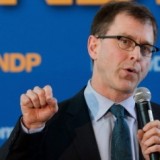
No means no. Fortunately for British Columbians, the Liberals aren’t fairing well in recent polls. Clark should have taken a lesson from NDP Leader Dix, who took a firm stance against the Northern Gateway a while back.

John Disney is the economic development officer of the The Old Massett Village Council, a band government of the Haida people.

Share
Gwyn Morgan (Peter J. Thompson/National Post photo)

Rafe Responds to Gwyn Morgan’s Attack on ‘Environmental Zealots’ Opposing Enbridge

Share

I’ll say this for Fraser Institute “Fellow” Fazil Mihlar, in charge with the Vancouver Sun’s op-ed page: he certainly knows where to find the bottom-feeders to support his ultra-right wing views. Earlier this week, it was right wing zealot Herb Grubel, today it’s some deep thinker, I don’t think, from SNC Lavalin and a director of HSBC, named Gwyn Morgan.
 
Perhaps Postmedia, which owns the Sun and the Province, aghast at stands taken from the recent columns by Vaughn Palmer and Mike Smyth, has been under pressure to make amends by ensuring the op-ed page remains the bulletin board for fish farms, independent power producers and pipeline/tanker enthusiasts.
 
Morgan states, “how difficult it can be for ‘big business’ to be heard over the doom-laden exaggerations of environmental zealots…and powerful international groups…stopping Gateway is part of a large  strategy to stymie further oil sands (sic) development.”
 
Sticks and stones, Mr. Morgan; sticks and stones may break my bones but words can never hurt me!
 
Morgan’s article is full of praise for the safety of pipelines and tankers and deals with none of the points raised by groups like The Wilderness Committee and The Common Sense Canadian.
 
One can be untruthful in two ways – telling lies or ignoring the facts.

I have some questions for Mr Morgan:

  1. Enbridge has admitted that there will be spills, as does Dr. Grubel. You have not maintained that these will not happen so one must assume that you agree that spills will occur?
  2. Enbridge has an appalling record which over the past decade has had a spill of more than one per week. How can you possibly defend their building two pipelines (one bitumen, one condensate) in BC?
  3. Their record for cleanups, as exemplified by the Kalamazoo spill, forces the question: given that there will be spills in BC, why should we trust Enbridge’s ability to clean them up?
  4. The pipelines would cross the Rockies, the Rocky Mountain trench, the Coast Range and through the Great Bear Rainforest – how would Enbridge get men and equipment to the spill?
  5. The stuff being shipped is not traditional crude oil but the highly toxic bitumen which, when spilled on water, sinks like a rock and is virtually impossible to clean up. Why, Mr. Morgan, should British Columbia run the certainty of spills of highly toxic tar sands that cannot be reached and could not be cleaned up, even if Enbridge could get to them?

Mr. Morgan, because these spills cannot be cleaned up, we’re dealing with serial spills adding ongoing environmental damage to previous uncleaned spills.

The overall problem of pipelines/tankers is not just the certainty of spills but the high, long-living toxicity of the substance spilled. It’s rather like having a revolver with 100 chambers with one bullet – if you start pulling that trigger, sooner or later you’ll blow your brains out. If, however, the bullet is simply marshmallow, who cares? The risk of hitting the loaded chamber is still a certainty but there is no  damage.
 
Bitumen is not marshmallow, Mr. Morgan.
 
I have not mentioned jobs and money, so I’ll close with them.

The pipeline would be built by experienced crews from outside BC and there would be less than 100 jobs remaining on a full time basis.
 
As to the money, Mr. Morgan, BC is not for sale. We who love this province want to preserve it.
 
You and the corporate industry in general, in Oscar Wilde’s words, “know the cost of everything and the value of nothing.”

Share
BC Conservative MP James Moore

Conservative MP James Moore Dumps Enbridge for Kinder Morgan, Needs Refresher on Company’s Record

Share

And so it begins.The spin to jettison Enbridge’s proposed Northern Gateway Pipeline in favour supposedly “safer” alternatives.

This narrative will play out in two ways. The first was demonstrated by Conservative MP James Moore on CKNW’s Bill Good Show earlier this week (read the full interview here). After slagging Enbridge for its poor public engagement and safety record, the MP for Port Moody-Westwood-Port Coquitlam moved onto what he presented as the superior alternative. 

And I think, you asked the question, who else is there out there? I think if you look at the Kinder Morgan pipeline and the way in which they are very judiciously and responsibly engaging with British Columbia’s First Nations, the way in which they’re taking environmental challenges seriously, they way in which they’ve operated for 60 years without any spill—there’s one on land that had nothing to do with Kinder Morgan, but had to do with contractors who were tearing up the streets in Burnaby. There’s a difference, I think, night and day between a company that gets public engagement, Aboriginal engagement, environmental stewardship and Enbridge, which I think their track record is not one that I think any other company should follow if they want to do business in BC.

Bear a few things in mind when you read these extraordinary statements by Mr. Moore. First, Moore, the Federal Heritage Minister, is a rising young star in the Consetvative Party – particularly in BC.

Second, nobody but nobody in Stephen Harper’s button-down caucus opens his mouth – especially about something so key to the Prime Minister’s agenda, not to mention such a hot button issue – without having first received explicit directions to do so from the very highest echelon. What this clearly means is that Moore has been tapped to do Harper’s Enbridge damage control in BC – and the choice of the Bill Good Show to debut this new framing was as calculated as a Catholic Sunday Mass.

The second alternative to the Northern Gateway Pipeline to Kitimat is one that will only work if Enbridge’s reputation is deemed salvageable – and let’s face it, at a spill a week, that’s looking increasingly doubtful. Neverheless, there may well yet be a move to reroute the Kitimat line to Prince Rupert, dumping the perilous planned port at the end of Douglas Channel in favour of a safer harbour just up the coast.

In many ways, Rupert is the more sensible choice, although the pipeline route itself is potentially riskier in this case, transiting several hundred km down the Skeena Valley – a vital salmon artery, rife with geological instability. It is for this reason the Prince Rupert option lost out to Kitimat back in 2005 when both were still on the table.

No matter the comparative safety of the Port of Prince Rupert, many other concerns about the pipeline, the Tar Sands it would carry and whose expansion it would facilitate, and the dangers of a spill in BC’s rugged coastal waters – particularly in Dixon Entrance and Hecate Strait, which the tankers from Prince Rupert would still transit – remain unchanged in this scenario.

Moreover, Enbridge’s credibility remains a major obstacle no matter what. The choice could be made to switch to a different pipeline company altogether, such as TransCanada or Kinder Morgan (the company from whom Kinder bought the Trans Mountain Pipeline, Terasen, had a rival bid to build a pipeline to Rupert in the early 2000s)…but I wouldn’t bet on the Prince Rupert option, for all of the above reasons.

Rather, as James Moore predictably indicated, the twinned Kinder Morgan Trans Mountain Pipeline to Vancouver would seem to be the alternative the powers that be will most likely glom onto to salvage their dreams of expanding the Alberta Tar Sands and accessing new Asian markets.

It is for that reason Mr. Moore needs a refresher on Kinder Morgan, the Texas-based energy giant that has indicated it wants to boost its bitumen pipeline capacity through BC from 300,000 barrels a day to 850,000, meaning a five-fold increase in tanker traffic through Burrard Inlet, the Gulf Islands and Strait of Juan de Fuca.

Moore was wrong on everything he told Bill Good about Kinder Morgan’s track record.

First, to his claim of good aboriginal engagement on the part of the company, just ask the Tsleil-Waututh First Nation, in whose territory the pipeline terminus lies and the tankers would transit. They came out last month, along with their neighbours the Squamish First Nation, to sign the “Save the Fraser Declaration”, joining over 60 BC First nations who’ve already declared their opposition to oil pipelines and tankers through BC.

The Musqueam First Nation of Vancouver, who also have a big say in the company’s plans, had already signed onto the declaration.

The Tsleil-Waututh have voiced their concern about the lack of consultation they’ve recieved on this matter from the BC Liberal Government and stated in April after the company made its plans official, “We want to make it crystal clear that we will oppose any and all increased oil tanker traffic in the Inlet and we oppose the notion of Kinder Morgan turning Vancouver into an oil port city.”

To Moore’s point that Kinder Morgan wasn’t to blame for the rupturing of its line in Burnaby in 2007, he must not be aware that the company plead guilty in 2011 in provincial court for the spill. The court heard that the pipeline’s owner should have done a better job of monitoring work near the line that tore into it, as this Global TV report shows.

Moore must also be ignorant of or deliberately ignoring the leak of 110,000 litres of oil the company suffered at its Abbostsford tank farm earlier this year.

Moreover, with drastically increased bitumen flow and tanker traffic – up to nearly 400 a year from the company’s port in Burnaby, if it gets its way – comes vastly increased risk; or, as my colleague Rafe Mair and many others remind us, certain calamities. And with such a disaster in the waters of Vancouver or the Salish Sea come enormous consequences, both environmental and economic, as Rex Weyler has illustrated in these pages.

Kinder Morgan may not have faced the same scale of public opposition to its plans as Enbridge has seen – but that’s only because it just made its plans official a few months ago. Campaigns are already developing to target the Texas company (full disclosure: I’m part of one of them) and with the likes of Moore shaping this new narrative – dumping Enbridge for a supposedly “safer” Trans Mountain option to Vancouver – the spotlight will increasingly be on Kinder Morgan.

Either Mr. Moore is deliberately deceiving the public about Kinder Morgan’s track record or he’s simply ignorant of it – and being from Vancouver, frankly, he should know better.


Share
Why isn't Adrian Dix fighting Kinder Morgan like he is Enbridge?

Dix Should be Questioned on his Free Pass for Kinder Morgan

Share

Mike Smyth of the Vancouver Province took on Adrian Dix this morning for not applying the same principles in his stance on the proposed Enbridge pipeline and consequent tanker traffic to the proposed Kinder Morgan pipeline twinning.
 
Mike is absolutely right. Dix has shown a political wimpishness which puts him, on this issue at any rate, right there alongside Premier Christy Clark.
 
The proposed lines both go through wild, inaccessible areas of BC, will carry the same gunk (bitumen), with the same certainty of disaster. Bitumen is impossible to clean up at the best of times (see Kalamazoo/Enbridge) and spills will be out of reach of any spill cleanup attempted. As I say, that doesn’t much matter because they can’t be cleaned up anyway.
 
We will have, along side the Kinder Morgan Trans Mountain Pipeline, the same pattern of serial spills, growing with each spill, with the same deadly results.
 
Dix’s cowardice comes out of the recent Chilliwack by-election when he felt it unwise to be against Kinder Morgan because it would look like the NDP was against everything. He came up with the weasel explanation that he hadn’t yet seen the Kinder Morgan environmental plan.
 
Why are those “weasel” words?
 
Because Dix knows as much about Kinder Morgan as he does about Enbridge. The argument has been proved. Both pipelines go through a hugely sensitive environment with fish bearing rivers and streams and Kinder Morgan’s threatens the Fraser River directly. The bitumen is the same, the spills a certainty and impossible to clean up.
 
The tanker traffic is deadly for both.
 
Get your act together, Mr. Dix or, on this issue at any rate, you aren’t much of an improvement over Premier Clark.


The Angus Reid poll on Enbridge published today shows a majority of British Columbians against the project. It must have been commissioned by Enbridge – at least that’s the suspicion when the story in both morning papers emphasizes that 24% might change their minds if Premier Clark gets her demands met. That sounds to me like “if the dog hadn’t stopped to pee he’d have caught the cat.”
 
This issue is not going to get any better for the pipeline people as the inevitability of catastrophic ongoing spills and the accumulation of ecological disasters becomes more firmly understood by the public. This will get clearer and clearer as time passes.
 
As I’ve said before in these pages, Premier Clark’s demand for better environmental oversight and money from Alberta are going nowhere. No matter what environmental safeguards are put in place there will be spills on land and sea on a serial basis. And there is no such thing as a “minor” spill of bitumen.

Enbridge’s Kalamazoo disaster turned out to be the biggest land spill in US history.
 
Finally, in my view as on octogenarian native of British Columbia, I say that our wilderness and coastlines are not for sale and I think that’s a view supported by most of us.

Share

Shell, Partners Apply to Export 24 Million Tonnes of LNG per Year from Kitimat

Share

Read this story form Reuters on Royal Dutch Shell and its partners’ application for a license to export up to 24 million tonnes of Liquified Natural Gas, connected to the group’s proposed LNG plant in Kitimat. (July 27, 2012)

Royal Dutch Shell Plc and its partners in a planned Canadian liquefied natural gas project have applied for a license to export up to 24 million tonnes of the fuel over 24 years, the company said on Friday.

The gas would be exported from a liquefaction plant Shell has proposed to build at Kitimat, British Columbia, on the Pacific Coast to take advantage of lucrative Asian markets. It would initially have to LNG processing units with capacity of 6 million tonnes each.

Shell and its partners, PetroChina, Kogas and Mitsubishi Corp, revealed the details of the proposal in May.

They said the plant could be in service around the end of the decade, pending regulatory approvals.

The proposal follows others being considered for Kitimat, which looks set to become a major Pacific Rim export hub for gas produced from the massive Horn River and Montney shale gas formations in British Columbia.

Read original posting: http://www.reuters.com/article/2012/07/27/shell-canada-lng-idUSL2E8IRCC720120727

Share
Dr. Herb Grubel is a former Reform MP, an SFU professor emeritus and Fellow of the Fraser Institute

Rafe Responds to Far-Right Wing Fraser Institute Fellow, Defender of Enbridge Pipeline

Share

Herb Grubel, a professor emeritus of economics at SFU, is a far right “Fellow” of the Fraser Institute – forgive me, that’s, of course, redundant.
 
I’m not sure if he shares the views of Fraser “Fellow” Walter Block, namely that a poor woman with kids she can’t afford to support should be able to, if she wishes, enter into a slavery contract with a rich man who promises to look after them. (Whether this consensual slavery includes bedroom privileges I can’t say.)* I interviewed Grubel a dozen or more times when he was a Reform MP and although the point never arose, Grubel is uncritically supportive of the free market system which is what Dr. Block rests his case upon.

If Grubel wishes to comment on this we will be happy to print it.
 
*(Read my opinion piece in The Tyee several year’s ago on Block and his colleagues, followed by Block’s own rebuttal)
 
Fellow Fraser Institute “Fellow” Fazil Mihlar is in charge of the Vancouver Sun’s editorial pages and in today’s Sun (August 1) is an op-ed piece by Grubel. (I’ve been a writer for over 30 years yet have never been so honoured – I wonder why?)
 
Grubel gives advice as to how Premier Clark can get more money out of the Enbridge line and, frankly, that doesn’t interest me, for reasons I will go into.
 
Grubel believes that pipeline operators are already required to clean up spills…that the government should create a trust to match clean-up costs in excess of the costs not covered by insurance. He goes on to point out that tugs could be used to move tankers…other measures will be developed, he says, to be applied to the prevention of oils spills on land and sea.
 
Here is the critical part:
 
No measures, however expensive, can prevent all oil spills, (emphasis mine – RM) as the small minority of self appointed guardians of the environment and their allies in the media (the media??? – RM) are fond of pointing out. Only the outright prohibition of all oil transport will end all risks.
 
Grubel goes on to say that sensible British Columbians will vote for politicians “who support policies ensuring they will continue to be able to keep their homes warm, their cars running and shelves in their stores stocked while they enact and enforce policies that induce pipeline operators to adopt the best methods for minimizing oil spills and maximizing the protection of the environment.”

Before getting to the point of the matter, let me congratulate Grubel for acknowledging that spills are inevitable – a critical admission for what I will say in a moment. 

Dr. Grubel, as one of the “self appointed guardians of the environment”, I can only tell you that unlike your friends in the oil industry, we exist with very little funding and what we get is sporadic. So far at the Common Sense Canadian we have yet to receive our first foreign dollar.
 
Now to the meat of the matter.
 
Dr. Grubel glosses over the most important fact in this controversy – the oil spills he speaks of as certain cannot, for all intents and purposes, be cleaned up.
 
It is this fact that throws Grubel’s arguments out the window. We’re not dealing with gasoline, natural gas, bunker oil or ordinary crude oil but gunk called bitumen. When there is a spill in water, the condensate, which allows the bitumen to be piped, separates, leaving the bitumen to sink like a stone. I don’t suppose that Grubel has read about the Enbridge/Kalamazoo spill which occurred in a populated state and was accessible by equipment and how Enbridge has been unable to clean it to this day, more than two years later.
 
Grubel cannot have considered where the Enbridge pipeline is destined to travel – 1,170 km over two mountain ridges (The Rockies and Coast Range), through the Rocky Mountain trench thence into the Great Bear Rain Forest. It would cross nearly 1,000 rivers and streams, most of which are essential to salmon populations. Even a Milton Friedman disciple ought surely to be able to take a moment to be human and reasonable and see that the Enbridge pipeline would be an ecological disaster of huge proportions – and permanent. 
 
There is another point seldom raised which is of considerable concern – this pipeline will have regular leaks and fractures, each time creating a new, permanent ecological wipe-out, meaning we are looking at serial disasters.
 
As to tanker traffic, Grubel admits that there will be spills but industry will mitigate the consequences. He’s unable to get his head around the fact than any spill on our coast will have permanent, horrible consequences. Perhaps Grubel has never seen our north coast.
 
What Dr. Grubel has done is demonstrate, clearly, what we “self appointed environmentalists” have been saying all along – spills on land and sea are inevitable and that no amount of money will be sufficient compensation.
 
He has failed to consider that the consequences of those spills will be permanent, ongoing, serial catastrophes.

“Sensible British Columbians” know this and will take that knowledge into the polling booth.

A response from Herbert Grubel (published August 23, 2010)

Rafe has always been fair in our numerous discussions on CKNW when I was a member of the Reform Party in Ottawa during the 1990s. Such fairness was rare at those times when the media were out to demonize the Reform Party. I will always gratefully remember our efforts to bring rationality to the issues of the day by considering the benefits and costs of government policies, even if we ended up disagreeing on the final results of such calculations.

It surprises me that Rafe now seems to deny the need for the consideration of costs and benefits when it comes to human activities that affect the environment. But before I elaborate on this point, let me take up the challenge of responding to one of Walter Block’s outrageous positions on public policy.

Walter is the poster boy for Libertarians. In a recent public debate we had over some government policy he said that my views are those of a pinko and fascist. That should be enough to establish the fact that I disagree strongly with most of Walter’s ideas and that includes the one he advanced about what a widowed mother should do to feed her children. On the other hand, I believe that Libertarian principles should inform all public policies but that compromises are needed to accommodate the large range of other values held by people in a free society.

There is an irony in the fact that the views of both Walter and Rafe are based on the acceptance of absolutes. For Walter it is freedom, for Rafe it is the preservation of nature in its raw state. In a world in which humans exist with all of their needs and preferences, compromises have to be made.

Rafe’s rejection of my suggestion that the government should insist on the creation and enforcement of rules that minimize the incidence and severity of spills and maximize the dedicated cleaning efforts in the case of such spills rests firmly on his adherence to the view that nothing should ever be done to alter the existing state of nature.

This position is indefensible and impractical. All human activities carry risks. We may get injured or killed when we take a shower or drive a car. Yet, we take showers and drive cars because the benefits are greater than costs, especially after we have made all feasible efforts to minimize accidents.

I am willing to bet that Rafe does engage in all kinds of risky activities and I am at a loss to understand why he insists that collectively taken human activities like the transportation of bitumen should be allowed only if it carries a zero risk of damage to the environment.

I find it ironic also that the proudly liberal and progressive Rafe is extremely conservative when it comes to the environment. He insists that humans should do nothing ever that changes the existing ecology of a piece of land or a body of water. Political conservatives he despises similarly insist on the preservation of existing laws and institutions.

The fact is that nature itself constantly changes the environment, gradually through evolution and suddenly with floods, fires, volcanic eruptions, the impact of meteors and other such events.

I see nothing unnatural and catastrophic in the fact that the clean-up efforts of humans and nature have left a thin layer of oil one foot below the surface of the beaches that had been covered with oil from the Exxon Valdez spill in 1989. A previously alien species of bacteria is still busy at work gorging itself on this layer while its existence enriches rather than lowers the variety of life forms in the area. For Rafe this addition to the ecology somehow is a catastrophe of the sort that must never be allowed to occur.

Rafe and I will agree to disagree on environmental and many other issues of public policy. I hope he will keep up his work and continues to insert his absolute values into the debate over public policies. I will take his, as well as Walter’s views into account whenever I assess the practical merit of collective actions affecting the welfare of our fellow humans and the environment.

In the meantime, we should all celebrate that we are able to have the kind of exchange of views exemplified by this response to Rafe’s comment on my Vancouver Sun editorial. We live in a great, if imperfect society and time in history. It would be even greater if we could agree to refrain from attaching to our opponents inflammatory labels. Calling me “far-right-wing” is not the way to cultivate needed and civilized exchange of views.

Share

NEB Approves Enbridge Proposal to Reverse Ontario Pipeline on Same Day Company Suffers Another Spill

Share

Read this story from iPolitics on the National Energy Board’s conditional approval this past Friday for Enbridge to reverse the flow of its Line 9, enabling the company to ship oil to customers in Eastern Canada and the US. The decision was announced on the same day Enbridge produced yet another pipeline leak, this time in Wisconsin. (July 27, 2012)

CALGARY — The National Energy Board said Friday it has approved Enbridge Inc.’s plan to reverse the flow of part of an oil pipeline in southern Ontario.

The federal watchdog says it has imposed 15 conditions on the $16.9-million project, mainly having to do with pipeline integrity.

Line 9 currently flows from Montreal to Sarnia, Ont., but Enbridge wants to reconfigure it so it flows from west to east. Refiners in central and eastern Canada want to use cheaper Canadian crude instead of pricier oil imported by tanker from overseas.

The NEB approval pertains to the section of pipe between Sarnia, Ont., and Westover, Ont., near Hamilton.

In May the board held hearings where it heard concerns from the public about possible spills from the pipeline.

Labour Minister Lisa Raitt, a former natural resources minister, said the NEB decision is “quite important” as it helps improve pipeline access to Canada’s coasts and customers in the U.S.

Raitt said the reversal reflects what customers want and need and keeps Canada’s oil flowing in a way that is most economic, adding that customers on the east coast will be able to receive cheaper crude from North America rather than have to import it from abroad.

“Energy is a matter of national importance and the government welcomes efforts to better utilize our energy assets for the benefit of Canadians from coast to coast to coast,” said Raitt. “So in this respect the expansion and the diversification of our energy markets is one of our priorities.”

Enbridge rival TransCanada Corp. is also working on a plan to ship western Canadian crude east. It’s looking at converting its gas mainline, which is running part-empty, to gas service. It could ship between 400,000 and 900,000 barrels per day of oil, depending on customer demand.

Read more: http://www.ipolitics.ca/2012/07/27/neb-approves-part-of-enbridge-line-9-reversal-in-ontario-with-conditions/

Share

BC Liberal Envrironment Minister: Kinder Morgan Faces Same Hurdles as Enbridge

Share

Read this story from The Province on BC Liberal Environment Minister Terry Lake’s statement that American energy giant Kinder Morgan faces the same challenges over the proposed twinning of its existing Trans Mountain Pipeline to Vancouver as Lake’s government has recently outlined for the proposed Enbridge Northern Gateway Pipeline. (July 31, 2012)

B.C. Environment Minister Terry Lake says some of the conditions that the province has set out before approving the Northern Gateway project will also be applied to the proposed Kinder Morgan pipeline expansion.

The government wants the company to beef up oil-spill prevention and response before it will support the project, he said.

B.C. also wants a larger share of revenue from the company to offset the financial costs of an oil spill.

Kinder Morgan’s expansion of the Trans Mountain Pipeline, which runs from Alberta to Vancouver, would see an increase in the size and number of tankers passing through Vancouver’s harbour.

Last week, Premier Christy Clark called for more economic benefits from the Enbridge pipeline before it will be approved because B.C. would bear all the environmental risks.

Alberta Premier Alison Redford has rebuffed any suggestion of increased compensation for B.C.

Meanwhile, a group of Burnaby residents who live next to the Kinder Morgan pipeline want to ensure the company can afford to compensate them for the “inevitable leaks and ruptures” from a twinned pipeline.

The 12 residents plus a housing co-operative in the neighbourhood at the southeast end of Burnaby Mountain have applied for intervener status at a public hearing by the National Energy Board.

“As landowners who stand to be affected by leaks, ruptures or explosions along the pipeline right of way … they have a direct interest in the operation” of the pipeline, says a letter filed with the board by Ecojustice, a Vancouver environmental law group representing the group.

Burnaby-Douglas NDP MP Kennedy Stewart, who has also applied for intervener status, said he conducted a telephone poll of 35,000 Burnaby residents and 75 per cent were against expansion of the pipeline.


Share

First Nations and Former Government Leaders: ‘BC is Not for Sale’

Share

Read this story from The Vancouver Observer on Monday’s press conference hosted by the Union of BC Indian Chiefs and featuring former federal Environment Minister David Anderson, wherein he and prominent First Nations leaders delivered a strong message to the Clark and Harper Governments regarding the proposed Enbridge pipeline that “BC is not for sale.” (July 30, 2012)

The head of the Union of BC Indian Chiefs said that selling BC’s coast and rivers is not the way Premier Clark should be fighting against Alberta’s oil agenda. Grand Chief Stewart Phillip of the Union of BC Indian Chiefs spoke  at a press conference today with leaders from BC’s municipal and environmental groups.

“Well, look who just caught up. Premier Clark is right that we need to stand up to Alberta’s aggressive oil agenda, but selling our coasts and rivers out from under us is not the way to do it,” Phillip said in a release.

“First Nations right across BC have vowed we will never allow Enbridge’s pipeline and tankers, and non-Natives are united with us in a growing groundswell of unity to protect all of us from oil spills.” Premier Clark should take “decisive action” in opposing heavy oil pipeline and tanker projects, he said.

Phillip was joined by former federal Minister of the Environment David Anderson and Prince Rupert City Councillor Jennifer Rice. They called for the rejection of Enbridge Inc.‘s Northern Gateway pipeline and tanker proposal following a US-Canada Enbridge pipeline oil leak of over 1,200 barrels (more than 190,000 litres) in Wisconsin over the weekend.

The Northern Gateway is a 1,177 km dual pipeline project transporting 525,000 barrels of heavy oil per day between Edmonton, AB to Kitimat, BC. The project is a proposal from Calgary-based Enbridge Inc., a company specializing in crude oil and liquids pipelines, natural gas transportation and distribution, and green energy.

Over 100 First Nations have banned tar sands pipelines and tankers from their traditional territories.

No amount of money can protect coast, cover damage of oil spill, says former federal environment minister.

“Protecting our salmon streams and our ocean coast from oil spills is not negotiable,” said former BC Liberal Leader and former federal Minister of the Environment David Anderson. “No amount of money can protect our coast, and no amount of money can repair the damage of a spill of heavy Alberta crude oil…Premier Clark should make that clear to the Alberta and federal governments, and then move on to negotiating a Canadian National Energy Strategy based not on increasing production and consumption, but on the fundamental need to reduce greenhouse gas emissions from all Canadian sources.”

Anderson cited Enbridge’s poor record on environmental and worker safety as the main reason to reject the Northern Gateway project. The US National Transportation Safety Board released a scathing report in early July about Enbridge’s handling of a 2010 oil spill in Michigan, calling the company’s employees incompetent and stating that the company had a “deviant” culture around safety procedures.

Read more: http://www.vancouverobserver.com/politics/bc-not-sale-enbridge-northern-gateway-say-aboriginal-and-former-government-leaders

Share