
Article about the Get Out Migration by Celia Brauer in the Georgia Straight. Read article
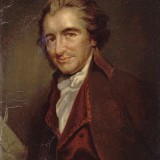
by Dr. Chris Shaw
It seems fitting with the launch of The Common Sense Canadian that we ponder Tom Paine and the Current State of Canadian Civil Liberties. What he man who used the term “Common Sense” as the title of his revolutionary pamphlet on freedom and revolution might make out of the current state of Canadian “civil rights”.
As problematic as it can be to reach back 200 years to interrogate the long departed, Paine’s writings offer some clues how he would answer. Paine would be utterly disgusted at the travesty of faux civil liberties we so blithely assume shield us all and would be shocked at how casually our elected officials to withhold information and misuse our legislative institutions. Sadly, he’d hardly be surprised by either.
Paine was not a fan of governments in general and bitterly opposed in particular to monarchy. In Paine’s view, governments were innately prone to abuse power.
“Some writers have so confounded society with government, as to leave little or no distinction between them; whereas they are not only different, but have different origins. Society is produced by our wants, and government by wickedness; the former promotes our happiness positively by uniting our affections, the latter negatively by restraining our vices. The one encourages intercourse, the other creates distinctions. The first is a patron, the last a punisher. Society in every state is a blessing, but government even in its best state is but a necessary evil; in its worst state an intolerable one; for when we suffer, or are exposed to the same miseries by a government, which we might expect in a country without government, our calamity is heightened by reflecting that we furnish the means by which we suffer. Government, like dress, is the badge of lost innocence; the palaces of kings are built on the ruins of the bowers of paradise.” [italics his]
Paine’s later The Rights of Man was written in defense of the French Revolution. Like Thomas Jefferson in the American Declaration of Independence, Paine would lay stress on natural rights as “inalienable”, essentially a gift from a higher power to all humans derived solely from the very fact of humanness. Following on the Enlightenment concept of “natural law”, natural rights did not depend on the validation of any government or social structure, they simply existed. Governments could – and often would – try to suppress natural rights, but could neither create nor extinguish them.
In contrast, civil and political rights were those bestowed by the state and designed to protect the individual from excesses of power and to enable people to exercise some level of political control. Civil rights are those that guarantee the safety of the individual and protect against discrimination. Political rights the freedoms we often take for granted: assembly, speech, religion, the press, suffrage, due process in law, etc.
Civil and political rights –lumped together as “legal rights”- are rarely given voluntarily by the state, but usually have to be fought. The fight always comes with a significant price tag, since freedom is rarely free. The fight for legal rights can be extremely violent as the American and other revolutions show. In less extreme cases, legal rights can arise relatively peaceful: women’s suffrage, for example.
Paine, viewing 2010 Canada through the prism of history would see what? He would have no doubts that Canadians were functionally bereft of civil liberties in all but name – mirage like, but insubstantial. At the federal level, Paine would note the arbitrary nature of a minority ruling party more than willing to dismiss Parliament at whim. He would find in the Charter of Rights and Freedoms the gaping libertarian hole of Section 33, the so-called “Notwithstanding” Clause. Essentially a political compromise to of the most callous order, the clause allows the federal and provincial governments to opt out of pretty much any of the civil rights provisions of the Charter that they don’t like. Paine would wonder at the ingenuity of politicians who could so casually create a Charter of Rights and include within the same document the means to deny its very provisions.
Paine would watch with dismay the lack of transparency by the government. The clear parallels to his own day would be starkly revealed in the way it deliberately ignores the will of Parliament by denying basic information on the handling of Afghan prisoners.
Paine would have watched agents of the federal government in the guise of the 2010 Integrated Security Unit (ISU) conduct round the clock surveillance of Olympic political dissidents who had committed no crime apart from holding contrary views and harassing and intimidating individuals while tracking down their friends, families and neighbors to probe for incriminating information in the absence of the slightest evidence that such information even existed. Paine would have appreciated the irony of three levels of government applauding ISU for providing a “safe and secure Olympic Games” by trampling the Charter thoroughly underfoot.
Here, to British Columbia, the self-touted “best place on Earth”, Paine could hardly have failed to see the same arrogant misuse of power: Legislation passed at provincial and municipal levels that sought to curtail freedom of speech and assembly on behalf commercial agreements with a private entity called the International Olympic Committee. The City of Vancouver’s and BC’s signage laws made fundamental compromises to civil liberties while trying to pretend that it was all fine since it was only “temporary”. The Assistance to Shelter Act would have caught Paine’s notice with its egregious provisions that made individuals doing no harm to themselves or anyone else subject to removal on the whim of police officers.
Paine would have watched the cavalier destruction of the wild salmon fishery and the expansion of private power projects by a government with no respect whatsoever for the concerns of the citizenry. Paine surely would have wondered how an apparently simple conflict of interest case such as the Railgate scandal could still be shrouded in secrecy even years after the initial disclosure.
In Common Sense, Paine enumerated many of the abuses that had led Americans to rebel: arbitrary misuse of power, abrogation of “English” common law civil rights of the day, violence and harassment directed against its own citizens, and, in the end, the lack of any functional means for redress leaving only surrender. This constellation of abuses left no recourse besides rebellion.
For Paine, an illusion of rights in the absence of their reality was more obscene than an honest denial of the same could ever be. In our own day, despotic regimes around the world, unlike Canada, make no pretense to honouring human rights. Despicable, perhaps, but at least not bearing the sin of hypocrisy.
Paine’s conclusions for Canadians might have come to him in a burst of déjà vu: Your governments have actually become your enemies and serve interests not your own. You would be better off without them. Common sense dictates that you take action to reform or remove such governments; how you do so is up to you.
What Paine would not know how to address would be the question about how we create necessary reforms and generate truly representative government when so much of the public is totally apathetic and/or has been brainwashed by the mainstream media and governments themselves on the mantra of “peace, order and good government”?
This last remains the challenge for our own day.
Dr. Christopher A. Shaw was one of the most outspoken opponents of Vancouver’s 2010 Winter Olympics and wrote a book chronicling Vancouver’s Games, Five Ring Circus.
Posting by Dave Schreck on his Strategic Thoughts blog about Bill 17, which he refers to as the “Flood Valleys for Power for Export Act”. Read article
Story on salmonaresacred.org about the Get Out Migration organized by Alexandra Morton, which started April 23, and arrives in Victoria on May 8. Read article
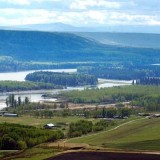
The Campbell Liberals’ decision to proceed with Site C is almost as bad as their Harmonized Sales Tax scam because it’s obvious from the content of the Site C announcement that it’s premature – before the proper studies have been done – and so is mainly a PR ploy to try to distract public attention away from the popular revolt against the HST.
Furthermore, the way Premier Gordon Campbell was obviously trying to use the Site C issue to position himself into a province-building legacy akin to W.A.C. Bennett’s is further offensive, especially since he has been deconstructing so much of the legacies like B.C. Hydro and BCRail left by previous governments but also because his spending and taxing choices in general have been so regressive.
Those Vancouver school kids demonstrating against underfunding of education were right on: the Campbell crowd can find hundreds of millions of dollars to retrofit a roof for a soccer stadium (and many other dubious spending choices like that) but they won’t find money for school districts to properly fund education, for health boards to properly fund hospitals or for other pressing needs such as welfare and Medicare as well as useful programs such as arts and culture grants.
More recently we have seen a wave of layoffs in the provincial government and it’s no surprise that some of the steepest cuts have come in Ministries such as Environment and Forests that are charged with protecting the public interests while political agencies such as Public Affairs Bureau have generally been spared from such cuts.
It’s clear that the main reason Campbell is doing what he’s doing – bringing in the HST in order to get the $1.6-billion bribe from Ottawa – is to try to minimize his embarrassment over the huge deficit, and especially to try to hide the fact that he lied about the size of that deficit in the previous election campaign, which is unconscionable.
The Site C issue itself is a prime example of Campbell’s deceits: the Campbell Liberals have knowingly misrepresented the state of the province’s energy supplies, claiming we are net importers when really we have an abundance of reliable supplies which we choose to enhance by being clever traders – we import power from Alberta when it’s cheap and we export power to the U.S. when it’s highly profitable.
I am not opposed to economic growth and expansion of power supplies, and I’d even support Site C provided it can be fairly proven to be safe from the engineering perspective and viable from environmental and community perspectives, but I am very opposed to Campbell pushing it ahead prematurely for primarily partisan reasons.
So what we have is Campbell trashing the public interest in many ways and many areas in order to vainly try to rescue his own political reputation. It is disgusting. He must go.
If you haven’t signed the HST petition yet you should ensure you do so well before the July 5 deadline regardless of how you feel about the petition proponent Bill Vander Zalm, whose own record is checkered. That’s because the issues are bigger than the personalities involved, and a vote against the Campbell Liberals’ mismanagement of the HST can also be – and should be – a vote against his mismanagement of many other issues too.
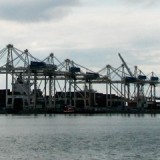
What trumps the best soil in North America? Or what my father (an agrologist in a very early life) once told me was the “finest soil in the world, second only to the Nile Valley”? What trumps pioneer farmers whose families cleared the land and built the dykes? What trumps an international commitment to a migratory bird flyway? Or protection of the Fraser River estuary? Or a commitment to law and the land, the environment and the people?
Pavement trumps, of course. Big business with undue influence on government trumps. So does government that abandons ethical responsibility for the quality of life in the communities where people
live their lives, pay their taxes, and raise their children – people who want only to be heard, and to know that common sense will rule.
The South Fraser component of Gateway is a 40-year-old transportation plan that definitely trumps modern thinking. The government ignores its environmental responsibility while hypocritically flaunting buzz terms like “sustainable”, “green”, “living smart”, and “carbon neutral” – a futile attempt to sanitize this dirty and wasteful development.
In other words, the South Fraser Perimeter Road trumps everything with this government’s “pavement politics”.
There are many reasons to oppose this blacktop boondoggle: it destroys precious farmland, dislocates people, demolishes habitat of threatened species. It increases pollution and congestion, and encourages real estate speculation.
But another major problem can be found in a report commissioned by former federal Minister of International Trade David Emerson, on the planned port-related transportation network known as Gateway. The report observed that the efficiency and competitiveness of the Port Metro Vancouver (PMV) had little to do with the construction of a new transportation network, and everything to do with modernizing the labour structure and distribution systems that service port activity. The paper noted that unless those elements changed, building new infrastructure would not be the panacea either big business or PMV were seeking. In other words, infrastructure alone would not enable the Port to effectively compete with the great ports of the world that had already addressed labour and distribution issues.
What does this mean? Simply, it means that a distribution system which is not operating around the clock is fundamentally inefficient and uncompetitive. It also means that outdated labour rules and rates will fail to serve us in the competitive global market.
And the real travesty is that the creators of Gateway know this is true. They have been asked time and again why they need new highways when the existing infrastructure is used only eight hours a day. And their answer? The distribution system says it would need a vast change in present practice. The truckers don’t want to work at night. And the excuses multiply. The Port executives know the problem. So do the distributors. So do the truckers. And so does the government.
But rather than confront the reality of an inefficient, underused system, we will spend over a billion dollars to go around the roadblock. Instead of issuing an executive order to run the port and its distribution network 18 or 24 hours a day, an irresponsible government finds it easier to pave the land.
Who is the winner? Certainly not the people. Trucks may move faster for the same eight hours a day. Gigantic distribution warehouses and miles of new blacktop will deliver containers and goods – for the
same eight hours a day. And the people and the land and the environment will pay – forever.
A private prosecution previously laid by biologist and activist Alexandra Morton against Marine Harvest Canada was taken over by the federal Justice Department. By Judith Lavoie in the Vancouver Sun. Read article
Blog posting by Jarrett Walker analyzing choices for transit in the direction of Point Grey. Read article
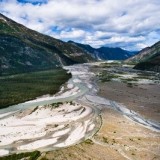
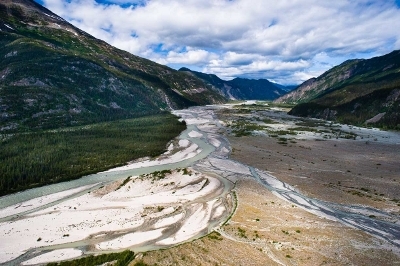 Photo by David Nunuk, July, 2009.