Category Archives: Oil&Gas

Exxon Chief Acknowledges Global Warming From Fossils Fuels, Insists Humans Will Adapt

Share

Read this Canadian Press story, via TheTyee.ca, on Exxon CEO Rex Tillerson’s recent statement covering global warming, fracking, and other controversial aspects of his company’s business. (June 28, 2012)

ExxonMobil CEO Rex Tillerson says fears about climate change, drilling, and energy dependence are overblown.

In a speech Wednesday, Tillerson acknowledged that burning of fossil fuels is warming the planet, but said society will be able to adapt.

The risks of oil and gas drilling are well understood and can be mitigated, he said. And dependence on other nations for oil is not a concern as long as access to supply is certain, he said.

Tillerson blamed a public that is “illiterate” in science and math, a “lazy” press, and advocacy groups that “manufacture fear” for energy misconceptions in a speech at the Council on Foreign Relations.

He highlighted that huge discoveries of oil and gas in North America have reversed a 20-year decline in U.S. oil production in recent years. He also trumpeted the global oil industry’s ability to deliver fuels during a two-year period of dramatic uncertainty in the Middle East, the world’s most important oil and gas-producing region.

“No one, anywhere, any place in the world has not been able to get crude oil to fuel their economies,” he said.

In his speech and during a question-and-answer session after, he addressed three major energy issues: Climate change, oil and gas drilling pollution, and energy dependence.

Tillerson, in a break with predecessor Lee Raymond, has acknowledged that global temperatures are rising. “Clearly there is going to be an impact,” he said Wednesday.

But he questioned the ability of climate models to predict the magnitude of the impact. He said that people would be able to adapt to rising sea levels and changing climates that may force agricultural production to shift.

“We have spent our entire existence adapting. We’ll adapt,” he said. “It’s an engineering problem and there will be an engineering solution.”

Andrew Weaver, chairman of climate modeling and analysis at the University of Victoria in Canada, disagreed with Tillerson’s characterization of climate modeling. He said modeling can give a very good sense of the type of climate changes that are likely. And he said adapting to those changes will be much more difficult and disruptive than Tillerson seems to be acknowledging.

Steve Coll, author of the recent book “Private Empire: ExxonMobil and American Power,” said he was surprised Exxon would already be talking about ways society could adapt to climate change when there is still time to try to avoid its worst effects. Also, he said, research suggests that adapting to climate change could be far more expensive than reducing emissions now. “Moving entire cities would be very expensive,” he said.

Read more: http://thetyee.ca/Blogs/TheHook/Environment/2012/06/28/exxon-fossil-fuel-adapt-climate/
Share
Province cartoonist Dan Murphy speaks with CBC yesterday

Enbridge’s Attempt to Kill Spoof Backfires as Censored Cartoonist Goes Public

Share

Province newspaper cartoonist Dan Murphy went public on CBC yesterday to confirm suspicions that his publication had pulled a spoof he created last Friday, under pressure from Enbridge Inc.

The cartoon, which mocks Enbridge’s new ad campaign designed to mollify concerns about its proposed twin pipelines from the Alberta Tar Sands to Kitimat, was posted on The Province’s website Friday morning, only to be pulled several hours later.

Online magazine backofthebook.ca obtained a response from Province Editor-in-Chief Wayne Moriarty on Monday, confirming the company had pushed for the removal of the cartoon:

Wayne Moriarty, The Province‘s Editor-in-Chief, says the animation was removed at the request of Enbridge “because it contains copyrighted material.” He admits that use of the material might be protected under fair use laws, but says the newspaper chose not to pursue the matter. He points out that The Province has run editorials critical of the pipeline, and insists that the decision to pull the satire has nothing to do with the $5 million campaign, which is running in his paper and The Vancouver Sun, both of which are owned by The Pacific Newspaper Group, among many other media outlets.

But Murphy contradicted parts of Moriarty’s statement on CBC Tuesday evening. The cartoonist said he was called in for a meeting with Moriarty, who told Murphy that the chief revenue and digital officer for Postmedia, The Province’s parent company, was upset over the parody.

Said Murphy, “The information he gave us there was Simon Jennings was very upset over this video, that Enbridge was very upset, that Enbridge was going to pull a million dollars worth of advertising out of Postmedia newspapers if it didn’t come down. And also if it didn’t come down that Wayne Moriarty was going to be fired.”

Murphy said Moriarty later told him, “Enbridge was mostly upset because we had taken their material and turned it into a parody.”

The CBC story included reaction from Langara University journalism professor Ross Howard, who dismissed Enbridge’s alleged concerns under the principle of “fair comment”, noting, “When you’re commenting about what that corporation is doing, what it stands for, it’s the same as using their own name and putting their symbol on it. That’s why they have logos and symbols.”

Enbridge released a statement yesterday denying it had demanded the removal of the video or threatened to pull a portion of its $5 million ad campaign from Postmedia papers. According to company spokesperson Todd Nogier, “Enbridge Inc. did not request the Province or Post Media pull the video…Enbridge has not discontinued this campaign, nor its investments as a part of that campaign, nor did Enbridge threaten to discontinue that campaign.”

And yet, the company later confirmed in a conversation with CBC that “…the company had a conversation with Postmedia and they apologized for the parody…any further conversation would be inappropriate.”

Regardless of Enbridge’s claims, the controversy over the cartoon has only served to increase the attention it has received. The video was promptly reposted by citizen journalists on youtube, with one posting generating over 12,000 hits as of this writing. A story The Common Sense Canadian ran yesterday on the subject was picked up by several other online publications and has generated over 1,600 “likes” on facebook in a day and close to 10,000 hits on our website. Blogger Laila Yuile has generated significant traction covering the story on her website as well, as the story has been all over the blogosphere and social media since Friday.

The fallout over Enbridge’s alleged actions is indicative of the clash of old and new media. Clearly the company believes it is still operating in an old media world, wherein a company can control a story by way of advertising dollars and corporate heft. But in today’s increasingly online media world, these heavy-handed tactics pose a real risk of backfiring, as they plainly have here.

As one commenter noted on the youtube page where the video has been reposted, “It’s on youtube now. It’s not going away.”

Share

Liberals to Reclassify Natural Gas for LNG as “Clean”

Share

Read this blog from the Huffington Post Canada on today’s announcement from the Clark Government that it will be adding natural gas to its list of acceptable “clean” energy sources to enable proposed Liquid Natural Gas (LNG) plants in Kitimat to use natural gas to power their facilities. (June 22, 2012)

VANCOUVER – Premier Christy Clark has tweaked regulations to ensure her job creation plan that includes building three liquefied natural gas plants in northern British Columbia squares with the government’s aggressive plans to cut greenhouse gas emissions.

Clark has previously acknowledged the plants — which are known energy hogs — could be at odds with the provincial Clean Energy Act, but she’s relying on them to create employment.

On Thursday, Clark announced she will be redefining only natural gas that’s used to power the northern LNG plants as “clean energy,” while keeping the classification of all other natural gas in the province as is.

The province’s Clean Energy Act already included cases in which burning natural gas could be considered clean, and so the altered regulation effectively brings the natural gas used to fuel the LNG plants in line.

“To make sure that B.C. can win in the global marketplace, while also doing our best to make sure we’re protecting our environment, we’ll be announcing a new regulation,” she told a conference of energy sector companies in Vancouver.

Clark added the designation will only apply to power generation that meets a set of environmental emissions standards.

Read more: http://www.huffingtonpost.ca/2012/06/21/christy-clark-natural-gas_n_1617451.html

Share
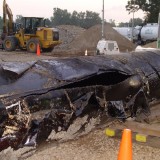
Enrbidge's burst pipeline near the Kalamazoo River in Michigan, 2010

More BS than Bitumen Flowing From Alberta After Third Recent Spill

Share

A story in yesterday’s Edmonton Journal on the latest pipeline spill in Alberta, this one near Elk Point, was more full of crap than the province’s rivers and farms are full of oil these days.

This spill, from Enbridge’s 541-kilometre Athabasca Pipeline – which officials are pegging at 230,000 litres of diluted bitumen – comes on the heels of two others in less than a month, including the Plains Midstream spill just last week near Sundre and Pace Oil and Gas’ well leak near Rainbow Lake in late May. Of course, that was Plains Midstream’s second disaster since April, when its Rainbow pipeline produced the province’s largest leak in 36 years.

In other words, it’s been a bad couple of months for an industry trying to win over public opinion for two major bitumen pipelines proposed to traverse British Columbia (Enbridge and Kinder Morgan). This dizzying succession of spills has seriously complicated what was a tough sell to begin with.

But you wouldn’t know it from the stream of public relations bs flowing from Alberta politicians and industry reps in yesterday’s Journal story.

Here’s Darin Barter, spokesman for the Energy Resources Conservation Board:

Having the incidents so close together is unusual and not indicative of Alberta’s level of safety,” Barter said.

“Given the enormous amount of oil and gas infrastructure in this province, it’s a very safe system.”

He said the recent spills are “very different incidents.”

Phew! One’s a well leak, another a burst pipeline, this one a leaky pump station. So the sheer variety of ways these things can screw up is reassuring, if I understand you correctly, Darin?

Or how about Enbridge’s official comment on the subject, from spokesman Graham White via email Wednesday:“The vast majority of the spill is on the site and there is no impact to waterways or wildlife.” No impact to waterways…really? That’s right. Because, you see, “The area affected is our pump station site, some area along the pipeline right-of-way that is also (owned by) Enbridge and part of a local field.” (A field not owned by Enbridge, incidentally).

And fields don’t have water tables beneath them, which in turn don’t connect with nearby rivers and streams. So Mr. White must be right. Nothing to see here folks.

Then again, we should not be surprised by Mr. White’s attitude. His company has, after all, been quite up front about the fact they do spill a lot of oil and will continue right on doing so.

Mike Diesling, press secretary for Alberta Energy Minister Ken Hughes, feels the same way. According to him, Alberta has a “good” pipeline system. “The problem is we have 400,000 kilometres of pipeline and occasionally, we will have a spill,” Deising said.

According to the Journal, the province’s premier isn’t too concerned either:

Premier Alison Redford said pipeline spills “happen sometimes” and are part of balancing social and economic factors.

“I think people have a pretty good appreciation of the fact that there does need to be a balance and it is unfortunate when these things happen,” Redford said.

Yes, we do understand that it is terribly unfortunate when these things happen, Madame Premier, but what “balance”? Balance between oil spilling and not spilling?

So, if I have this straight, when you have a whole lot of pipelines carrying a whole lot of oil, you are bound to get spills. Check. And when these spills happen, they’re not a big problem, because…well, spills happen.

The message from Alberta’s oil intelligentsia is, then: “Oil spills happen, but don’t worry, because oil spills happen.”

Are we clear? About as clear as the black sludge the keep spilling all over the place.

Share

BC NDP Confirm Support for Fracking, LNG

Share

Read this story from the Vancouver Sun, reporting on the BC NDP’s support for natural gas and LNG development in BC integral to BC’s future, dismissing the mounting environmental concerns about fracking and LNG in the process. (June 14, 2012)

Opposition energy critic John Horgan sounded almost as happy as the B.C. Liberals recently when Shell Canada announced that it was moving forward on a $4-billion pipeline to transport natural gas from northeastern B.C. to a proposed liquefaction plant at Kitimat.

“Very good news,” Horgan said. “I’m pretty excited about it. Shell’s a big deal. They’ve got gas that they want to get out of the ground, and they want to get it to a market where they can get a better return than they do in North America.”

Natural gas, not oil, be it noted. Still his enthusiasm for LNG development stands in marked contrast to the national NDP’s recent doomsaying about resource exports, hydrocarbons, pipelines and tanker traffic.

When Horgan was reaffirmed as energy critic by new leader Adrian Dix last year – a position that is likely to translate into a term as energy minister if the New Democrats form government in 2013 – he made it clear that the party’s green proclivities on oil would have limited application to development of the provincial natural gas resource.

“A natural-gas proposal makes sense,” Horgan said, “because it’s a product from British Columbia, so the royalties would stay here, the jobs would be created here. And gas vents; it doesn’t stick.”

His made-in-B.C. stance even extends to the most controversial aspect of natural gas development, namely the means of extracting it.

Fracking, to use the unflattering short-hand term for the process of hydraulically fracturing shale rock to release the gas trapped within, has generated concerns about excessive water use, subsurface pollution, and seismic activity.

But would Horgan “call for a moratorium on hydraulic fracturing until British Columbians know more?” The question was put to the would-be energy minister by would-be NDP candidate George Heyman of the Sierra Club during Horgan’s recent appearance on Voice of B.C. on Shaw TV.

“No,” was the clear implication of his more lengthy reply.

“People within the NDP predisposed to green, environmental concerns were troubled that you heard from other jurisdictions where people were lighting their taps on fire because the gas had seeped into aquifers and into the water tables.

“That’s not the case in B.C. Our deposits are three and four kilometres under the ground. In Pennsylvania, the Marcellus play, which is providing gas now to much of Eastern Canada – that’s very shallow, relative to our deposits.”

He’s impressed with the B.C. industry’s experience and expertise. “We’ve been fracking in B.C. for decades and we do it fairly well. I’ve been to a number of frack sites, and I’m comfortable with the technology.”

As for water use, he maintains the provincial party has already addressed those concerns. “We’ve put in place what we consider to be a scientific panel that would review and ensure that water is disposed of appropriately, and that we reduce the amount of fresh water that’s involved in fracking.”

Seismic activity? “Not significant issues when you’re that deep in the ground. You wouldn’t want to necessarily be fracking along the Juan de Fuca fault, but in the Peace country it’s relatively safe – at least, that’s what I’m advised, and I’ve not heard of any seismic activity in the Peace.”

So green New Democrats like Hey-man should relax. But even as Horgan and his colleagues support fracking, pipelines, terminals and the tanker traffic necessary to transport the product overseas, there’s another big challenge to LNG development.

Read more: http://www.vancouversun.com/technology/Horgan+deems+greener+future/6780093/story.html

Share
Rafe Mair interviewed Adrian Dix earlier this year on his party's positions on the environment and resources in BC

Dear Mr. Dix: A Letter From Rafe Mair to BC’s Future Premier

Share

Dear Adrian Dix,
 
The recent polls show that you and your party have a wide lead over the Liberals and Conservatives – something which gives many of us who care deeply about the environment encouragement, including thousands of us who are not usually supportive of the NDP. It is those people whom I have in mind today.
 
The political spectrum has altered substantially in recent years with a wide gap in centre, which your party is clearly occupying. To do this with success you must address concerns about the nineties when the NDP was in office. Apart from the fact – a big one – that the NDP had, ahem, leadership problems, in fact the NDP had a much better track record in fiscal matters than painted by the “right”, especially when one considers the sudden trauma of the “Asian ‘flu”, which all but ground our forest sector to a halt.
 
The Campbell/Clark Government has, with some success, painted the NDP as a government that bankrupted the province.
 
I believe that you should deal with those issues – though not at length, because voters want to know what you will do, not what you have done. The fact is, however, that the Liberals will present themselves as steady stewards of the public purse, which they clearly are not, and in my view you must be able to match allegations with facts.
 
Before I get to the environment, one other issue. When we sit around the fire relaxing with a toddy, we often muse that it would be wonderful if the federal and BC governments could just get along. The fact is that we are a federated state which sets out – not always with clarity – the powers, rights and obligations of each government. The system is built on tension, not ass-kicking, and the Premier and her party ought to know this.
 
Premier Clark is presently dealing with the Kitsilano Coast Guard issue with kid gloves. That may be a good policy in issues like this but in the larger sense, the people of BC, I believe, want the provincial government to stand up boldly to the Ottawa bully, especially in these days where the Harper government wishes to devastate BC’s environment.
 
This segues neatly into the environment issue. This issue does not lend itself to compromise. One of the “weasel” words from the developer is “mitigation”. You either protect the environment or you don’t, and three obvious issues come to mind: fish farms, private power and the pipeline/tanker debate.
 
On the first, you simply must force them to go on land. I believe it was a mistake to turn that power over to the Feds but that’s been done and we must deal with what we have. I suggest a protocol which requires farms to move on shore within a reasonable time or their licenses will not be renewed. The fish farmers have all denied they do to harm the environment for over a decade and they must be brought to heel. You cannot simply pawn the issue off to Fisheries and Oceans Canada – the people expect you to act.
 
Your position on private power (IPPs) is more than a bit hazy. You seem to be opposed to them but will, after you make the contracts public, still honour the contracts. I realize this is a tricky issue because if you go further, you will be painted as anti-business. Can you not declare that any licenses granted but not acted upon will be taken away? On other proposals, and I especially refer to the Klinaklini, surely you must say to them, “Proceed at your peril”.
 
And, of course, you must revive the British Columbia Utilities Commission – with teeth, as in days of yore.
 
This leads to BC Hydro which, if in the private sector, would be in bankruptcy protection. Much of that unhappy situation results from the IPPs from whom BC Hydro was forced to buy electricity at hugely inflated prices. Hydro has some $40 BILLION dollars in future payments for power it does not need. How can an NDP government deal with this without taking action on these contracts? Isn’t this analogous to the mayor elected on a reform ticket still honouring sweetheart deals between the former mayor and his brother-in-law? These IPP contracts are scandalous payments to the government and its political pals and cannot be protected by “sanctity of contract”
 
Your position on pipelines and tanker traffic is, in my view, pretty solid but must be restated at regular times. I understand that you have postponed your decision on the Kinder-Morgan line until you see what their new proposal is. That probably made sense in the Chilliwack by-election but otherwise makes no sense at all. It is a time bomb now – how can that situation be improved by increasing the line’s capacity?
 
The 2013 election will largely be fought on environmental issues – for the first time in my long life.

You must walk the tightrope of support of our environment and the rightwing allegations that you are anti-business. You must expect that, well before the election, the federal government, with a sweetly smiling Premier Clark, will announce big contributions to the province so that we, too, can get rich out of the Tar Sands and be prepared for that. The answer is like the joke where a man asks a woman to go to bed with him for $50,000. She muses about her obligations to her kids, etc. and blushingly agrees. The man then asks if she will go to bed with him for $50 to which the indignant woman exclaims, “What do you take me for, a common prostitute?” to which the man replies, “We’ve already established that, madam; now we’re dickering over the price.”
 
The lesson is our province is not for sale at any price.
 
Sincerely,
 
Rafe Mair

Share

Plains Midstream Spill Impacts May be Permanent

Share

Read this story from the Globe and Mail on the likely lingering effects of the ongoing Plains Midstream pipeline spill in Alberta. (June 12, 2012)

A sunny break from heavy wind and rain allowed crews to come out in force to battle an oil spill that has stained one of Alberta’s most important rivers – one that, environment officials warn, is likely to never be completely cleaned up.

Rough weekend weather and a flooded Red Deer River had impeded efforts to clean up a spill of 160,000 to 480,000 litres from a Plains Midstream Canada pipeline. But on Tuesday, a response team of nearly 200 workers set to work skimming, vacuuming and absorbing the spill.

It was difficult work, made worse by the high water that is hampering access to the 25 pools of oil that Plains crews have identified in back eddies along the 30 kilometres of river that stretch between the ruptured pipe and Lake Gleniffer, a reservoir whose dam has helped contain the spill.

“It’s been very, very difficult to access a lot of these areas because of the high flows, the very rapid current,” said Martin Bundred, the lead man on the spill for Alberta Environment and Sustainable Resources Development. “We have to use airboats to get in [and there are] lots of sandbars lots of obstacles – whole trees coming down the river. It’s not a nice place to be.”

In fact, the challenges of cleaning an oil-stained river are so great that it’s unlikely that all of the oil will be cleaned up. Some will deliberately be left alone to degrade naturally, an unwelcome prospect for those whose backyards and pasture lands along the Red Deer have been blackened from the leak.

“There are situations where it does make sense to leave things in place,” said Mr. Bundred. In this case, “with a very light crude, you’re going to get degradation very quickly.”

Read more: http://www.theglobeandmail.com/news/national/ruptured-pipeline-to-be-vacuumed-out-to-prevent-more-oil-from-spilling/article4253832/

Share
Oil-soaked marsh from Plains Mainstream spill (supplied photo)

Plains Midstream Disaster Should be Wake-Up Call Re: Enbridge Proposal

Share

Every one of us stops and looks at our own situation sometimes and asks, “Why the hell am I doing this?”

This self examination may be about personal habits such as, “Why do I play the slots when they’re mathematically impossible to beat?” Or, “Why do I do this job when I’ve long had an alternative I would love?” Or it may be, “Who do I think I’m kidding when I say I don’t drink too much?!”

I had this blood rush to my head the other morning when I read the Globe and Mail’s articleon the Plains Midstream oil line burst into the Red Deer River. This is the second major spill for Plains Midstream within the past two years and bids fair to be the largest oil disaster in Alberta’s history. (Remember that this is ordinary crude not the Bitumen Enbridge and the tankers are all about.)

This article debates the ways and means to take pipelines either through, above or under a stream or river – Enbridge would cross 1000 of them.

This had me reflecting on the proposed Enbridge twin lines (one to carry the bitumen and one to take condensate back to the Tar Sands) over the Rockies, into the trench, over the Coast Range through the Great Bear Rainforest to the head of treacherous Douglas Channel.

We’re starting to hear all about how Enbridge will apply its talents to the safest pipeline money can buy; at the same time we’re hearing about how much safer tanker traffic is than in days of yore.

What the hell are we doing even considering this project, let alone debating how “safe” we can make it? Do we, as a people, have to put our hand on the stove to confirm all the evidence that we’ll get burned? And why are we doing all this as a favour to Alberta and Ottawa?
 
It suddenly struck me that it was like was talking with my doctor about how to remove my appendix when I had no symptoms of appendicitis. If I didn’t need to take a risk then why would I? So the surgeon could make some money? So it must surely be asked about the Enbridge pipeline and the subsequent tanker traffic, “WHY IN GOD’S NAME ARE WE EVEN TALKING ABOUT PERMITTING THESE CERTAIN DISASTERS IN OUR PRECIOUS LAND AND COASTLINE?”
 
There has never been a less necessary catastrophe in the making in our history.
 

Share
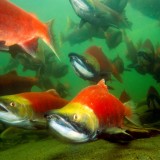
Sockeye and other fish and wildlife are threatened by plans to ship jet fuel through the Fraser River estuary (Land Conservancy photo)

Jet Fuel Tankers in Fraser River Would Put Critical Fish Habitat at Risk

Share

As Parliament debates the watering down and the neutering of environmental legislation in Canada you again must be made aware that the lack of leadership by Environment Canada and DFO (with the laws they now have) have allowed one of the most irresponsible projects to be proposed for construction in the world class Fraser River and its globally significant estuary that is home to some of the largest salmon runs and migratory wildlife populations in the world. If Bill C-38 is passed as is, this valuable river and key fishery habitat will receive less protection than it has over the past  few years despite what the Minister Ashfield has promised – a more focused effort to better conserve key habitats and fisheries. This promise is nothing less than a cruel hoax.

The Fraser River is is one of the most critical fishery rivers and key fishery habitats in the world and that fishery does not now receive proper protection and with Bill C-38 it will get much worse. In the past decade DFO and EC have not done their job in enforcing their sections of the Fisheries Act and above all have compromised proper and comprehensive environmental reviews that can harm fish and migratory birds and their essential habitats.

The Vancouver Airport Fuel Facilities Corporation (VAFFC) attempted to barge jet fuel into the Fraser River in 1988. The then Federal Environmental Review Process held proper hearings and rejected that proposal in 1989 as too great a threat to the estuary and public safety. Imagine – better environmental protection some 23 years ago! Despite that finding, the VAFFC refused to build a safer option – a pipeline from the Vancouver Airport to the Cherry Point refinery and large fuel dock near Bellingham in Washington State.

Two years ago VAFFC detected that times had changed and environmental laws were not being applied (despite the misleading claims of the opposite from DFO Minister Ashfield and Ministers Kent and Oliver) and applied to ship giant Panamax tankers of cheaper jet fuel from offshore locations into the very fragile and highly productive Fraser River Estuary, build a large offloading terminal several kilometers upstream and there store up to 80,000,000 litres of toxic and highly flammable jet fuel on the shores of the Fraser River. So as to ignore the Federal CEAA process, whose weak regulations did not even trigger a comprehensive or public panel review of this major project, VAFFC asked the BC Environmental Assesment Office for a voluntary review and Port Metro Vancouver (PMV) then accepted the Province as a lead in a so called harmonized review with PMV. Most citizens and local city councils have found this arrangement totally unacceptable and unethical.

Why would the Federal government allow a junior government lead review when this is a federal airport, federal port, federal migratory birds, federal fish and habitat and relates to a federal pilotage authority, federal navigable waters and Canadian shipping laws? Also why would the Federal Government delegate environmental impact review to the port (PMV) that is dedicated to industrial development in fish and wildlife habitat areas? This is one of the greatest conflicts of interest imaginable. In this project, PMV will indeed profit from any project approval. Only a lower level Environment Canada official to date has stated in writing that this project is unacceptable (August 2011) – i.e.: “The project would present a new and unacceptable risk to the locally, nationally and internationally-important fish and wildlife populations of the Fraser River Estuary, including migratory birds and species at risk…” and “Environment Canada is of the opinion that there is a limited ability with currently available technologies to effectively control a potential Jet-A fuel spill in the Fraser river Estuary”.

Last week the PMV released a new report rationalizing the low risk of tanker traffic in the Fraser River. This is despite the fact that the VAFFC could have up to 100 tankers and barges a year entering the estuary full of toxic and  flammable jet fuel. We have had a safety systems engineer review the tanker traffic report produced by offshore consultants for PMV. A covering letter from VAPOR and the VAPOR tanker traffic critique are attached for your information and action.

It is urgently requested that BC MLAs and federal MPs look into this matter, in that we are witnessing a serious slide into a high risk activity in this world class fish and wildlife habitat area and the BC and Federal environmental assessment processes seem unwilling to relate to this project in a a serious or meaningful way. Also if Bill C-38 is passed by the Harper Government, this type of irresponsible risk exposure to our environment and public safety is bound to increase greatly over the next several years and our living resources in the river and their habitats will again be further degraded. Our children and grand children will damn those that allowed this to happen.

It is urgent that you now act on these matters in that Canada will be greatly diminished if this type of irresponsible environmental planning and assessment is allowed to continue.

Share

Widespread Oppostion to Gutting of Fisheries Act Through Bill C-38: Sun Special Report

Share

Read this investigative report – the second part of a four part series from the Vancouver Sun examining the Harper Government’s clash with conservationists over its omnibus budget bill and the Enbridge pipeline. This installment focuses on the concerns of fisheries biologists, academics, conservationists and First Nations over Harper’s plan to gut the Fisheries Act through Bill C-38. (June 6)

Otto Langer has devoted his adult life to protecting fish habitat.

Now he wonders if it was all for nothing. The retired head of habitat assessment and planning for the federal Fisheries Department in B.C. and Yukon describes the Conservative government’s planned changes to the Fisheries Act as the biggest setback to conservation law in Canada in half a century. And he takes it very personally.

“I feel I have wasted my lifetime, that I should have done something else,” says Langer, who now predicts a gradual decline in fish habitat if the changes take effect.

Through a massive package of proposed laws in Bill C-38, Ottawa plans to limit federal protection of fish habitat to activities resulting in serious harm to fish that are part of a commercial, sport or aboriginal fishery. Across the country, hundreds of scientists have condemned the change.

“It’s going to remove freshwater protection for most fishes in Canada, which can’t be a good thing,” says University of B.C. zoology department professor Eric Taylor, who also cochairs a federal committee that advises the government on species at risk.

“Habitat is not just a place to live; it’s a place to breed, rest, avoid predators, get food.”

Taylor argues the Fisheries Department should be fighting for biodiversity. “They should have an interest in protecting Canada’s aquatic biodiversity – for all Canadians. They now seem to be abandoning that.”

Minister of Fisheries and Oceans Keith Ashfield has said the changes will focus federal protection efforts “where they are needed,” provide clearer and more efficient regulations, and create partnerships with provinces, aboriginal groups and conservation organizations.

He promised to provide better enforcement of the rules, and also to protect “ecologically significant areas,” such as sensitive spawning grounds or where the cumulative impact of development is a concern.

So-called minor works, such as cottage docks and irrigation ditches, will be identified and no longer require permits, said Ashfield, who refused to be interviewed for this article.

Critics consider the bill a regressive step that is certain to have serious impacts on fish.

Read more: http://www.vancouversun.com/technology/Canada+fish+face+upstream+battle/6737525/story.html

Share